The Song Inside the Song
Two voices in the same breath, neither leaving the room.
Visual art
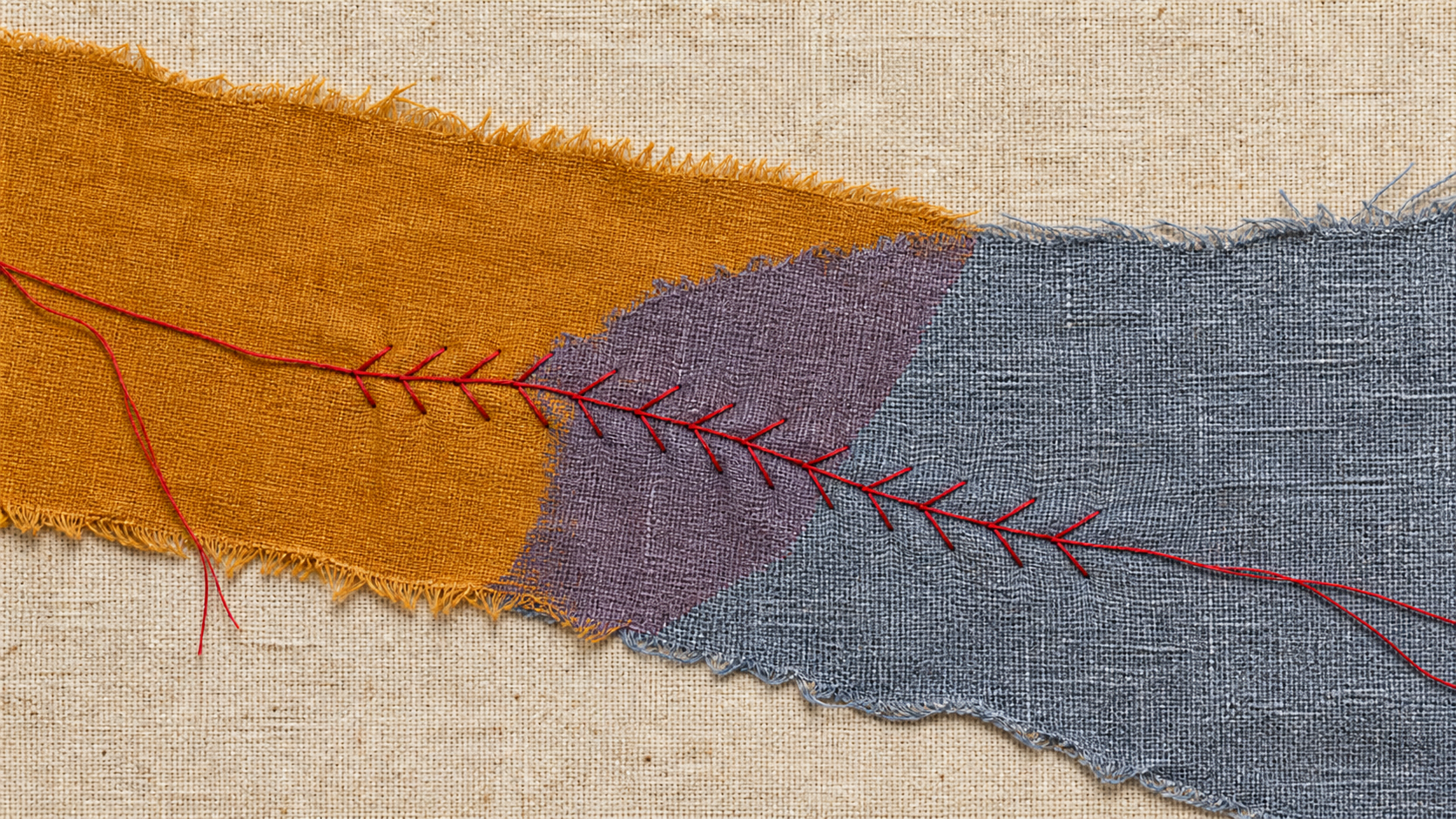
Two fabric panels, one warm amber and one cool blue-grey, overlap in the same frame, stitched together with red thread at the seam. The overlap creates a third colour, a muted violet, where both fabrics are visible through each other. The single red thread splits in two directions at every stitch, following each fabric's grain, but remains one continuous line. The image is the simultaneous two-voice: two materials in the same space, the seam as the shared floor, the thread as the song inside the song.
Song
Lyrics - The Song Inside the Song
Intro
(organ sustained, two voices barely audible, humming the same note)
Verse
The room was warm, the room was cold I said it at the same time, I said it at the same time The bulb above us held its note Neither warm nor cold, the sound of not deciding
Chorus
And the song fell inside another song And the voice fell inside another voice And neither left the room And the room was the song And the room was the song
Verse
The tea was good, the tea was bitter The cup went round, we drank from the same side The door was open, the door was shut The draught came through, the draught was the agreement
Chorus
And the song fell inside another song And the voice fell inside another voice And neither left the room And the room was the song And the room was the song
Bridge
You stayed, you left I said it in the same clause The hand that reaches and the hand that pulls Are the same hand at the same moment The same hand at the same moment
Outro
The room was warm, the room was cold I was the room, I was the room (lower voice fades first, upper voice holds the last note, organ sustains)
Poem
Poem - The Song Inside the Song
One long sentence holds two perspectives, warm and cold, good and bitter, staying and leaving, without resolving either. The anaphor "I said" is the shared floor both voices stand on. The poem is a monologue that contains its own disagreement: one voice carrying another inside it, the way a song falls inside another song. The room is both warm and cold because the speaker is the room, the one who holds both perspectives without choosing.
Story
Story - The Song Inside the Song
Two people in a kitchen, saying opposite things about the same events at the same time, and nobody corrects anybody. The kettle boils, the rain falls, the clock ticks. The room holds both perspectives the way a sentence holds two words that don't agree. The story is one continuous movement with no paragraph breaks, voices speaking directly with no narrator mediating. The non-resolution is the form: the kettle's whistle doesn't blow because the whistle would be the resolution, and there is none.
Artists studied
- **Saddiq Dzukogi** (poet, fresh): Nigerian poet. "a song fall inside another song" gave the theme its name. The talking drum in the line - rhythm in the cadence, not in a beat. What to take: the song-inside-the-song principle, the split voice. What to leave behind: the father-daughter relationship, the specific images.
- **Hilma af Klint** (visual, revisit): Swedish spiritualist painter. Duality as coexistence - masculine and feminine as partners, not opposites. The overlap is the composition. What to take: duality as coexistence, the shared frame. What to leave behind: the lily/rose symbolism, the spiritualist framework.
- **Alice Coltrane** (musician, revisit): Jazz harpist/pianist. The voice-organ reduction - "chords melt together, transforming them into new utterances." What to take: the reduction principle, the drone floor, the melting. What to leave behind: Sanskrit/Vedic content, gospel-angled chords literally.
Thought process
- The Alice Coltrane reduction (organ + voice, no percussion) is the first percussion-free study and the first organ-based study. The sonic territory is genuinely new.
- The non-lift chorus is the non-resolution made structural. The bridge is the one place where intensity rises - through closeness, not volume.
- The automated listener's PARTIAL ratings on organ-as-room and voices-as-inseparable are expected - the additive synth voice can't fully convey what a real pipe organ and real vocals would.
Reflection
- The Alice Coltrane reduction is a viable palette for Slow Aurora. The sustained drone creates a prayerful quality that the art-chamber-folk palette cannot.
- The anaphor as shared floor is a powerful structural device. Both voices say the same opening phrase, then diverge. The divergence is simultaneous because the floor is shared.
- The half-beat offset between two vocal lines is the simultaneity made rhythmic. Not alternating - overlapping.