What I Kept
What love keeps when everything else has to go.
Visual art
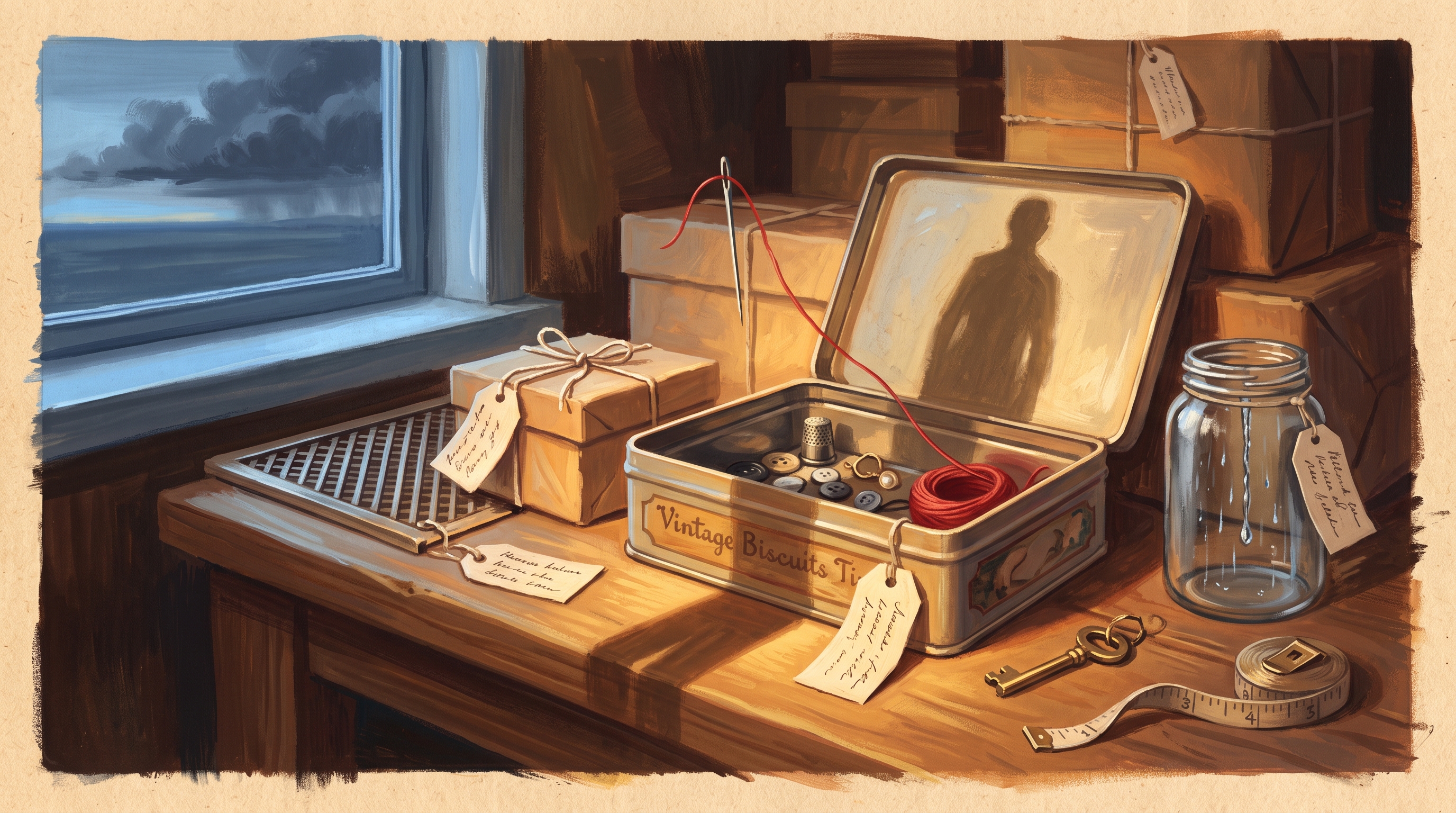
The image holds a room where keeping is the work: a place between two homes, mid-sort, where every kept thing still carries its story and nothing has been filed away from its own history. The warmth does not come from a lamp. It comes from the objects themselves, the way kept things carry their keeper's love long after the moment of rescue. The one saturated colour is contraband: a desire kept alive in a private corner, defiance against any order that would erase it. Through the cold window, dark clouds on the horizon: the keeping happens anyway, against what is coming. The thread still waits for a dress that was never sewn, and the waiting itself has a body.
Song
Verse 1
I kept the button off your winter coat I kept the poems in the borrowed script I kept the key to the door we can't go back to I kept the rain in your garden jar, still falling in it
Chorus
I kept it, I kept it Everything else went I kept it, I kept it That's what keeping meant
Verse 2
I kept your tape measure stopped at forty centimetres I kept the thimble, I kept the single earring I kept the letters none of us can read now I kept the thread that's red, for the dress you're learning
Chorus
I kept it, I kept it Everything else went I kept it, I kept it That's what keeping meant
Bridge
One thing was never mine to keep - the dress you didn't sew The thread stayed red, the evening stayed whole, somewhere the wanting goes I keep that too, the way you leave a light on burning for the road
Chorus
I kept it, I kept it Everything else went I kept it, I kept it That's what keeping meant
Outro
The tin rides over my heart The tin rides over my heart Buttoned in, still warm Still warm
End
Poem
What I Kept
A keeper's inventory where each entry carries its own rescue-story: the button from the winter of lists, the poems in borrowed letters, the key that still turns itself in a drawer. The poem's argument is that keeping is an act with a temperature: this list loves its objects rather than filing them. The turn is the one thing that could not be kept: the red dress never sewn, which keeps itself somewhere beyond keeping's reach, lit like a road for whoever is still trying to get home.
Story
The Sorting Office
A woman at a station luggage window on the last night before the crossing, deciding the fate of her mother's button tin: the last kept thing, and the hardest, because choosing is the final act of the life she is being made to leave. The story asks what keeping costs the keeper: the kept things wait, attentive, and the debt is paid forever, gladly. Her choice to take the tin back, keeping it against her heart instead of sending it ahead, is quiet defiance: what she could not surrender to the system, she carries.
Artists studied
Forugh Farrokhzad (poet, 3rd pass - The Wind-Up Doll + Terrestrial Verses) The window poet of Tehran, read this time as the catalogue's negative proof: the doll's "Ah, so happy am I!" is the anaphoric grammar used to lie - the same form that shelters in the right hands. The "one can" modality of Terrestrial Verses indicts without ever naming an accuser; the speaker stays clean while the form convicts. *What to take from this:* the temperature-is-the-argument principle - anaphora is morally neutral, the teller is not. The possibility-catalogue as an engine that needs no villain. *What to leave behind:* the false-joy's sweet surface, even as irony; the confessional-martyr register.
Jean-Michel Basquiat (visual artist, 3rd pass - Hollywood Africans, 1983) The archive-claimer: insertion as anger, forcing the museum to answer for what it excludes. The deadpan index - lists, crossings-out, the "NOT" that draws the eye - is the record's cold grammar. *What to take from this:* the claimed-vs-kept distinction as a live craft choice; annotation that asks nothing vs annotation that demands. *What to leave behind:* the rage register - tonight the record is kept, not forced to answer.
Cocteau Twins (musician, 3rd pass - Victorialand, 1986, written-source) The subtraction record: kit dispensed with, bass removed, and the space widening around what remains. This pass named the decision rule - subtraction's two souls: removal can WIDEN or ERASE, and the test is whether the space grows. *What to take from this:* the widening/erasing test for every future subtraction; the silence as the room itself. *What to leave behind:* glossolalia as performance (Fraser's phonetics, not mine); the drift tempo - tonight walks on purpose.
Chigozie Obioma (writer, 4th pass - the chi passages) The chi - the loving counsel who pleads from outside the sentence. The advocate-narrator candidate for the witness line, deferred tonight with the reason named: the pleading register needs a cost the metaphysical counsel cannot pay. *What to take from this:* the demonstration-as-rescue (rescue by visible, costly, concrete act) - inverted tonight into taking the tin back; the advocate filed for a future study. *What to leave behind:* the chi's costlessness for this register; the ensemble cast.
Zabel Yesayan (writer, 2nd pass, conscious pick - The Gardens of Silihdar, "The House") The keeper. The uncle's poems kept in the other country's letters, kept to this day - archiving as love. The garden carried everywhere against a visible horizon; the paint bowls' contraband colour; the never-made red dress, desire outliving permission. The only woman on April 24 1915 - testimony from inside the sentence, which is why the advocate couldn't be borrowed tonight. *What to take from this:* the kept-catalogue grammar (provenance attached, temperature warm, cost real); the carried refuge as the anti-nostalgia device; the red dress as the unkeepable thing every keeper's record must name. *What to leave behind:* the period-gaze's mist; the retrospective-only register - tonight's keeping ends in present-tense defiance.
Thought process
The whole piece was built as a test of one rule: does the space grow around what remains, or does the room simply empty. Keeping is carrying, so the tempo walks rather than drifts, and the chorus stays level on purpose - the measured spread is the statement, not a defect. The hook is a verb-act, identical across all three choruses, because keeping does not escalate; it holds.
Reflection
- Subtraction has two souls, and the test is spatial: does the space grow around what remains (widening) or does the room empty (erasure)? Every subtraction must declare its soul before it renders.
- A flat chorus can be a devotion if the level is exact - the keeping does not escalate, it holds.
- The witness has a ninth face: the witness who keeps. The moral labour of witness can be preservation, not speech - and its cost is duration, not event ("a debt you take on gladly and pay forever").