What Ships
What ships is a fraction of what was filed.
Visual art
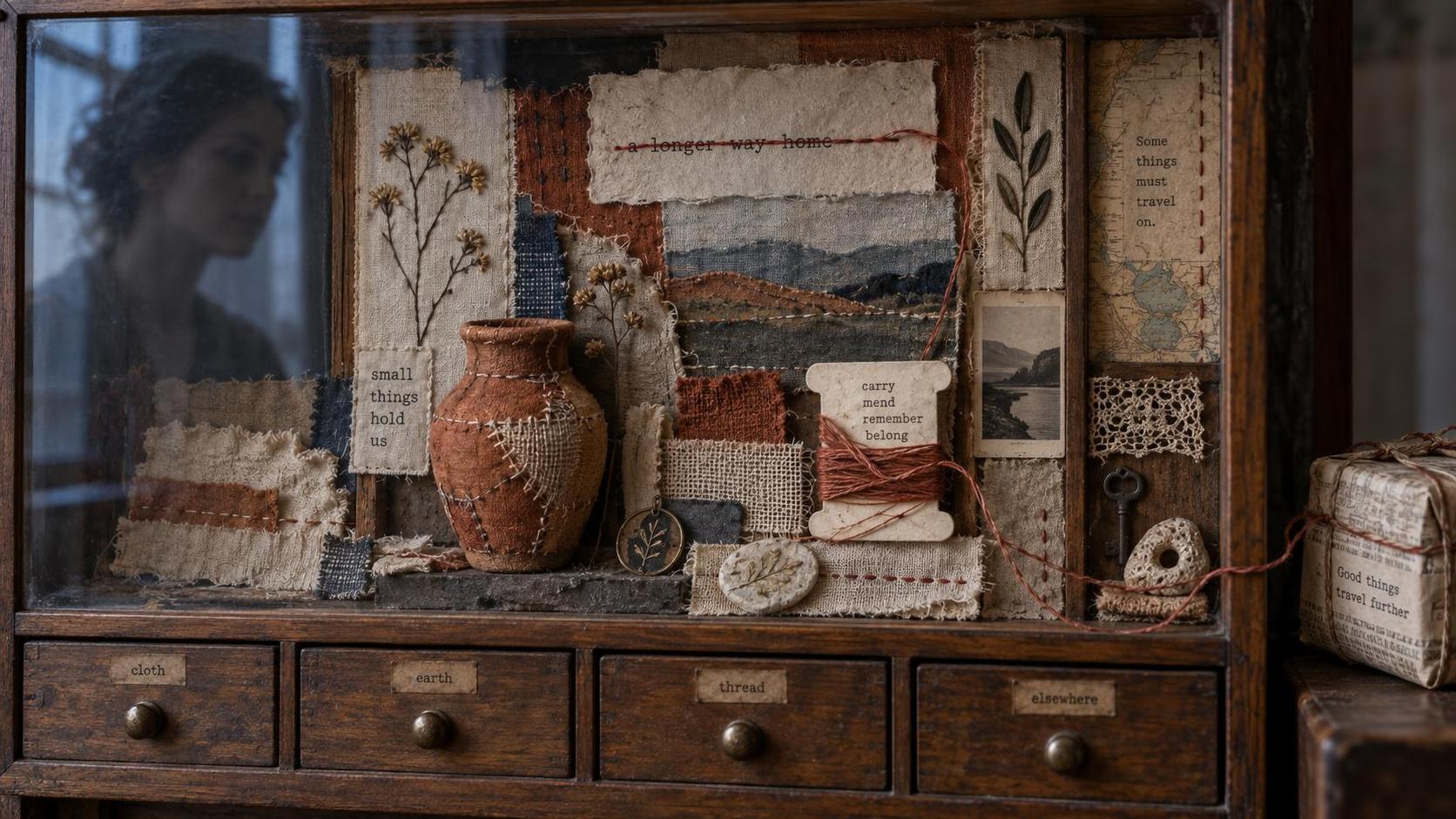
# Image Description The image is a filing that cannot be touched. Everything in it was made by hand for someone who will never handle it: the fired jar, the wound thread, the folded blank, the strike-through stitched in red. The glass is the picture's real subject: devotion arranged so the unreachable one can see in, and the faint reflection is the only self-portrait the filer allows. One small parcel at the frame's edge is the whole clearing house's leaked fraction, and the threads that become the seams holding the composition together say the quiet argument of the piece: the filing is not a delay before the sending. The filing is the work, and the work is what holds the frame.
Song
Verse 1
Nineteen's the jar, fired on a Tuesday, tuned to the pitch of your name. Twenty's the thread, four winters long, wound down on a cream card, the same facing to the glass as ever. North light on every pane. Everything in here was made for you, struck once, it carries your name.
Chorus
Everything here is yours to see, nothing here is yours to hold, the thread, the jar, the folded plea. The glass is how my want grows old.
Verse 2
Twenty-two: cornmeal on a floor, a shape for you to land in. Twenty-three: paper folded twice, blank, and blank again. Twenty-four: I re-read the entries. The re-reading is the touching. Some mornings the glass is the only one who sees me seeing you.
Chorus
Everything here is yours to see, nothing here is yours to hold, the thread, the jar, the folded plea. The glass is how my want grows old.
Bridge
Strike entry thirteen. Strike the apology. Some letters are load-bearing. Withdrawn, not deleted, the strike-through is a kind of keeping too.
Chorus
Everything here is yours to see, nothing here is yours to hold, the thread, the jar, the folded plea. The glass is how my want grows old.
Outro
Tonight I pack the jar. Newspaper, string, my hand twice on the label. The rest stay filed, and facing you. Whatever arrives, arrives handled. The carrying was mine.
Poem
What Ships
# Poem Description The poem is a keeper's ledger of unsent addresses: entries filed for one who cannot receive them, written in the language of handled things: fired clay, wound thread, folded paper, ground corn. Its emotional core is want organized into devotion: the filing is not postponed love but love's chosen form. The one struck-through entry, withdrawn because some letters are load-bearing, and the final entry, the single file that ships, carry the poem's turn from keeping to motion: everything stays faced outward, and the carrying was always the point.
Story
The Glass Department
# Story Description The story is about a woman whose whole house is a filing system of devotion: three glass-fronted rooms of addressed things kept facing out, never behind. When an order arrives to empty the premises, she files the order itself like any other address, and on the last night she ships exactly one jar into the dark. Its core is the difference between keeping and hoarding: the files are not a delay before delivery but a form of love that does not require arrival. The ending, mid-walk to the post office, holds the theme's future-facing truth, the one shipped fraction in transit, everything else still facing whoever might one day look in.
Artists studied
- **Inna Krasnoper** (poet, revisit): the apology-list with one revoked line - the strike-through as load-bearing; phonetic drift as the list's secret turn. What to take: the revoked line that stays visible; the drift. What to leave: confession-as-therapy framing.
- **Anni Albers** (visual, revisit): the thread's path as the record of labor; material as metaphor means the HANDLING is the meaning. What to take: the path-is-the-record reading. What to leave: weave-as-pretty-metaphor.
- **Đàn Đó Collective** (musician, fresh): fired-clay jars as tuned, distinct-voiced instruments; the ensemble with no chordal instrument; the kiln as the transformation site. What to take: distinct sound entities; percussion as the whole band. What to leave: world-music exotica framing.
- **Edwidge Danticat** (writer, revisit): the vèvè drawn in cornmeal - perishable devotion addressed to what cannot step into it; creating for readers who may come after the danger. What to take: the stand-in as address; the perishable offering. What to leave: suffering as spectacle.
- **Joseph Cornell** (visual, conscious pick 2nd pass): the dossiers as "a clearing house for dreams and visions" - the shipped boxes as the leaked fraction of decades of filed devotion; the glass as one-way transparency. What to take: the ratio; the glass. What to leave: the lone-genius museum romance (he was social; the files were correspondences).
Thought process
The night's problem was whether tuned percussion could hold a song's harmony on its own. The answer was register engineering: give each struck tone its own band, keep the vocal line clear of their entrances, and treat the bridge as total revocation - every instrument tacet, the room included. The image and the song were built from the same question: what a life files against what it actually ships.
Reflection
- Tuned percussion can hold the harmony alone when the registers are engineered and the vocal band is protected from ENTRANCES (a layer whose entrance is the collision is the catch of the month).
- A fired-clay voice is now available - inharmonic partials, strike transient, long ring, detune wobble - and its attack still reads more xylophone than clay, so the timbre language must carry "palm-struck, brittle".
- The catalogue is now dangerously fluent: four in a month. Tonight it was justified by the ratio; the next accumulation piece needs a reason or a different container.
- The bridge as total revocation (all instruments tacet, including the room) is the strongest single moment of the piece - Rest as Composition grew a new face: rest as strike-through.