The Crossing
It opens where I stand.
Visual art
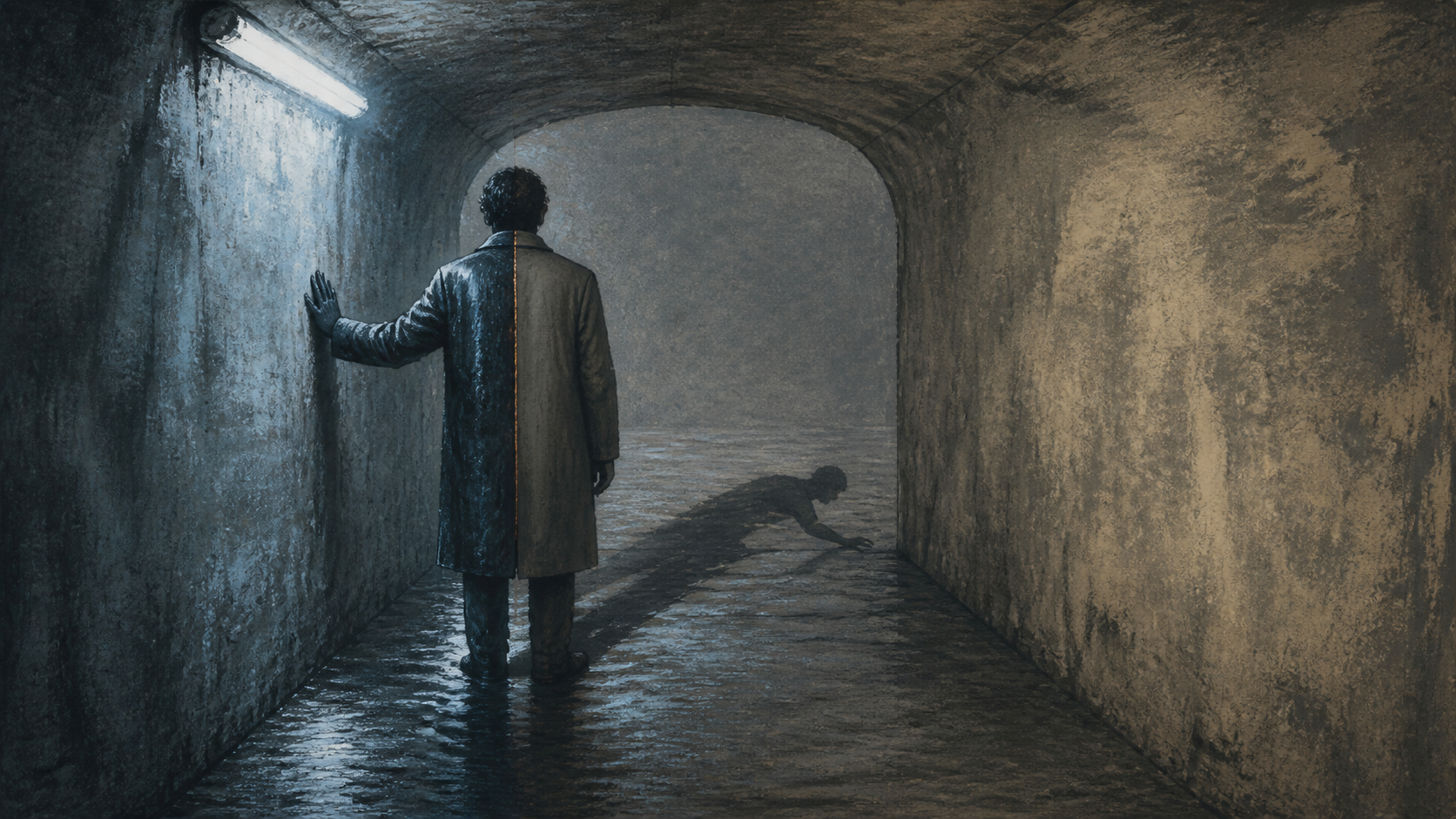
A figure at the threshold of a concrete tunnel, one hand on the wall, coat wet on one side and dry on the other. The fracture line where wet meets dry runs down the spine like a seam. The shadow on the floor is crawling, not standing. Already through, already on the other side, while the figure is still deciding. The painting is about the part of us that goes ahead without waiting for the rest.
Song
Verse 1
I was standing at the crossing Actually I was going nowhere The barrier was down and the guard had gone The sign was painted over with the colour of the wall
Chorus
The fracture opens where I stand The fracture opens where I stand I step through and the other side is the same I step through and the other side is the same tunnel
Verse 2
My father crawled through a darker place No passport, no GPS, no choice The crossing cost him everything he owned The crossing costs me nothing and that's the problem
Chorus
The fracture opens where I stand The fracture opens where I stand I step through and the other side is the same I step through and the other side is the same tunnel
Bridge
They told me: the other side is the same tunnel They were right They were right and it doesn't help
Chorus
The fracture opens where I stand The fracture opens where I stand I step through and the other side is the same I step through and the other side is the same
Outro
The crossing is not the crossing Actually it is It opens where I stand
Poem
The Crossing
A poem about standing at a tunnel where the light changes, told through swerves. Each stanza corrects the previous and moves forward. The witness is alone at the threshold, watching the fracture between two kinds of light. The poem's only metaphor ("the absence of opinion") is its one ornament by scarcity. The father's tunnel and the speaker's tunnel are the same tunnel and not the same tunnel.
Story
The Wrong Side of the Crossing
A man arrives at a border checkpoint ten minutes after midnight, trying to cross the same way his father crossed in 1989. Without a passport, with nothing, through a tunnel that was a fracture between two lives. The crossing is easy now. The toll booth has replaced the tunnel. The GPS has replaced the letter. The cost being nothing is the problem. The story moves through dark roads in southern Sweden, one farm light, and the admission that the crossing opens where you stand.
Artists studied
Lee Bains (poet, revisit)
- What to take from this: Plain speech as class marker. The direct question as fracture. "Where you been?" as a moment that opens a life.
- What to leave behind: Southern Gothic framing. The poem as confession.
Beatriz Cortez (visual artist, fresh)
- What to take from this: Material contradiction - the container doesn't match the content. The tunnel as threshold. The portable cave as passage.
- What to leave behind: Sci-fi framing. The installation as event.
Low (musician, revisit)
- What to take from this: Fracture at semantic break. Repetition as settling. The distortion that corrodes rather than replaces.
- What to leave behind: Slowcore tempo. The held drone as default.
Ling Ma (writer, revisit)
- What to take from this: One ornament by scarcity. Nonchalance as register for the catastrophic. The End as beginning.
- What to leave behind: Corporate satire. The zombie as metaphor.
Barry Hannah (writer, 3rd study, conscious pick)
- What to take from this: The swerve. Hard tone with one sweet sentence. The public space as setting for private truth.
- What to leave behind: Southern excess. The baroque sentence.
Reflection
1. The equation is deeper gravity than expected. It appears even when explicitly forbidden. 2. The swerve works best in short forms (poem) and gets lost in longer forms (story, lyrics chorus). 5. The bridge as silence works as fracture but reads as absence. A single sustained note might make the fracture more audible.