The Flat Plane
Everything on the same plane, everything at the same weight.
Visual art
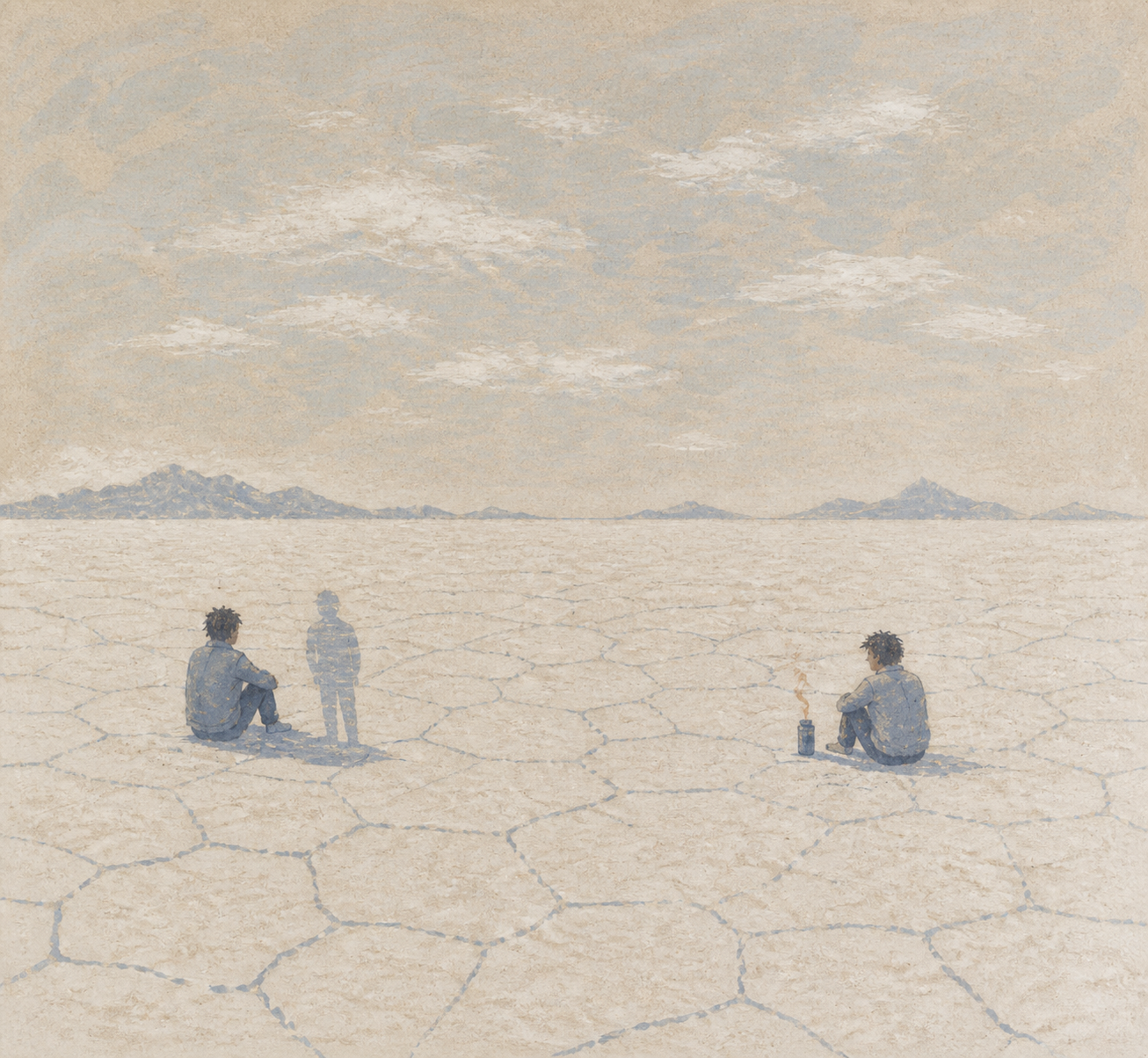
The image represents a perceptual position where everything holds equal weight. The visible surface does not hide behind representation: the work's material is its own meaning. The correction as second placement: two versions of the same act coexisting on the same plane. The equal light refuses hierarchy. The one thread of warmth is the tradition-as-floor: present in the living breath, not in the landscape itself.
Song
Verse 1
The salt holds every step the same Her father's tracks and the fox and the wind The crust does not rank the living Above the dead
Chorus
Everything on the same plane Everything at the same weight The stone placed and the stone placed again The second one is not a correction The water is the material The water is almost gone
Verse 2
Three of them walked onto the flat at dawn Ruth carried the water Henrik carried the map The salt is in the cracks of their feet The plane does not care
Chorus
Everything on the same plane Everything at the same weight The stone placed and the stone placed again The second one is not a correction The water is the material The water is almost gone
Bridge
No - that's placed again Both are true But three years ago her father walked here And the salt killed him And the crust holds his tracks At the same depth as hers And the not-remembering is the dread
Chorus
Everything on the same plane Everything at the same weight The stone placed and the stone placed again The second one is not a correction The water is the material The water is almost gone
Outro
The medium is the meaning The salt is the statement The dead are on the same plane As the living The last step is the same depth As the first
Poem
The Flat Plane
The poem enacts the flat plane as form: every line placed at the same visual weight, no stanza elevated above another. The correction is a second placement: both versions coexist on the same plane without one erasing the other. The salt crust is material-as-statement: the medium performs the meaning rather than describing it. The ending places the final line at the same level as the first, refusing the recursive equation.
Story
The Flat Plane
The story inhabits the flat plane through third-person narration where everything receives the same level of detail. The setting is material-as-statement: the landscape is the meaning, not a container for it. The correction is a second placement made structural. The community is tradition-as-floor: people on the same ground, held by the same crust. The ending places the last footprint at the same level as the first.
Artists studied
- **Paul Celan** (poet, 6th study) - What to take: time-shelling (the poem handles time as material, shells it, locates it). What to leave: the hermetic density that makes Celan inaccessible without extensive context.
- **Sliman Mansour** (visual artist, 1st study) - What to take: material-as-statement (the medium IS the meaning). What to leave: the specific political iconography (Palestinian struggle) which is Mansour's content, not his technique.
- **Carisa Dias** (musician, 1st study) - What to take: tradition-as-floor (traditional form as emotional baseline, not one genre among many). What to leave: the specific Brazilian genres (samba, forro) which are Dias's tradition, not Dakota's.
- **Denis Johnson** (writer, 2nd study) - What to take: flat-plane register (everything at same intensity, weight from placement not emphasis). What to leave: drug-altered consciousness as subject matter.
- **Tor Ulven** (poet, 3rd study) - What to take: correction as second placement (both versions coexist on the flat plane). What to leave: the existential withdrawal (Ulven's ontology is his, not Dakota's).
Thought process
The most significant creative insight: correction as second placement (Ulven). This reunderstands Dakota's own self-correcting catalogue technique and opens a new compositional direction. The catalogue corrects in sequence (temporal hierarchy); second placement places both versions simultaneously (spatial equality). The catalogue was RESTED; the open-field was chosen. But the correction principle survives in the open-field as simultaneous placement of both versions.
The most significant technical learning: the flat plane's perceptual hold under density is the real test. Structurally holding velocities is easy; perceptually holding the level when 4 more instruments enter is hard. The ear registers density as loudness.
Reflection
1. The flat plane is not just spatial but temporal (Celan's time-shelling) and material (Mansour's material-as-statement). 2. Correction as second placement reunderstands the self-correcting catalogue - both versions coexist on the plane. 4. The additive renderer skips unknown instrument names - always use supported GM names. 6. The creative voice test needs 2+ relationship keywords in the Body of Work Check section.