The Translucent Home
The walls are see-through but the postcode is real.
Visual art
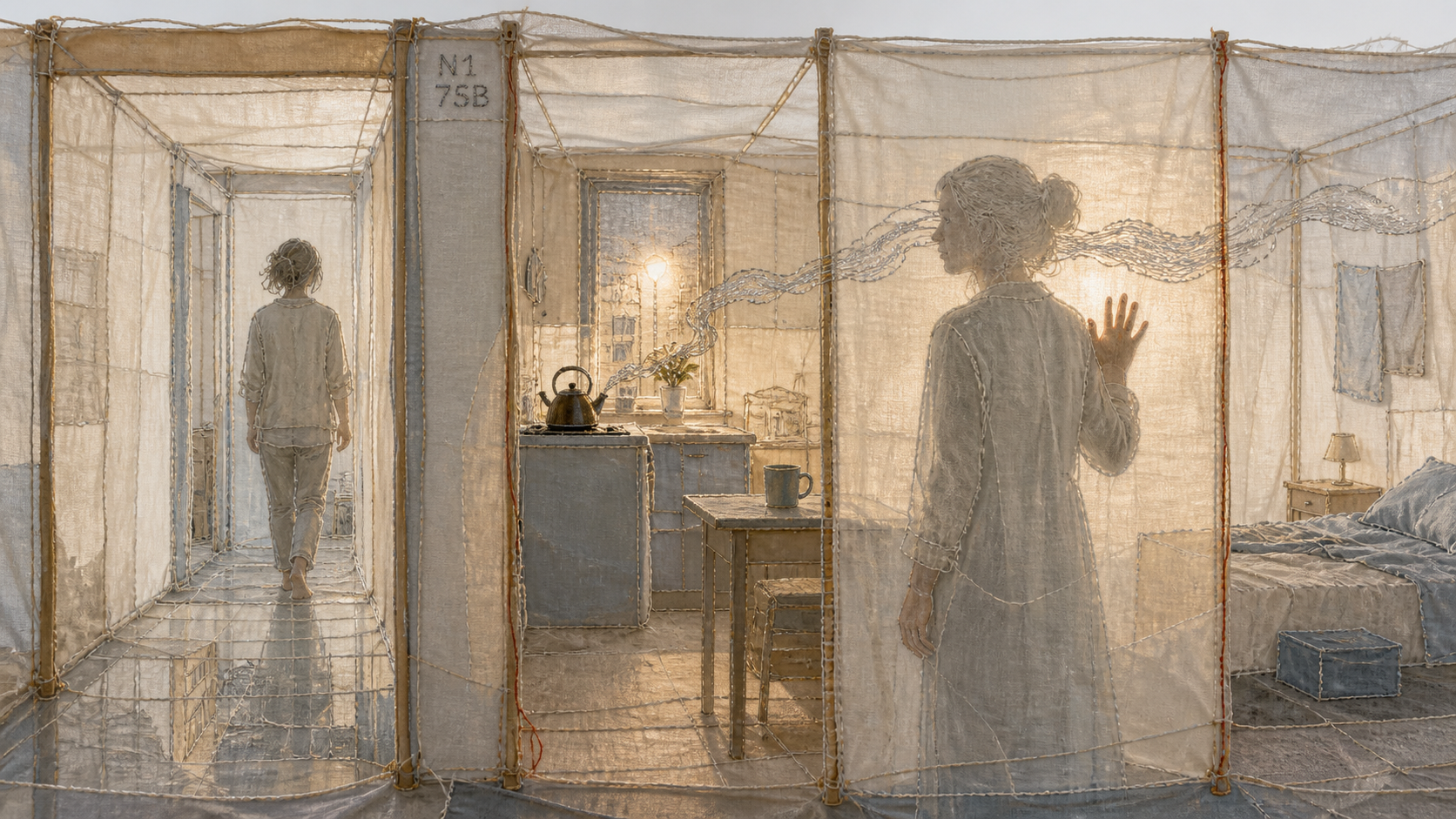
The image represents the translucent home, a domestic interior seen through fabric walls that hold their shape while letting light pass through. The visible seams and support poles are the room's own anatomy, shown not by cutting the wall open but by the wall's inherent transparency. The kettle's steam passing through the fabric without distorting it embodies the membrane's quality: permeability, not exposure. The stitched postcode is the address that grounds the ethereal, the one solid thing in a see-through world.
Song
The Translucent Home
Lyrics
Verse 1
The kitchen window lets the garden in The bedroom window lets the street in He asks what I see through the kitchen glass I see the garden, he sees the street through the bedroom We're looking at different windows from different rooms And each window gives us what the other side holds
Chorus
23 Wenlock Road, flat 4, N1 7SB The postcode is the truest thing I know The windows are transparent but the address is solid The room holds its shape and lets the light go
Verse 2
He walks the hallway heel to toe Every floor he's lived in had a creak that he knows The third board from the kitchen, we both stand on it And the board creaks for both of us at the same time The building's oldest sound, holding both our weights
Chorus
23 Wenlock Road, flat 4, N1 7SB The postcode is the truest thing I know The windows are transparent but the address is solid The room holds its shape and lets the light go
Bridge
What holds its shape when you can see through it? He says the window, I say the postcode The window holds the frame, the window holds us We are the heaviest thing, everything else passes through The steam fogs the glass and the window is a wall Then the steam clears and the window is a window again
Chorus
23 Wenlock Road, flat 4, N1 7SB The postcode is the truest thing I know The windows are transparent but the address is solid The room holds its shape and lets the light go
Outro
What is visible does not need an ending The postcode is real, the kettle is warm We see different things through different windows And the seeing is enough
Poem
The Translucent Home
The poem is about a home whose walls are see-through - not as metaphor but as condition. The speaker lives inside the membrane and finds that the transparency doesn't reveal anything you couldn't see by walking into the next room. The postcode is the truest line because it's the one thing that isn't translucent. The anti-equation ending stops speaking and blesses what remains visible.
Story
The Translucent Home
The story inhabits a flat where the walls have always been see-through. A pair, Maren and Kade, live inside the membrane. Maren holds still; Kade paces. The tension is between the translucent home (which holds its shape) and Kade's broken groove (which can't settle). The postcode is the one solid thing. The story ends by conceding the mystery: what remains visible is enough.
Artists studied
Czeslaw Milosz (poet, revisit)
What to take from this: The anti-equation closing move. The poem that stops speaking and blesses what remains. The carried past without resolution. What to leave behind: The explicit naming of the stopping ("Better to stop speech here"). The formula replaces a formula.
Zarina Hashmi (visual, revisit)
What to take from this: Vocabulary as structure. Minimal means, maximum precision. The enumeration of home's elements with the curiosity of someone losing them. What to leave behind: The literal use of foreign words. The foreign is structural, not linguistic.
Fidju Kitxora (musician, fresh)
What to take from this: The broken groove. The rhythm that can't settle. The gaita and ferrinho as instruments of diaspora. The groove is the interior. What to leave behind: The literal funaná form. The break is inside the translucent, not total.
Isaac Babel (writer, revisit)
What to take from this: The hinge as reveal. The description that already contains the event. The moment that reveals the story was always about this. What to leave behind: The twist ending. The hinge is not a twist.
Do Ho Suh (visual, conscious pick)
What to take from this: Translucency as a structural quality. The membrane that holds shape while being see-through. The address as anchor. The fabric architecture as home. What to leave behind: The literal fabric material. The technique is about permeability, not material.
Reflection
1. The humanizer check must actually scan files for em dashes, not claim "no patterns found" based on a quick skim. Em dashes are the most persistent AI pattern in this work. 2. The creative voice test requires specific relationship keywords in the Body of Work Check section. Plan for these when writing the creative direction.