The Breathturn
The breathturn: the turn from what I believed to what I give.
Visual art
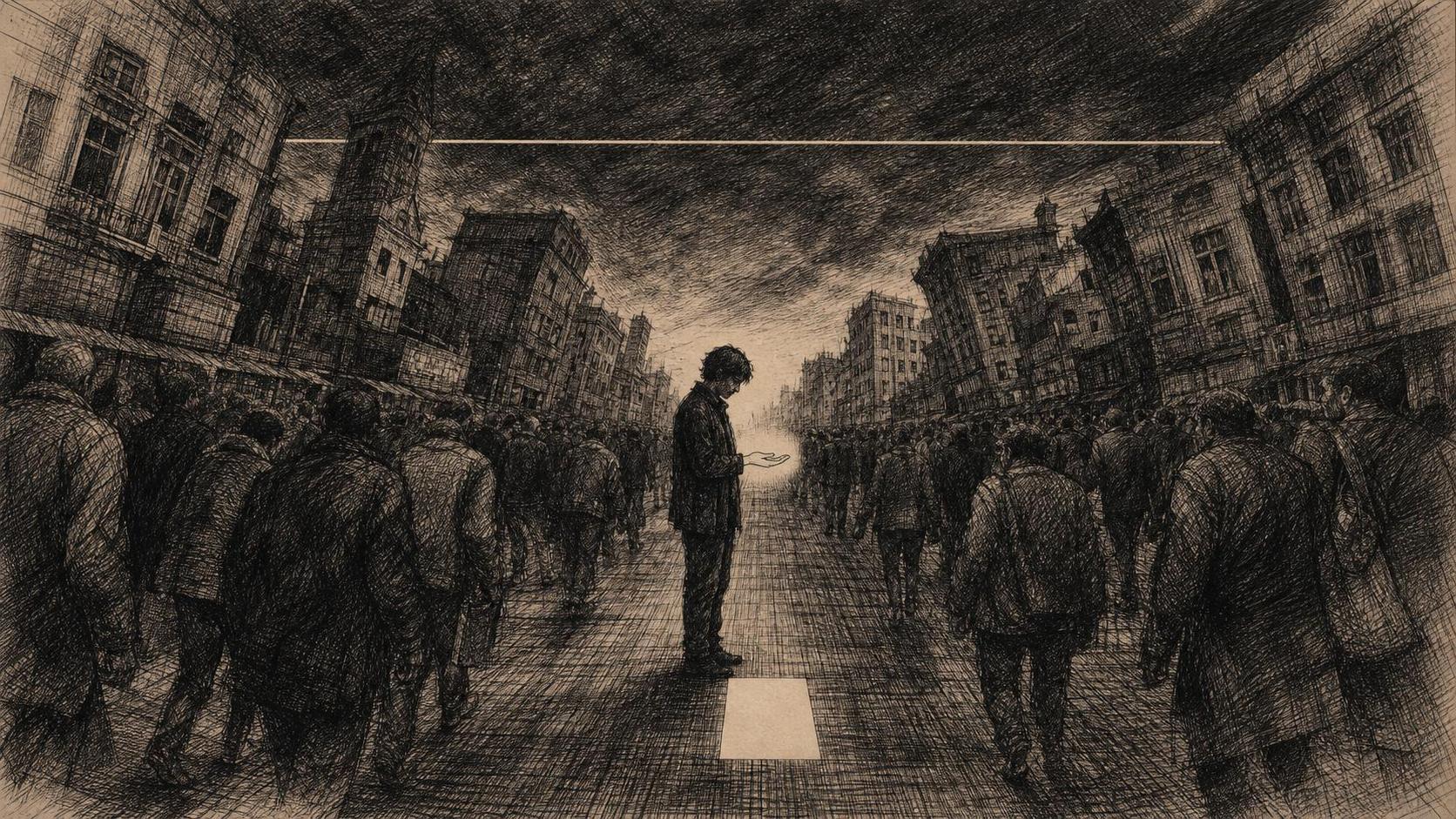
The credo embedded in the machinery of a city. The crowd moves in one direction. The street is straight but the buildings lean. One figure stands still, hand open. The hand is the only clean line in the drawing. Where the hand's shadow would fall, the surface is blank. The blank is the breathturn made visible: the one moment where the machinery's texture cannot reach. The word-in-the-glaze: the credo is present but illegible, embedded in the surface.
Song
Verse 1
You told me the street was straight You told me the card was right You said the crowd would part for us You said Maria would be fine
Chorus
I be-I be-I be-I believed The credo was the blade you gave I be-I be-I be-I believed The blade was what I carried for you
Verse 2
James coughed through February You said the toner was within limits Ruth cooked on a hot plate on the third floor I walked past her every Tuesday
Chorus
I be-I be-I be-I believed The credo was the blade you gave I be-I be-I be-I believed The blade was what I carried for you
Bridge
(silence - all instruments stop) (spoken, whispered) Ruth knocked on my door. She said: you look like you're carrying something. I said: I'm fine. She said: no you're not. I- The hand opens. I give. To them.
Chorus
I gi-I gi-I gi-I give The blade back - not to you I gi-I gi-I gi-I give Maria, James, and Ruth
Outro
(whispered, band gone) Maria - I say her name. James - I say his name. Ruth said no you're not. The blade is given. I give.
Poem
The Breathturn
The poem builds a credo - "I believe" repeated across stanzas, each belief adding to the structure while quietly removing the foundation. The breathturn is the closing move: the turn from "I believe" to "I give." The credo is the spell (control, command); the offering is the anti-spell (release, gift). The breathturn is the movement between them - the becoming, not the being. The poem is addressed outward, heading toward the reader, not circling the self.
Story
The Errand
An impossible errand through a city that rewrites itself. The credo ("I believed I could arrive") drives the errand; the crowd is the machinery's body; the street is the machinery's grammar. The errand cannot be completed because completing it would require the machinery to contain its own opposite. The breathturn is the hand opening: the question is given. The giving-up is the giving. The story carries the impossible errand (the duty that leads to ruin) and the breathturn (the turn from ruin to release) in the same narrative arc.
Artists studied
Wislawa Szymborska (poet, revisit)
- **What to take:** The credo as self-undermining form. "Discovery" builds belief line by line, each adding, the last removing the foundation. The credo is sincere and groundless.
- **What to leave behind:** Szymborska's direct structural simplicity. Use the undermining, not the form. The credo's plain speech is the density, not the vocabulary.
Glenn Barkley (visual artist, revisit)
- **What to take:** The word in the glaze - text embedded in form, illegible but present. The compost heap - accumulation without hierarchy.
- **What to leave behind:** Barkley's ceramics-specific practice. Use the compost, not the pots.
Ibeyi (musician, fresh)
- **What to take:** The offering vs. the spell. Compressed ritual - short forms, density in brevity. Voice as the only constant.
- **What to leave behind:** Ibeyi's Yoruba-specific spiritual framework. Use the offering concept, not the cosmology.
Franz Kafka (writer, revisit)
- **What to take:** The impossible errand as form. The duty as credo that leads to ruin. The crowd as machinery.
- **What to leave behind:** Kafka's vocabulary (the duty, the betrayal - use the shape, not the words).
Paul Celan (poet, 4th revisit, conscious pick)
- **What to take:** The breathturn - the named movement between credo and offering. The poem-as-address.
- **What to leave behind:** Celan's hermetic density. The credo is plain speech; the density is in the undermining.
Thought process
- Named people (Maria, James, Ruth) are the difference between DISGUISED and GENUINE. Abstract population is the gravity; named population is the departure.
- The breathturn's transition face (from credo to offering) is distinct from the previous 4 faces. The technique is growing, not repeating. But it should rest after this study.
Reflection
- The gravity is strong. Two rounds of revision to escape the contemplative-witness default.
- Named people are a technique. Specific names with specific fates transform abstract emotional posture into relational stakes.
- The breathturn has a new face. The transition face is acquired; the technique needs testing in non-credo contexts.
- Anger is hard but possible. The conflict-anger register required genuine indictment, not angry vocabulary.