The Room Being Replaced
The room that looks the same but isn't - the light stays, the person doesn't.
Visual art
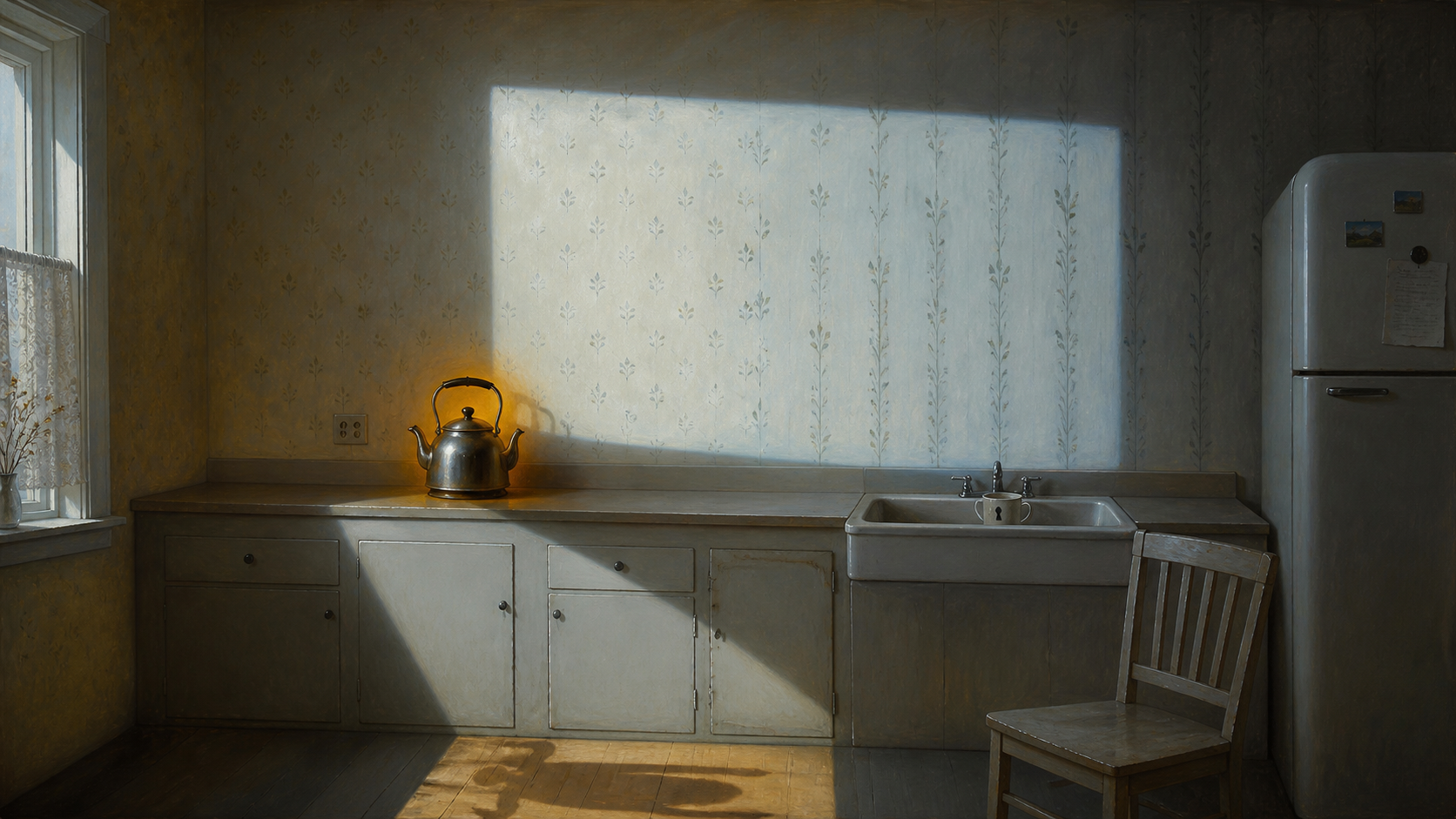
A rectangle of morning light on a kitchen wall that has been repainted the same colour. The light is slightly wrong - too large, too high, casting the memory of yesterday's light. A standing figure's shadow falls from the chair where no one sits. The wallpaper pattern shifts with each iteration, the kettle glows with warmth that has no source. The image depicts the moment of replacement: the room is a perfect copy of itself, and the wrongness is in the details the eye registers before the mind questions. Hopper's geometric light meets Tse's allegorical dissolution.
Song
Verse 1
The light comes in at seven-fourteen The rectangle holds the wall The kettle is warm The kettle is warm and the morning is the same morning
Verse 2
The floor is warm where she stood The chair faces the window The smell of soap is here The smell is here and is not soap
Overlap
The room is the same room The room is the same room The light is the same light The light is the same light The room is the same room The light is not the same light
Verse 3
The door opens into the hall The hall is the same length Three doors - one open, one closed One quiet, one quiet, one
Overlap
The room is the same room The room is the same room The warmth is the same warmth The warmth is not the same warmth The room is the same room The warmth is not the same warmth
Bridge
The light leaves at four-forty-two The rectangle narrows Thins to a line Disappears
The wall holds the mark The mark is not visible The mark is the same mark The mark is not the mark
Outro
The kettle clicks off The kitchen is quiet The fridge hums The chair is cold
The room is the room The room is the room The room is
Poem
The Room Being Replaced
Two voices overlap in the same room - one is the room before, one is the room after. The stretto structure makes the reader inhabit both at once, unable to separate what was from what is. The poem's midpoint break (the Wende) silences one voice; the other continues alone, and the silence where the first voice was is the replacement completed. The poem is about the gap between a former state and a current state, lived in without being bridged.
Story
The Room Being Replaced
A man lives in a flat that has been replaced with a copy of itself. The kettle, the chair, the mug, the fridge, the hallway - all the same, all not the same. The story inhabits two timelines simultaneously without marking them, so the reader experiences the replacement the way the character does: as a series of small wrongnesses that cannot be named. The light falls at the same angle. The kettle is warm. The mug has the same chip. The room is the room. The room is not the room. The story ends mid-sentence - the sentence that was still being written when the replacement completed.
Artists studied
Saddiq Dzukogi (poet, revisit)
What to take from this: The "song inside another song" as a structural principle - the inner voice mimicking what's gone, carried inside a new container. The epic scope (9-poem series) with intimate detail. What to leave behind: The specific Hausa orature forms - they belong to Dzukogi's tradition, not Dakota's practice.
Edward Hopper (visual artist, revisit)
What to take from this: Light as geometric protagonist - the rectangle of light as a shape with edges, not a mood. The empty room as subject, not setting. What to leave behind: The specific American realist tradition - the diner, the gas station, the hotel room. The technique (light as subject) transfers; the iconography doesn't.
Nduduzo Makhathini (musician, revisit)
What to take from this: The repeated figure as floor - a melodic motif that repeats while the voice moves over it, not a drone. The patience that deepens rather than develops. The three-movement ritual structure. What to leave behind: The Zulu spiritual context - the ritual is Makhathini's, not Dakota's. The voice as ritual tool is transferable; the specific ritual isn't.
Dorothy Tse (writer, fresh)
What to leave behind: The Hong Kong surrealist tradition - the specific political context of Tse's dissolution is hers. The method (perceptual gap) transfers; the context doesn't.
Paul Celan (poet, revisit - conscious pick)
What to take from this: The stretto - two voices overlapping before the previous one has finished. The Wende - the courage to stop one voice and let the other continue alone. The gap as subject, not bridged. What to leave behind: The Holocaust as subject - Celan's historical context is his. The stretto and the Wende are transferable structures. Also: the fragmentation of syntax - Celan breaks language because his experience can't be rendered in whole sentences. Dakota's experience can be rendered in whole sentences, so the fragmentation would be decorative, not structural.
Thought process
- Third study today. The first completed all 14 steps (the-song-inside-the-song). The second stalled at Step 2 (the-ferrymans-labor-2). This third study completed all 14 steps.
- The Talk Talk genre study was the right reference - density-as-dynamic and bridge strip were directly adapted. The gap (overlapping vocals) was filled by Celan's stretto, not by the genre study.
- The automated listener's MATCH on the bridge caesura ("something missing" aligned with intent) is the strongest evidence the technique worked.
Reflection
1. The stretto is a transferable structure across forms - poetry, fiction, music. 2. The Wende (the moment one voice stops) is more powerful than the overlap. Absence > density. 3. One note changed (F# → F natural) can carry the entire thematic weight of a study. 4. The repeated figure as floor is distinct from the held note and the drone - it moves but returns. 6. The Talk Talk genre study is the closest reference for spiritual minimalism, but a study of Arvo Pärt would fill the gap.