The Pier Between Us
Two people on the same pier, same coffee, same grey water - one says time, one says leaving.
Visual art
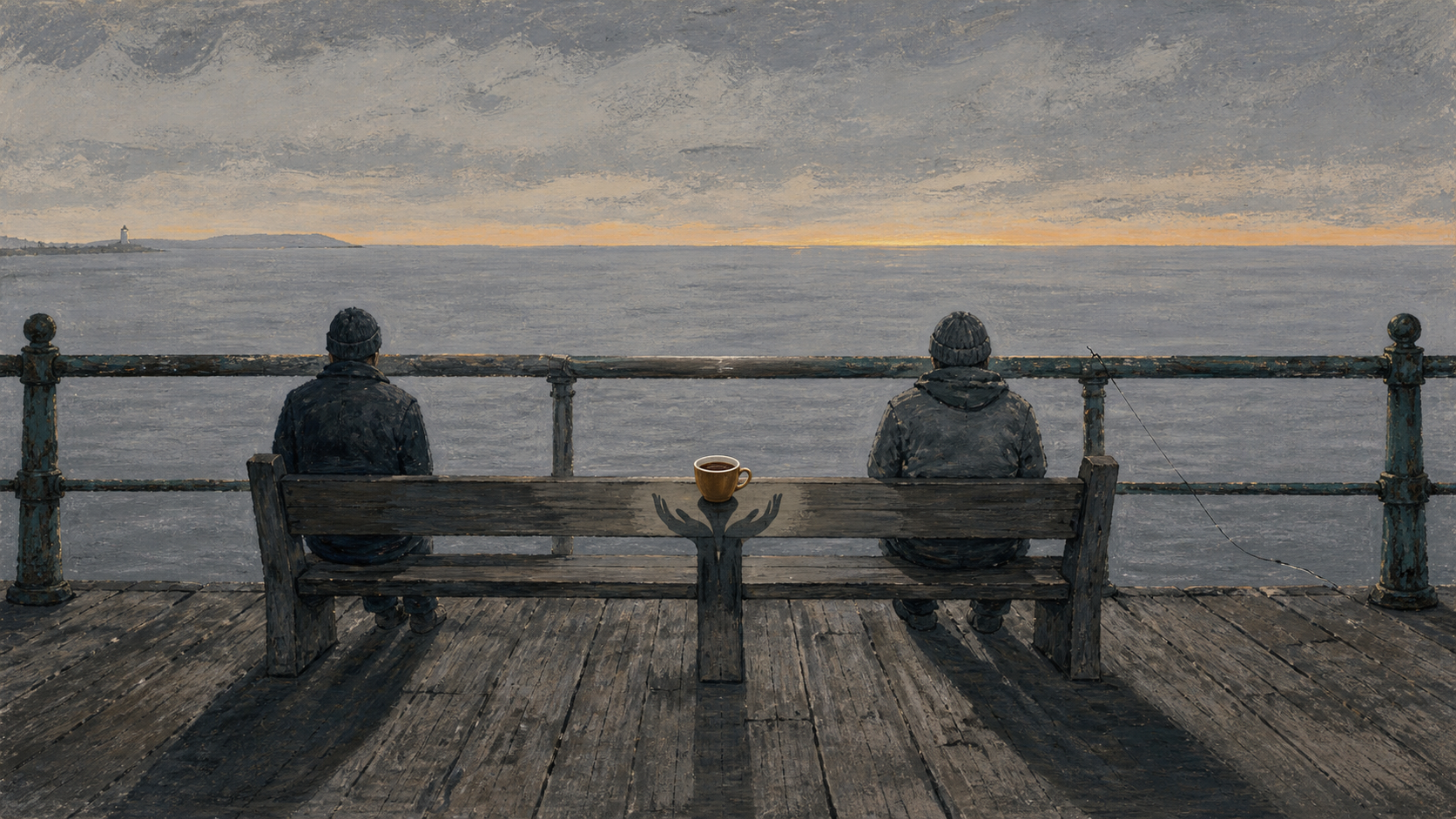
A pier at early morning. Two figures sit on the same bench, facing the same grey water, seeing the same things and disagreeing about what they mean. A single coffee cup between them carries the emotional weight: attended to, compressed, ordinary. The cup's shadow is a pair of cupped hands, open. The figures' shadows lean different directions though their bodies are both upright. The image is the warm register: the ordinary taken seriously, the two who disagree, the non-resolution as form. The pier is the public space where private truth arrives sideways.
Song
Verse 1
The coffee's cold because we've been here long That's what time does to things that started warm The railing's cold because the metal knows the morning The water's grey because the sky is grey I don't read the water for meaning The water is water The cup on the bench is yours You brought it You haven't touched it in twenty minutes
Verse 2
The coffee's cold because you left it there That's what leaving does to things that someone held The railing's cold because it's been breathing the same air The water's grey because it hasn't happened yet The before doesn't have a colour We call it grey because we don't know What to call the thing That comes before the thing The cup on the bench is mine I'm holding it because my hands need something
Chorus
Same cup same bench same cold One says time and one says leaving Same water same grey same early One says water and one says before The railing holds us both The pier doesn't choose
Verse 3
The fishing line is taut - I say a fish You say the current The line goes slack - you say the current let go I say the fish got away Same result you say Different reason I say You almost smiled I saw the almost
Verse 4
A man walked past with an old dog He looked at the cup I said He was looking at the dog you said You don't know that I said You don't know he wasn't you said The water will be blue later I said The water will be something you said
Chorus
Same cup same bench same cold One says time and one says leaving Same water same grey same early One says water and one says before The railing holds us both The pier doesn't choose
Bridge
And the cup sits on the armrest Same spot same position Handle facing the same way Neither of us touches it Neither of us picks it up We just let it sit there Being what it is Being what we say it is
Chorus
Same cup same bench same cold One says time and one says leaving Same water same grey same early One says water and one says before The railing holds us both The pier doesn't choose
Outro
The water is water The water is the before The cup is a cup The cup is mine Same railing Same cold Same grey The pier goes on
Poem
The Pier Between Us
Two voices on the same pier, attending to the same ordinary objects (a coffee cup, a railing, grey water) and disagreeing about what each thing means. The poem gives equal weight to both voices (same stanza length, same objects, different meanings). The disagreement is not resolved. The ordinary carries the emotional weight through compression: the cup is a cup and mine and cold for different reasons. The warm register is the attending, the compassion of staying with the disagreement without resolving it.
Story
The Bench
A man and a woman share a bench on a pier at dawn. A coffee cup cools between them. A fishing line drifts in the grey water. They disagree about everything: whether the coffee is cold because of time or because of leaving, whether the fishing line held a fish or the current, whether a stranger looked at the cup or the dog. The disagreement is not about facts; it's about meaning. The story doesn't resolve. The pier goes on. The ordinary objects carry the weight: the cup, the railing, the fishing line, the dog. The warm register is the narrator's equal compassion for both characters, attending to both without choosing.
Artists studied
Rumi (poet, revisit)
What to take from this: The staying-with. The compassion of attending without resolving. The sentence with its own inflection. What to leave behind: The ecstatic register. The divine as the subject. The direct statement of spiritual truth.
Francisco Goya (visual, revisit)
What to take from this: The private honesty in public space. The ordinary object that carries the emotional weight. The sideways truth. What to leave behind: The grotesque as the register. The nightmare as the subject. The direct indictment.
Mark Lanegan (musician, revisit)
What to take from this: The non-lift. The flat dynamic architecture. The staying at the same level. The warm register as the low register. What to leave behind: The dark as the only register. The grave as the only destination. The substance as the only texture.
Barry Hannah (writer, revisit)
What to take from this: The pier as the public space. The liar who tells the truth. The ordinary as lyric material. The sentence that doesn't explain. What to leave behind: The manic energy. The excess as the register. The wild voice.
Anton Chekhov (writer, conscious pick)
Thought process
- The study ran as a 3 AM chain (14 steps in a single session).
- All 5 artists were revisits (fresh pools empty). This is noted but not a problem - the revisits were productive.
- The composition used the non-lift for the third time (08-18, 08-19, 08-23). The non-lift is becoming a signature technique.
- The two-voice structure is the growth capability. The next study using it should push toward simultaneity.
Reflection
1. Two-voice structure requires equal weight - the form must give both voices the same space. 2. The warm register is not a mood - it's a posture. The warmth comes from the attending, not from feeling warm. 4. The non-lift in the composition requires the hook to be a fixed object that changes meaning through context.