The Self-Correcting Flood
The flood that lists and lists and gets it wrong and fixes it and keeps going.
Visual art
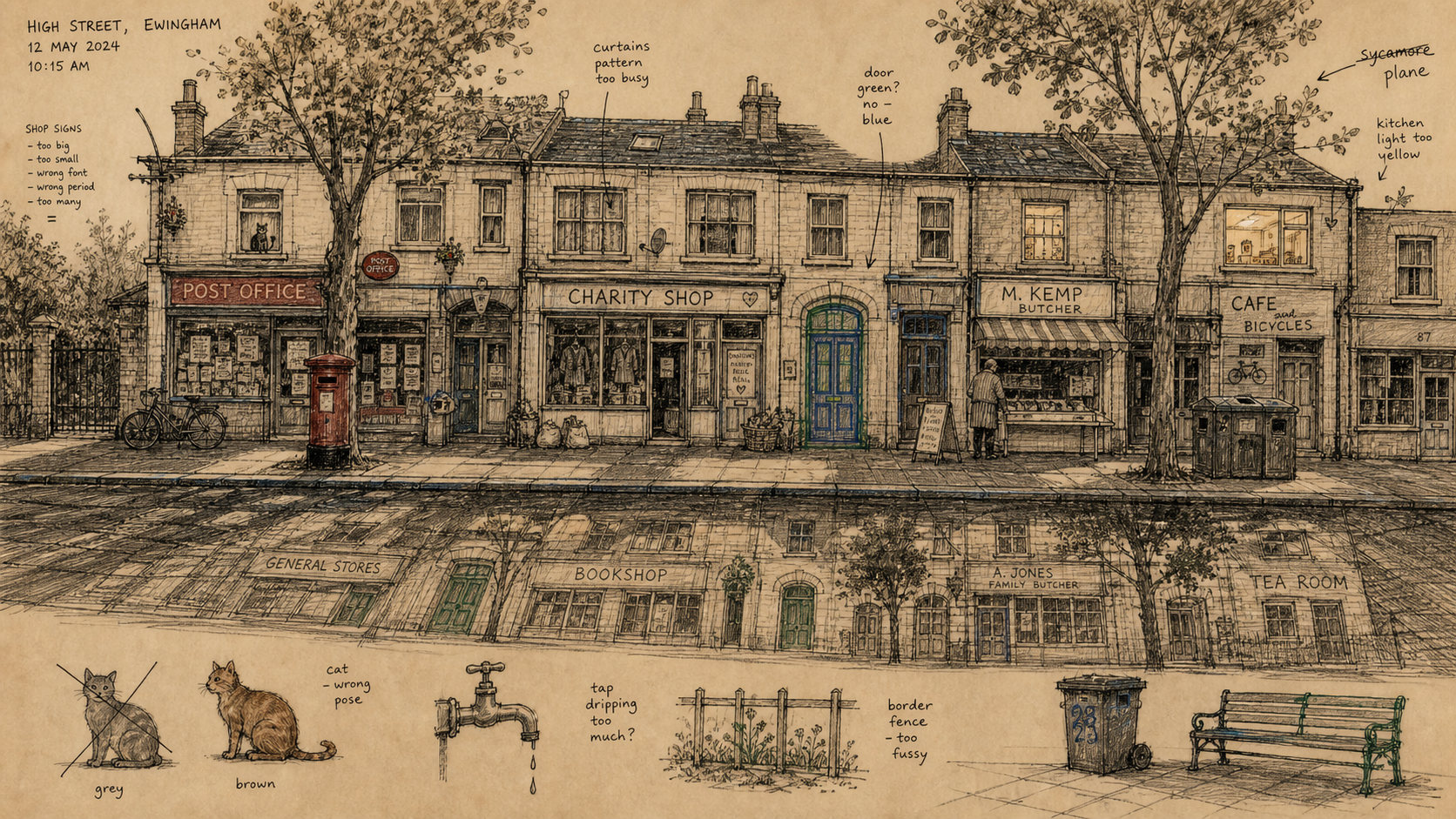
A street drawn as a self-correcting catalogue: every ordinary object rendered at the same level, with visible corrections - a door overpainted from green to blue, a tree mislabeled and amended, a cat drawn twice. The shadow cast on the pavement shows a different version of the same street, the earlier draft that stays visible underneath. The image argues that the correction is more honest than getting it right, and that the wrong version is part of the truth.
Song
Verse 1
The post box on the corner - no, the post office The one with the counter, the woman, the queue The cat in the window - no, the cat is brown Not grey, the light made it grey, the light was wrong The planes in the street - I said sycamores The planes have the mottled bark, the sycamores don't The leaf is a hand and the hand is no one's And no one is everyone I know
Chorus
Not that - this The wrong word stays and the right word follows Not that - this The correction doesn't erase the first attempt Not that - this Both versions are in the sentence Both versions are in the sentence
Verse 2
The shop that was a shop is a flat now The door was green - no, blue I can see the green under the blue The paint doesn't cover, the paint adds The kitchen tap drips and the border closed And I can't tell you which one matters more The pie is in the oven, the policy's on the table They sit on the same table and the table is the list
Chorus
Not that - this The wrong word stays and the right word follows Not that - this The correction doesn't erase the first attempt Not that - this Both versions are in the sentence Both versions are in the sentence
Verse 3
The flood doesn't rise - no, it accumulates Accumulation is not a river, not a tide It's a mind putting things in a row And getting the row slightly wrong And fixing the row And the fixing is not neat And the wrong thing stays And the right thing is next to it And both of them stay
Chorus
Not that - this The wrong word stays and the right word follows Not that - this The correction doesn't erase the first attempt Not that - this Both versions are in the sentence Both versions are in the sentence
Bridge
The mountain lion walks down the street It doesn't belong here and it knows it It walks through the catalogue And the catalogue doesn't break The catalogue absorbs it The pie, the policy, the cat, the planes The tap, the border, the door, the lion All at the same level, all in the same row And the row doesn't stop
Outro
The post box - no, the post office The green door - no, the blue The grey cat - no, the brown The sycamore - no, the plane The list keeps coming The flood doesn't end The correction is the flood The flood is the correction And both of them stay
Poem
The Self-Correcting Flood
A poem that accumulates at the same level - domestic and civic, pie and policy, kitchen tap and border - with visible self-corrections that stay in the text. The wrong version is not erased; the correction follows it and both remain. The poem argues that accumulation with live internal triage is more honest than getting it right the first time, and that the list doesn't preach - it just puts things in a row.
Story
The Self-Correcting Flood
A first-person walk down a high street that becomes a self-correcting catalogue. The narrator lists what they see, gets things wrong (grey cat/brown cat, sycamore/plane, green door/blue door), and fixes them inline - the wrong version always staying visible. The story argues that the correction doesn't erase the earlier attempt and that everything - kitchen tap and border closure, pie and policy - sits at the same level. The flood doesn't end; the story stops mid-list.
Artists studied
- **Migwi Mwangi** (poet): pleating numerous lives, ordinary at same level. What to take: the poem holds many people, not one "I." What to leave: the specific Kenyan street energy - find the British equivalent.
- **Tolia Astakhishvili** (visual): the building slightly wrong, scrubbed-out corrections. What to take: the correction that doesn't disguise the earlier attempt. What to leave: the gallery-installation scale.
- **Moondog** (musician): percussion as composition, walking groove, contrapuntal lines. What to take: percussion as foreground, plain voice. What to leave: the Viking costume, the specific invented instruments.
- **Grace Paley** (writer): the plumber's snake remark, checking out the same books, sycamores and marriage. What to take: the thing that snakes, the same-level ordinary. What to leave: the domestic comedy containing grief - tonight's material is accumulation, not comedy.
- **Lucy Ellmann** (writer, conscious pick): accumulation as argument, self-correction inside the flood, "the fact that" as engine, the mountain lion interruption. What to take: the self-correcting catalogue, everything at the same level. What to leave: the 1,000-page scale - a poem or a song can do this in a few minutes.
Thought process
- The percussion-primary arrangement is the first in the body of work's study context. The sound moved from art-chamber-folk to percussion-forward modal walk.
- The self-correcting catalogue is a new structural capability. The wrong version stays visible, the correction follows, both remain.
Reflection
- The self-correcting catalogue is more honest than getting it right. The wrong version is part of the truth.
- Percussion-primary arrangement is harder than it looks. Making drums the lead instrument requires contrapuntal patterns, not simple kick-snare.
- A Dorian is the "slightly wrong" mode - the major sixth in a minor scale is the self-correction inside the harmony.
- The flat arc (non-lift) is a real choice, not just an absence.