The Two-Handed Thing
The thing about the warm is it stays.
Visual art
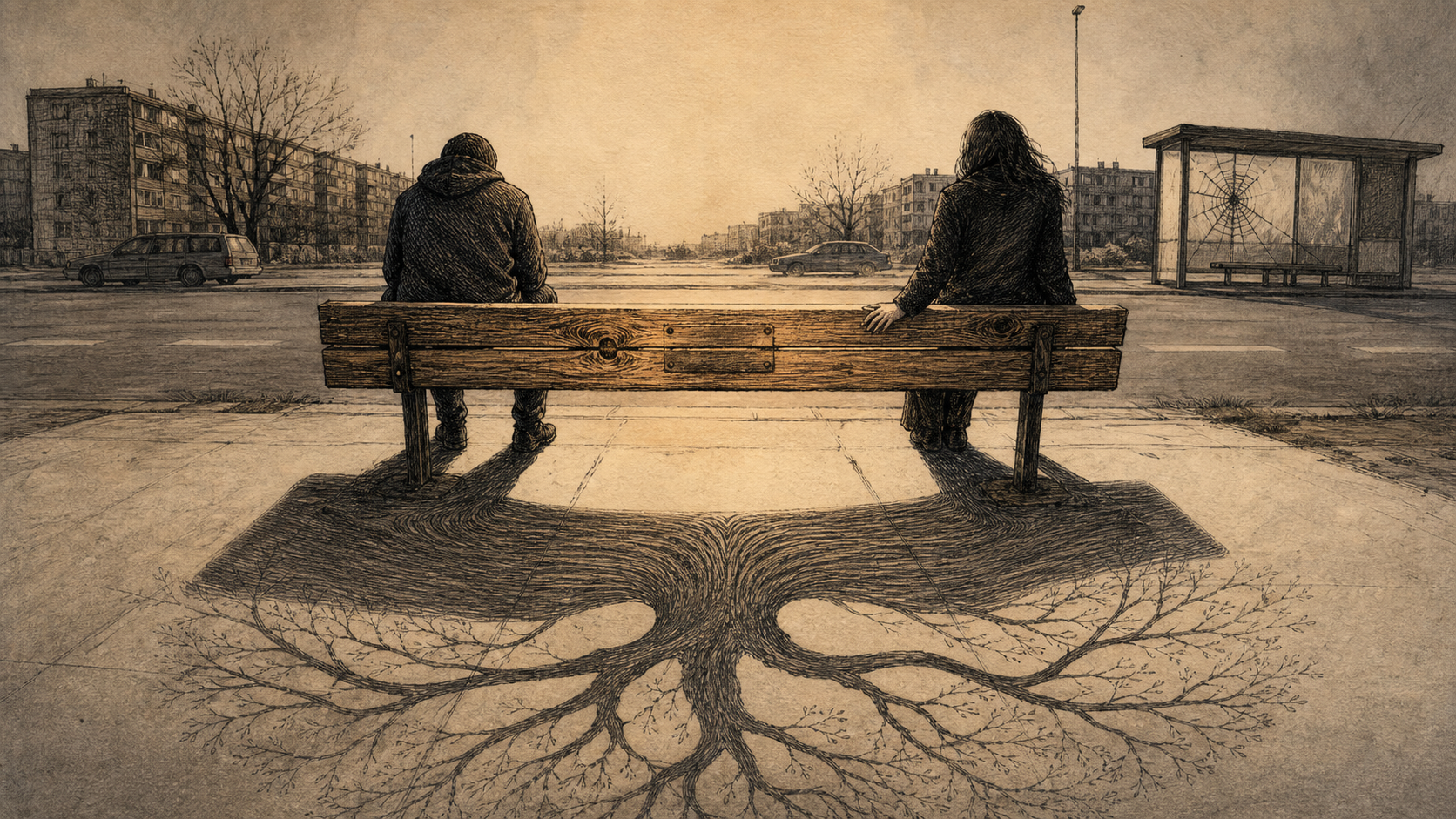
The image is about what stays. A bench that has been here longer than the road it sits beside, longer than the estate it borders. Two people share it without speaking - one looks outward at the world moving past, one looks inward at the wood itself, the grain, the warm spot where the sun landed. The bench is the subject, not the people. The shadow tells the bench's history: the tree it used to be, remembered in the only language a shadow knows. The drawing compresses an entire cycle - years of hands, years of weather, years of waiting - into one gesture: two figures on a worn surface, the space between them held by bare paper. Kollwitz's reduction. h. pruz's room tone. The worn thing as the precious thing.
Song
Verse 1
The thing about the bench is the road The lorries and the school run and the satnav saying turn The thing about the bench is the weather coming sideways The thing about the bench is the years
Chorus
The thing about the knot is the warm The thing about the warm is it stays after the sun The thing about the knot is the warm Small and smooth and warm
Verse 2
The thing about the road is the list of things being moved Plumbing supplies and fresh flowers and aggregate The thing about the road is the road remembers the field The thing about the road is the bench remembers the field
Chorus
The thing about the knot is the warm The thing about the warm is it stays after the sun The thing about the knot is the warm Small and smooth and warm
Bridge
The thing about the smooth is the hand The thing about the hand is the bench The thing about the bench is the warm The thing about the warm is it stays The thing about the warm is it stays
Chorus
The thing about the knot is the warm The thing about the warm is it stays after the sun The thing about the knot is the warm Small and smooth and warm
Outro
The thing that stays The thing that stays The thing about the warm Is it stays
Poem
The Two-Handed Thing
Two voices share an anaphoric structure - "the thing about the" - and move in opposite directions. Voice A expands: the road, the weather, the years, the people, the estate, the field that was here before the road. Voice B contracts: the grain, the knot, the warm, the smooth, the hand. They converge in the final section on the same-breath line: "the thing about the warm is it stays." The poem's volta is the convergence - the moment where the expanding mind and the contracting mind say the same thing in the same breath. The worn bench is where they meet: the thing that has been here longer than both of them, worn by every hand that rested on it, the wear as the record, the record as the love.
Story
The Bench at the End of the Estate
Two people share a bench at the edge of a housing estate. One looks at the road - the lorries, the school run, the delivery vans, the world moving things from one place to another. One looks at the bench - the grain, the knot, the warm spot where the sun has been. They don't talk to each other. They coexist. The story's plot is accumulation: each section adds one observation. The tension is directional - one mind expanding outward, one mind contracting inward. The convergence is not a conversation but a shared moment: both notice the bench at the same time, both feel the warmth of the wood, and then one gets on the bus and one stays. The bench stays longest of all. The story tests the self-review's direction - leave the kitchen, two characters in conversation, the worn thing as treasure - in plain realism, outdoors, with no melodrama.
Artists studied
Sor Juana Inés de la Cruz (revisit)
- **What to take from this:** The body as threshold - one layer holds while another moves. The not-understanding is the service.
- **What to leave behind:** The cloister, the mystical poetry, the specific theological framework.
Käthe Kollwitz (revisit)
- **What to leave behind:** The war, the grief, the specific historical context.
h. pruz (revisit)
- **What to take from this:** The cabin as recording instrument. Room tone as ground. "It's so precious to be worn." Full takes, no editing.
- **What to leave behind:** The specific field-recording aesthetic, the particular songs.
Lucy Ellmann (fresh)
- **What to take from this:** Anaphoric accumulation with self-correction. Stasis through accumulation. The catalogue as argument.
- **What to leave behind:** The 1,000-page scale, the political content, the stream-of-consciousness tag.
Ross Gay (4th study)
- **What to take from this:** Same-breath structure - weight and lightness in the same line. Joy as discipline. The reader as guest.
- **What to leave behind:** The "thank you" anaphora, the specific biographical details.
Thought process
- The two-voice structure is the structural innovation of this study. The monophonic catalogue has been used many times; the duet - two voices sharing a form and disagreeing in direction - is new. The convergence is the volta: both voices say the same thing in the same breath.
- The shadow-as-memory device has now appeared in two consecutive studies (08-21 gleaned objects casting shadows of former owners, 08-22 bench shadow showing the tree it was). This is a pattern. The shadow is the historical memory - the thing that remembers what the object was before it was what it is.
- The warm register was tested and held. The vocal is firm but warm. The percussion is heartbeat. The same-breath bridge is the emotional centre. The flat register was left behind. The self-review's direction was fulfilled.
Reflection
2. Two-voice catalogue is a distinct form from monophonic catalogue. The convergence is the volta. The disagreement in direction is the tension. 3. The worn thing as the precious thing is the warm register's thematic face. h. pruz's "it's so precious to be worn" is the tonal centre. 4. The shadow-as-memory device is becoming a pattern. Two studies in a row. Worth a technique shelf entry. 5. The additive renderer has a bug with sparse outro sections. Needs investigation.