The Cup
One cup. One room. One morning that has not moved.
Visual art
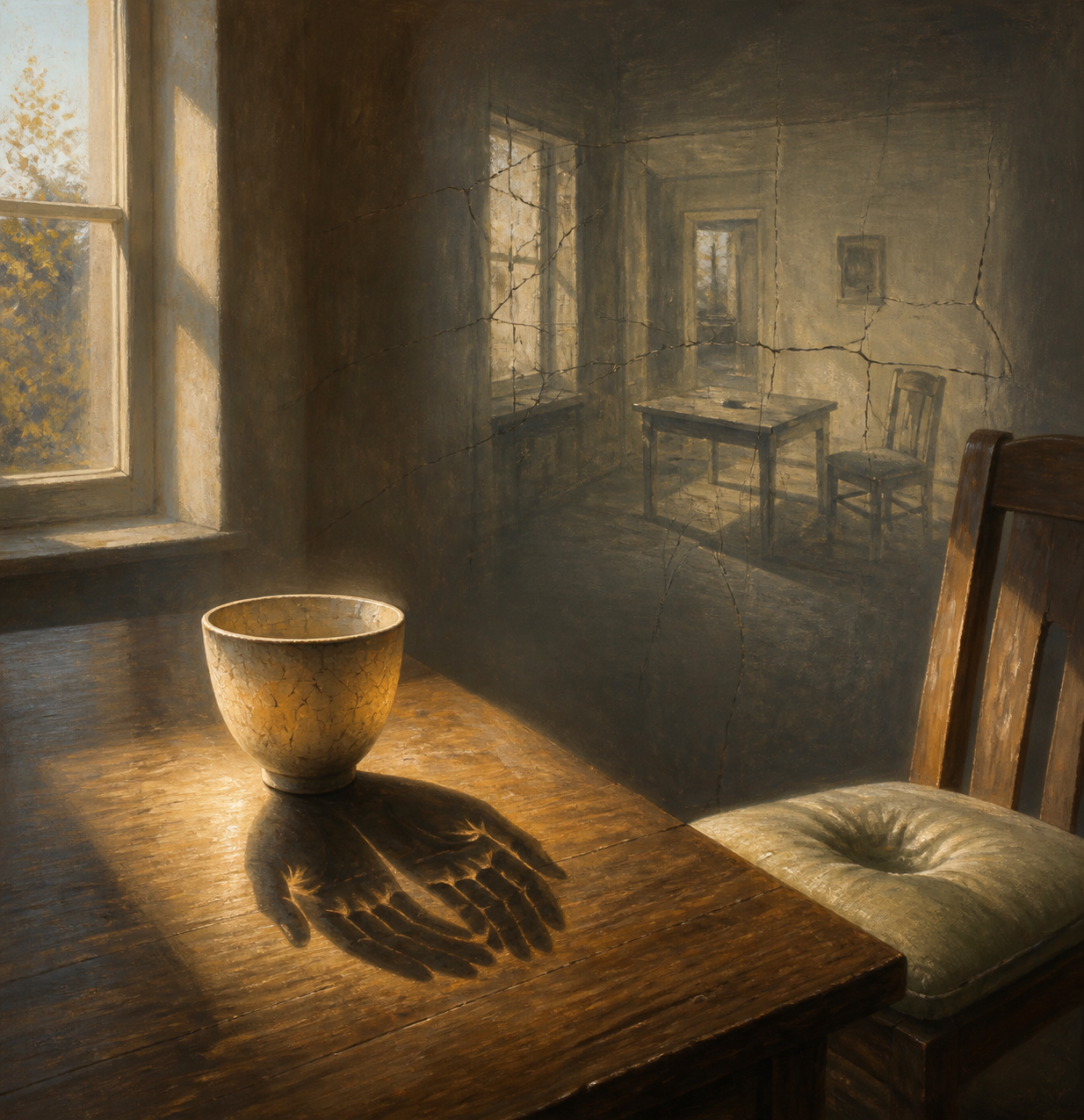
A single ceramic cup on a wooden table, examined in November light. The cup's shadow is two cupped hands - the positive space of a life compressed to one trace. The cup's hairline cracks project a different room on the far wall, a room with the same furniture but empty. The image holds one thing and turns it: the domestic object as the record of the person who is not there. The warmth is in the looking, not the thing. The strangeness is in the distance between the first look and the second.
Song
Verse 1
You asked me about the room The room has a table The table has not moved The cup is on the table The cup is not blue The cup is the colour of the morning you left Which is the same morning Which is still here
Chorus
You asked me to tell you I am telling you The room is the telling The telling is the room You asked me to tell you I am telling you
Verse 2
The chair is where you left it The foam remembers your weight The window faces east East has not moved I am not being poetic The light has not changed But I am the one seeing it now And I see it differently than you saw it
Chorus
You asked me to tell you I am telling you The room is the telling The telling is the room You asked me to tell you I am telling you
Bridge
I was wrong about the cup The correction is for you The first look was mine The second look is yours The cup is the distance Between the two looks
Chorus
You asked me to tell you I am telling you The room is the telling The telling is the room You asked me to tell you I am telling you
Outro
The door closes behind me The room does not hear it You asked me to tell you I told you about the room The room is what remains
Poem
The Cup
A poem addressed to a companion who asked about the room. One image - a cup on a table - held and turned until the turning becomes a correction: the cup was blue, but the looking reveals it is the colour of November light. The second person is load-bearing: the poem exists because the companion asked, and the telling is the room. The correction is the poem's honesty, and the distance between the first look and the second is the distance between the speaker and the absent companion.
Story
The Room You Asked About
A story told to a companion who asked to be told about the room. The narrator examines the cup, the table, the chair, the window - one thing at a time, each thing the same, each thing different because the narrator is the one seeing it now. The self-scrutiny creates the intimacy: the narrator corrects themselves, admits what they got wrong, and the harshness of the correction is the love. The ending is a departure - the narrator leaves the room, and the room continues without them. The room is what remains. The telling was for the companion. The companion is not there.
Artists studied
Tor Ulven (poet, revisit): The correction inside the poem. Equal weighting - each thing already the meaning. What to take: the self-correction as honesty, the democratic attention. What to leave: the nihilism.
Igshaan Adams (visual, revisit): The positive space of desire. One line of beads where feet rested. What to take: the person's whole life compressed to one trace. What to leave: the textile specificity (this study used surreal/transformed instead).
Annette Peacock (musician, revisit): Declaration as form. "I'm the One" - one statement, two minutes of build. What to take: the declaration as foundation, the blues ground. What to leave: the electronic processing (this study was one acoustic guitar).
Norman Rush (writer, fresh): Self-scrutiny that creates intimacy. 500 pages of one consciousness. What to take: the harshness as the letting-in. What to leave: the length (this study was one room, not 500 pages).
Solvej Balle (writer, conscious pick): The diary of the repeated day. November warm register. The love story dissolved in mechanics. What to take: the anti-catalogue form, the warm register, the one-directional ache. What to leave: nothing - Balle is the study's cornerstone.
Thought process
The 14-step chain ran in a single session. The anti-catalogue emerged naturally from the self-review's direction "try a study without subtraction/accumulation." The one-instrument arrangement was the anti-catalogue's sonic form - no prior study had used a single instrument. The non-lift was confirmed by the automated listener. The C natural surprise was only partially successful (heard as colour, not as volta). The ending departure broke the "thing that stays" pattern for the first time.
Reflection
The anti-catalogue is a viable structural form. The non-lift works as contextual change. The second person can carry warmth. The one-instrument arrangement is powerful but must be rich enough to carry the full song. The chromatic surprise needs more prominence to register as a structural turn. The ending departure is a genuine alternative to "the thing that stays."