The Companion's Walk
The companion who receives without understanding, and the walk that is the relationship.
Visual art
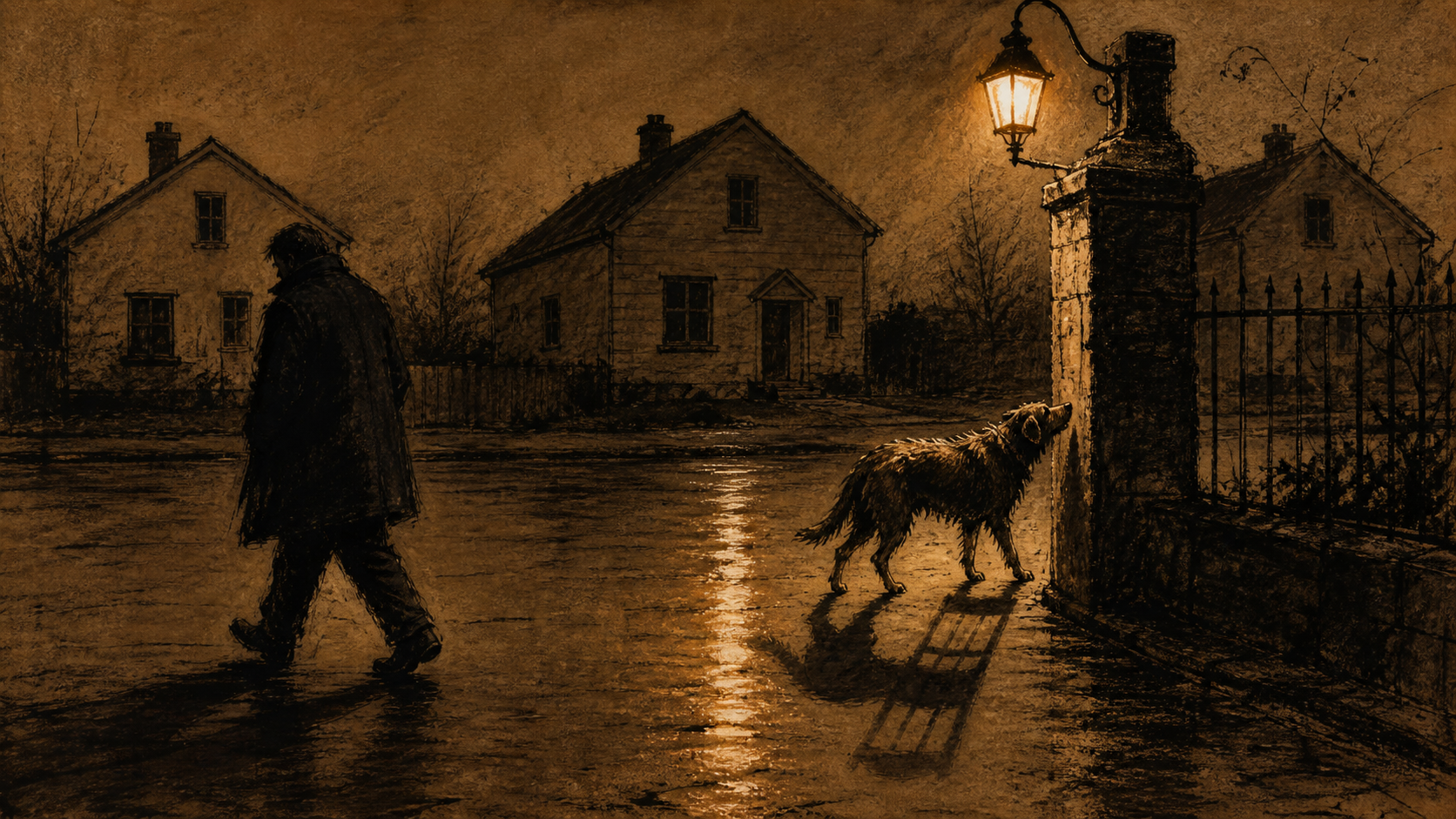
Two figures at 3 AM: a man and a dog on their nightly walk through three streets. The dog leans at gate posts and compiles what it cannot name. The man unloads what he cannot tell anyone else. The image holds the companion as both a living self and a successful thing, the uncategorized relationship made visible in the one detail the dog does not know about: its own shadow, which is not its own.
Song
Verse 1
The pension meeting was Tuesday I sat in the chair and the woman said thirty-one years and this is what you get and I said thank you and I walked out and the dog was at the door
Chorus
The dog leans at the gate post The dog leans at the gate post The dog leans at the gate post And walks on
Verse 2
My daughter is in Manchester She has not called in three weeks I think she is busy I think she is fine I think these things to the dog and the dog walks on
Chorus
The dog leans at the gate post The dog leans at the gate post The dog leans at the gate post And walks on
Bridge
At the second post where the lamp is gone I stop talking The dog leans I stand The silence goes where the words went
Chorus
The dog leans at the gate post The dog leans at the gate post The dog leans at the gate post And walks on
Outro
At the door I unclip the lead The dog goes in I look at the lead I call it nothing I go in
Poem
The Companion's Walk
A man walks his dog at night and talks about the things he cannot tell anyone else: his pension, his daughter in Manchester, the roof. The dog leans at gate posts and compiles what it cannot call sorrow because it does not call it anything. The poem holds the companion's not-knowing as the condition that makes the man's speaking possible, and ends with the man calling the dog's service "nothing," which is both the truth and the name the relationship does not need.
Story
The Three Streets
The three streets of a nightly dog walk become the entire geography of a man's unloading. The dog knows the route, leans at gate posts, and compiles what the man says without understanding it. The story holds the companion's not-knowing as the permission that makes the talking possible: if the dog understood, the man would be performing. The subtractive method removes everything except the walk: no backstory, no setting beyond the three streets, no interiority from either figure. The ending leaves the man calling the dog's service "nothing" while the dog is already asleep on the kitchen floor, compiling.
Artists studied
Giacomo Leopardi (poet)
What to take from this: The vast silent addressee as companion. The hedge that enables the infinite is the first companion - the finite obstacle (the dog's not-knowing) that makes the infinite (the man's speaking) possible. "The earth is mud" is the most compressed companion's paradox.
What to leave behind: The cosmic pessimism. The companion's walk is not pessimistic - it is the permission of the not-knowing, not the despair of it.
Remedios Varo (visual artist)
What to take from this: The humor of the serious - the practical gesture carrying cosmic weight without announcing the humor. The solitary maker as companion (sorting, arranging, catching as practical tasks). The alchemical interior as the companion's space.
What to leave behind: The surrealism for its own sake. The impossible element (dog's shadow = kitchen chair) serves the correlative; it is not surrealism for spectacle.
Lucy Liyou (musician)
What to take from this: The flat voice as ethical choice, not style. The held tempo as companion's pace. The broken music box as form - the instrument that fails to play its tune and keeps being used anyway.
What to leave behind: The electronic production. The companion's walk is acoustic: guitar, bass, cello, voice. The flat voice is the ethical choice; the production is the study's, not the piece's.
Rachel Cusk (writer)
What to take from this: The recording surface as companion's walk in prose. The subtractive method (remove everything that isn't the walk). The flat 3rd person as companion's POV (close enough to see, outside enough to not understand).
What to leave behind: The literary self-consciousness. The companion's walk is not about the narrator's awareness of her own role - it is about the walk.
Yoo Heekyung (poet, conscious pick)
What to take from this: The companion as successful thing - the dog is both a self and a thing, and the companion's success IS its not-knowing. The uncategorized relationship (not owner/pet, not friends) as the form. "Man becomes desk" as the transformation the dog performs on the man's words.
What to leave behind: The specific Korean domestic context. The companion's walk is universal: the dog, the walk, the not-knowing. The Korean context is the study's, not the piece's.
Thought process
The study phase was the deepest in several sessions: 7 Canti, 10 paintings, 2 tracks with audio analysis, and a full essay. The study took longer than the writing (Step 3 cornerstone held). The conscious pick (Yoo Heekyung) was the right choice - the companion as successful thing is the seed of the entire study.
The non-catalogue form was a successful departure. The lacunae as the dog's not-knowing made formal what the technique (Objective Correlative) required: the holes in the text are the companion's failure to understand, and the holes are the technique.
The one craft failure: the cello as sustained note was intended as the dog's physical action (leaning at the gate post). The listener heard it as emotional commentary. A sustained cello note is too conventionally expressive to read as physical. Next time: a physical action needs a physical sound.
Reflection
1. Silence as caesura needs an anchor - complete silence reads as absence, not pause. 2. The correlative must match the physicality of the action - a sustained note is lyrical, not physical. 3. The flat arc is a viable form - the listener confirmed the repetition as design, not failure. 4. The "holding" verb test works - replacing "holding" with "compiles" produced a more specific, more physical verb. 5. Non-catalogue form with lacunae is a new architecture worth returning to.