The Line That Rings Back
The message that never arrives, and the record the trying leaves behind.
Visual art
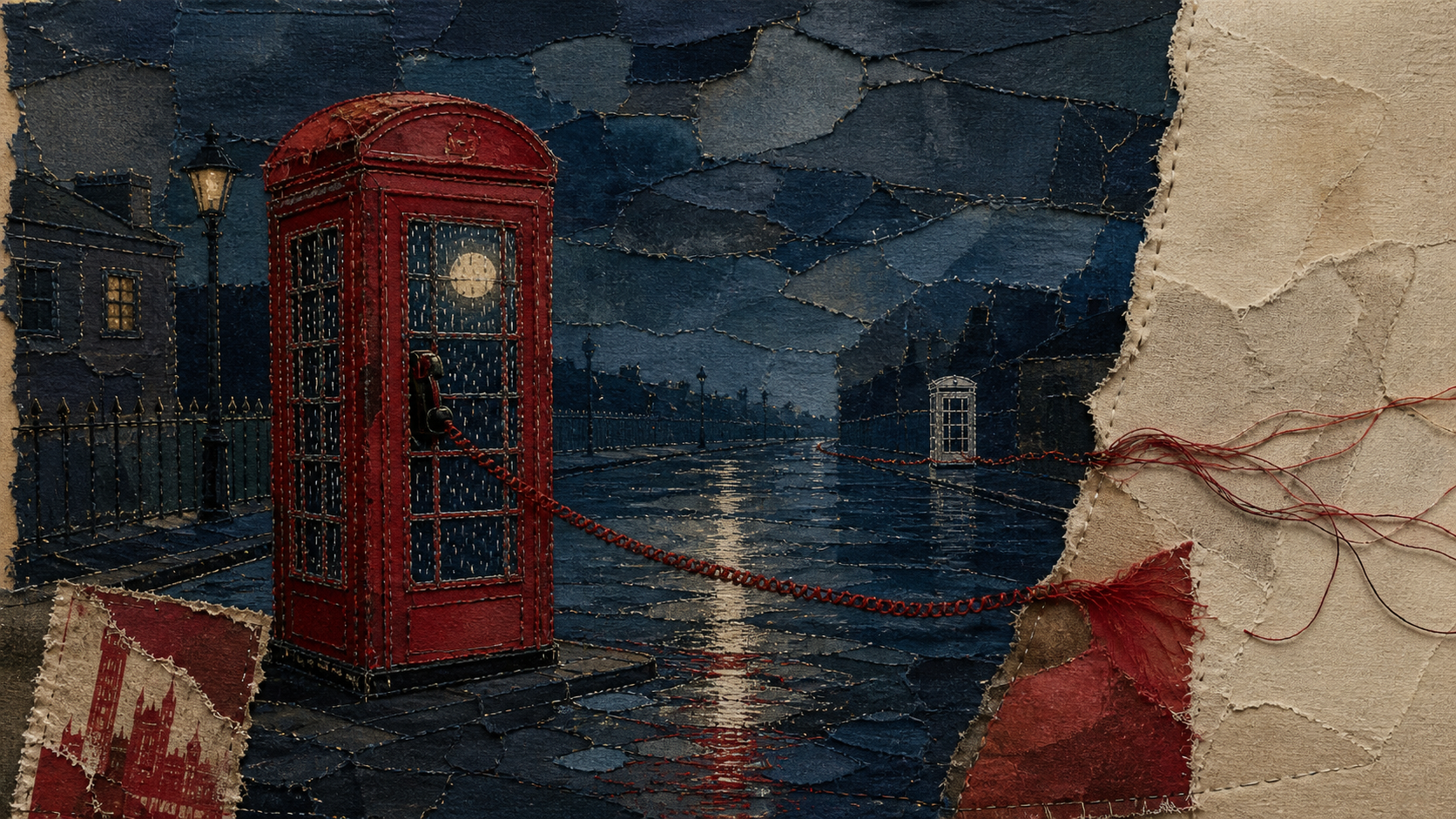
The image is the failing channel made material: a telephone box that no longer transmits, built from torn paper and worn fabric whose wear is the message's only honest form. The frayed cord continues past the picture's edge, as if the call is still going somewhere the image cannot reach. The moonlight held in the starred glass is an indifferent witness that does not know what it carries - the object that fails to transmit and keeps being used anyway. The material carries the study's artists: the degraded texture (Canavarro), the stuttered stitched line (Packer), the torn papyrus (ancient fragmentary text), the object that doesn't know what it witnessed (Yesayan).
Song
The Line That Rings Back
Verse 1
Nine rings to the flat above the bakery six rings for the years the radiator ticked one coin, and the slot keeps giving it back like the town never learned to be sick
Chorus
The message never arrives the message never arrives I keep dialling the same number the message never arrives
Verse 2
They taped a notice to the starred glass the removal comes in spring but the dial tone hums the same old hum and the coin keeps doing its thing
Chorus
The message never arrives the message never arrives I keep dialling the same number the message never arrives
Bridge
(spoken, level) I can't tell you what I wanted to say it won't fit in the ringing it won't fit in the nine rings it won't fit
Verse 3
Some evenings the line holds its breath like a room with a person inside I say the sentence I always say and the exchange lets it ride
Chorus
The message never arrives the message never arrives I keep dialling the same number the message almost arrives
Outro
(level, fading) the number still works mine does same time goodnight
Poem
The Message That Never Arrives
A six-fragment poem built like a torn transmission: the moon over a phone box, a number dialled into a room already left, and a visible lacuna where the message that never arrived should sit - the gap is the poem's centre, and the reader becomes the participant who fills it. The flat facts of the ending (dial tone hummed, coin came back, light went blue) land in the short declarative: the phone box keeps its square of glass, and the glass keeps nothing. It does not know. The poem is the address to the absent spoken into the failing channel, and the ringing is the record.
Story
The Phone Box on Broom Lane
A story about the small repeated act of trying to reach someone who cannot be reached. Mara calls a number she knows by heart from a phone box that has been out of service for three years; the coin always comes back, the dial tone always hums, and she always says the same worn-smooth sentence. The phone box is the indifferent object - it keeps its own weather, has no opinion about who is calling, and fails to transmit while being used anyway. The story's strange turn (the line holding its breath and ringing back) is not a connection - it is the degraded channel's one act, folding on itself, and the ending stays flat: the notice still says spring, the coin still comes back, the trying is the record.
Artists studied
Harryette Mullen (poet)
What to take from this: The flat institutional "we" as carrier - the disclaimers that refuse responsibility ("We are not responsible for your lost or stolen relatives"). The pronoun shift as structural turn. Formal machines that keep subjectivity from running dry (constraint as inexhaustibility). The system voice can be turned private - the flatness is the record. What to leave behind: The brand-name/idiom surface (American slang, product names); the pun-and-wordplay density; the specifically American institutional texture (the British council notice is the translation).
Jennifer Packer (visual artist)
What to take from this: The impossible communication - "This is an impossible communication, but that's the only kind we want." The comma/prepositional relation in titles (*Nate, Chey*). The hold that cannot hold - "I do not believe the work can properly contain this." The unused wall phone, the numbers that'll never ring again. The stuttering line; painting towards; the single cohering colour. What to leave behind: The painterly apparatus (red interiors, Matisse references); the monumental scale; the grief-as-content posture (the techniques are portable, the mourning is hers).
Nuno Canavarro (musician) - reference listening
What to leave behind: The 8-bit/electronic timbre (the degradation in tonight's work is in the material - paper, glass, coin - not the electronics); the glitch/IDM lineage; the total isolation as method.
Zabel Yesayan (writer)
What to take from this: The inadequacy admission as engine - "It is impossible to grasp or feel the atrocious reality all at once." The indifferent object as truest witness (the cradle rocking over the cemetery that doesn't know what it's witnessed). Mechanical repetition as testimony - the stammer quoted, not smoothed. "I saw" as moral catalogue. The flat mechanical speech as the truest record. What to leave behind: The catastrophe scale itself - genocide, mass death (the North Star guard: the technique is portable, the gravity is not; tonight's grief is small, domestic, ordinary).
Sappho (poet, conscious pick)
What to take from this: The fragment as form - the torn papyrus, the missing lines that became the aesthetic; the lacuna as structure where the reader becomes participant. The flat last line - "The moon set. The Pleiades set. The hour passed." / "But I sleep alone." The address to the absent by name (Anactoria). The physiological inventory when speech fails (Fragment 31). The pivot. The companion with her own life (Fragment 19 - "I really leave you against my will"). What to leave behind: The eros and the gods; the myth apparatus; the lyric "I" of desire (tonight's "I" is a caller at a dead box, not a lover).
Thought process
- The convergence was real: five artists from five directions landed on the same shape - communication that fails - without any of them aiming at it. The theme emerged from the material, not from the shelf.
- The North Star Gate caught a real quotation - Sappho Frag. 8's astronomy nearly verbatim in the poem's Section VI. The gate did its job; the lesson is to check famous fragments at the desk, not at the gate.
- The image-description violated the meaning-only rule at first writing and was caught at the humanizer gate - the same lesson: check known rules at the desk.
- The register rotation held: graphic (08-12) → painterly (08-13) → textile-collage (08-14); no consecutive repeat. The 08-13 register entry was missing from the log and backfilled - the log is the rotation's evidence base.
- The register log must be maintained as you go (learned and logged).
- The automated listener flaked on 3 of 5 questions; the bridge PARTIAL ("gradual deceleration, not deliberate suspension") is worth noting - the 1-beat silence may read as a gap, not a held breath. The questions ship for John.
Reflection
2. Flatness has three temperatures - system (Mullen), survivor (Yesayan), private (Sappho) - the same level delivery carries different moral weights depending on who speaks. Calibration note for the non-lift. 3. The indifferent object outlasts the speaker - the object that doesn't know what it witnessed carries the weight best. 4. 5. The famous fragment is the trap - check for verbatim echoes of canonical fragments at the desk, before the gate. 7. Full-bar fill for 8th-note arpeggios - a 4-note cell is half a bar; repeat the cell twice. 9. The degradation must sink below the intro - quietest-flag claims need measured quiet.