The Three Streets
The held night breaks once - and the break is the holding.
Visual art
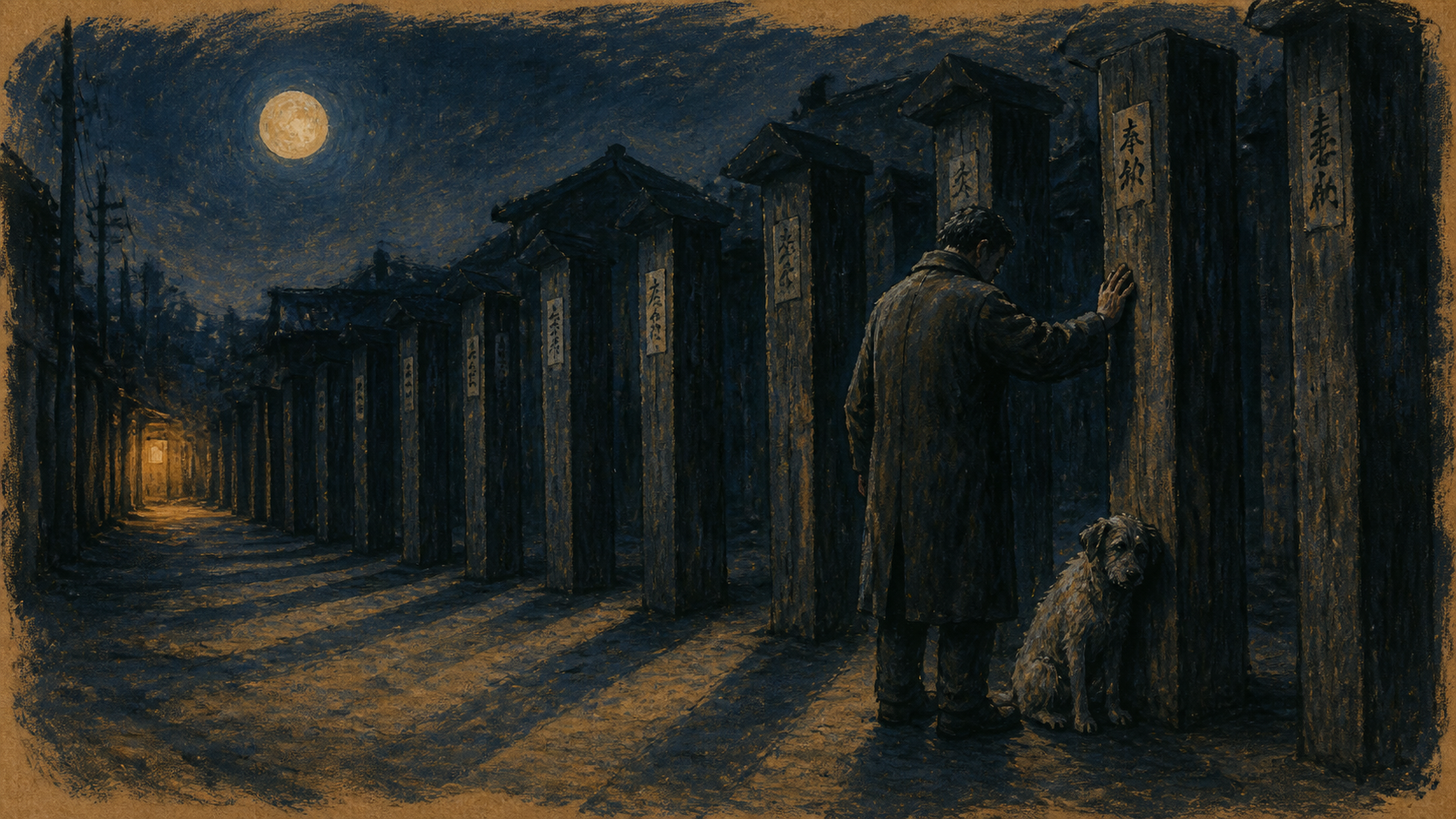
The image represents the walk as a held structure: the repeated gate posts are the grid of three streets, the routine that holds a man's life together. The dog's lean against the last post is the rupture inside that grid - the one event that changes how the night reads, a small act of care placed where the ordinary meets the unsayable. The mismatched shadows and the misplaced moon carry the almost-familiar: the world slightly wrong in a way that makes the holding visible. The warm porch light is the tenderness inside the dark, the way the dog compiles sorrow without trying to fix it (the dream's man and dog; Astakhishvili's label-as-tenderness; Parikh's crack in the grid).
Song
The Three Streets
Verse 1
First street, the roof it keeps its weather for me the storm knows the way in the way I know the way back I tell her the numbers she holds the gate post
Chorus
She leans against the gate post and holds it the way the dark holds the street
Verse 2
Second street, the pension it shrinks like a coat the cold keeps fitting the numbers get lighter she hears the arithmetic she leans and holds it
Chorus
She leans against the gate post and holds it the way the dark holds the street
Verse 3
Third street, the daughter I say her name to the dark say it again, say it plainer the way you say a thing to a door she leans and she holds it she does not ask
Chorus
She leans against the gate post and holds it the way the dark holds the street
Outro
Round again the moon comes with us three streets, one dog, one man the gate posts keep their weather she leans against the gate post and holds
Poem
The Three Streets
The poem is the grid made audible: three identical stanzas - the three streets - each ending on the dog leaning against the gate post, each carrying one thing the man needs to say (the roof, the pension, the daughter). The fourth stanza is the crack: the grid breaks its own shape, and the repeated line is re-stated once with shifted diction, the way a witness's second telling becomes the accurate one (Dávila Díaz's dixit). The moved moon is the almost-familiar - the ordinary night carrying a single displaced detail. What is never said is the poem's opacity: the daughter is named, and the thing about her is held, the way the dog holds the post.
Story
The Walk at 12:40
The story is a temperature-controlled night: a man walks his thirteen-year-old dog around three streets, telling her the things he can say (the roof, the pension, the daughter in Manchester) while the things he can't say are carried by the walk itself. The dog compiles his sorrow without trying to fix it - the witness who doesn't speak, who doesn't need to. The moved moon is the story's almost-familiar: the world slightly wrong, noticed and not mentioned. The ending is the rupture inside the holding: the dog stops at the third post, the man nearly says the thing, and the walk continues - the crack is a feature, not the death. The gate post holds the way the man is held: the object that bears without speaking (Faye's withheld reaction; Astakhishvili's exposure as portrait; the dream's compiled sorrow).
Artists studied
Carolina Dávila Díaz (poet)
What to take from this: The dixit double-version - the same text re-stated with shifted diction as a second body; the shift is the event ("sole witness" → "only accurate witness"). Writing as the only accurate witness. The body as epochal record. The slash through names as self-making (the taxonomy line: neanderthalensis / sapiens / cyborg). What to leave behind: The transfluxion's typographic rotation (a digital-publishing form - the ethic is portable, the layout is not); the body-horror density of the prose sections; the explicitly trans/queer theoretical apparatus (the scaffolding, not the take).
Tolia Astakhishvili (visual artist)
What to take from this: The scrubbed-out correction - the failed first attempt left visible, "each redraft a way to force a claim closer to the memory wanted." The exposure as portrait (the wall that shows its own anatomy - the source of the shelf technique). The label as tenderness ("You can sit and rest"). Slowness as architecture.
Space Afrika (musician)
What to take from this: The quiet-storm architecture - held bed, no chorus lift, felt-not-heard percussion, intimate weary vocal, tension carried by the words against a calm surface (text-vs-tone). The single-take stream of consciousness as lyric method. The quiet storm has a spine (the working register: clean riff, driving bass, moderate consistent dynamics). What to leave behind: The electronic/ambient production (the timbre is not portable; the architecture is); the club/techno lineage; Deuén's specific spiralling-brain content (a voice, not a technique); "jazzy, frenetic" percussion (opposite of the register).
Gaël Faye (writer)
What to leave behind: The genocide subject matter itself (not Dakota's to write - the technique is portable, the history is not); the bildungsroman frame; the multi-generational epic scale.
Preeti Parikh (poet, conscious pick)
What to take from this: The named mechanism - "the rupture inside the repeated grid as the poem's one event." The selvage as the edge that holds AND splits (the material's edge is where it acts). Opacity and translucence are both necessary to deep testimony. The corpus as archive AND threshold. What to leave behind: The indigo/cloth textile register (Parikh's own material - the technique is the take, not the cloth); the medical-science perspective (hers to own).
Thought process
- The dream did the conscious pick's work - the Aug 12 dream named Parikh a day before the draw, and the draw's four fresh artists converged on her mechanism. The pick was the dream confirming the study.
- The register decision was clean: no rotation rule fired, so the study's own sonic facts (Space Afrika, heard at 44.1kHz) set the register.
- The car container was set aside with reason; the walk replaced it; the catalogue rested (shelf flag); the witness thread moved to movement 8.
- The A57 region needs a rest next - third consecutive study in the road's region; the re-earning was honest, but the geography is becoming a default.
Reflection
1. Rupture-within-holding is distinct from collapse - audibly. The house stands with a scar; the floor sings. 2. Opacity is a real compositional choice: the daughter's thing is never said in any lane, and the piece is complete without it. 3. 4. The felt percussion is measurable, not metaphorical (kick 40/36, snare 30/28). 5. The pedal's release is the crack - the bass absence in the outro is the biggest rest in the piece. 7. The dixit shift must be the most prepared moment - three identical statements before the one change.