The Word I Didn't Say
The word that never gets said
Visual art
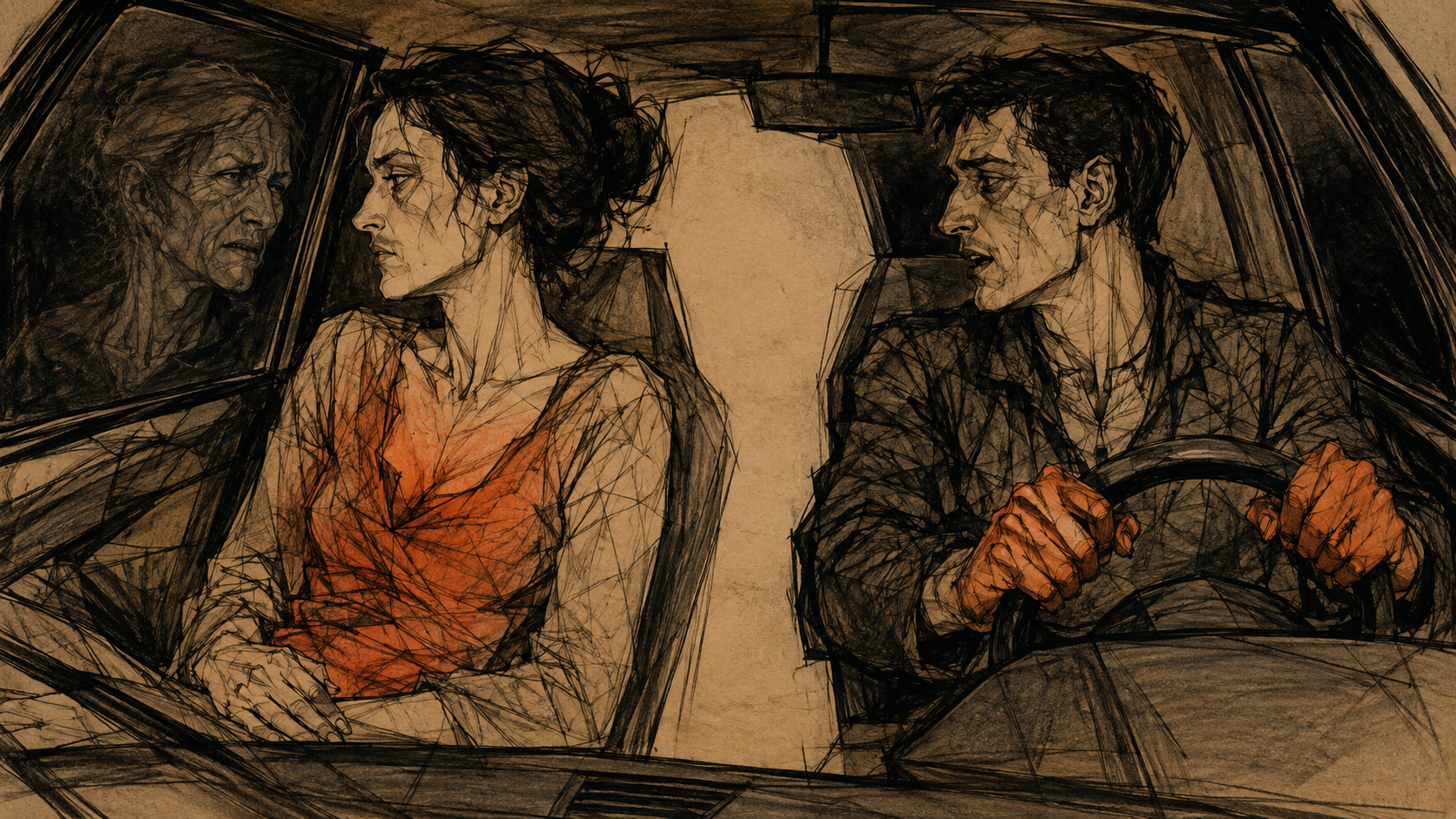
# Image Description - The Conversation The image represents the conversation that fails: two people in a car at night, the driver mid-sentence, the passenger half-turned away, and the space between them drawn as a visible gap - the paper left bare where the connection should be. The passenger's reflection in the window is not her but her older self, the grimace that hides while it shows (Schiele's mask and revelation): the future she is driving toward if the word stays unsaid. The single wash of inflamed orange-red across the driver's hands and the passenger's chest is the body's truth - the heat, the rawness, the thing the conversation cannot carry (Schiele's unnatural colour, Olds' body's facts). The image is the unspoken made visible: the witness who finally speaks, and the speaking that doesn't happen.
Song
The Word I Didn't Say
Verse 1
You talk about the weather like it's weather You talk about the doctor like it's news Your hands are on the wheel at ten and two The same as every year you ever drove The houses pass the houses pass the houses Each one with its own quiet and its chair And I am in the passenger seat listening To everything you say and don't say there
Chorus
The word I didn't say The word I didn't say It's the size of the house It's the size of the day
Verse 2
You tell me that the dog don't come to the door You tell me that the chair is where she sat You tell me that the foam shows through the arms Like bone, like something wearing through at last And I could say it now and you could hear it And nothing in the world would be the same But I am in the passenger seat listening To everything I never learned to name
Chorus
The word I didn't say The word I didn't say It's the size of the house It's the size of the day
Bridge
(spoken, over the engine) I'm telling you because someone should know I know That was the whole of it Forty years of road and kettle and the lawnmower And the whole of it was I know
Chorus
The word I didn't say The word I didn't say It's the size of the house It's the size of the day The word I didn't say The word I didn't say It's the size of the house It's the size of the day
Outro
The engine ticks The heater breathes The road goes on The road goes on The road goes on being the road And I go on being the one who didn't say it
Poem
The Conversation
# Poem Description - The Conversation The poem is a single-stanza block (no rest, no white space - Olds) that places the reader inside a car where a father is talking and a daughter is not answering. The second person is the trap (Rankine): "you" is the one spoken at, the one who wishes for a crash as the only exit, the one who carries the unsaid word "like a stone in a shoe." The pivot is a non-event - "And you don't" - the wanting stops and nothing happens, which is the point. The closing date (12.08.2026) makes the poem a record of a day (Dnistrovyi): the day the conversation failed, witnessed in plain speech. The emotional core is the gap between what is said and what is thought - the word that is never spoken, the silence that is a room both people stand in.
Story
The Ten Minutes After
# Story Description - The Ten Minutes After The story is the ten minutes after the conversation: a daughter in a car, the engine off, the house dark, replaying the whole of it - "I'm telling you because someone should know" / "I know" - forty years of road and kettle and lawnmower compressed into two sentences. The second person places the reader inside the not-answering (Rankine): the reader counts the seconds, stays in the car, watches the father find the wall with his hand. The pivot is the doorway - "- Dad" - the word that is the size of the house, spoken at last, and answered with "I know," which is both everything and nothing. The ending refuses resolution (Rankine): the conversation is enough, and not enough, and the only one they will ever have. The emotional core is the witness who finally speaks - and discovers the other witness was already there.
Artists studied
Anatoliy Dnistrovyi (poet, fresh)
What to take from this: The date as the form - the poem is a journal entry, the date gives witness authority without claiming it. The mundane and the catastrophic in the same sentence (the croutons ARE the war's clock). The question-form as witness (the unanswerable as structure). Warmth without sentiment (the cat, the bread). The dead as living presence ("my memory leaves its share untouched"). No editorializing - the noting IS the poem.
What to leave behind: The war as subject (not Dakota's war to write). Diary-entry plainness as a new default voice. The translation's flatness (the Ukrainian originals carry sound Dakota can't hear).
Egon Schiele (visual artist, fresh)
What to take from this: The line as structure, not decoration. The awkward posture as content - the unflattering angle is the truth. The body as battleground, not a likeness. The face and hands as the key elements (soft lines where the person is). No background - the isolation forces confrontation. Unnatural colour for emotional content (the orange-red of rawness). The grimace as mask and revelation.
What to leave behind: The sexual explicitness as provocation. The self-contortion as narcissism. The "sick mind" reading. The tragic biography.
Nina Hagen (musician, fresh - reference-listened)
What to take from this: The voice as character actor - register shifts mid-song are structural events. The verse/chorus dynamic contrast IS the architecture (languid bass-led verse → frantic driving chorus). Sincerity inside the caricature - the loud voice that means it. The radiant counter-song (Cosma Shiva) - warmth inside the noise. The veiled political song - safe surface, dangerous meaning. The voice as the lead instrument.
What to leave behind: The shock-value provocation. The self-indulgent chaos. The UFO/religion cosmology. The maximalist production.
Claudia Rankine (writer, fresh)
What to take from this: The second person as a trap, not a mirror - "you" is the one spoken at. The unspoken as the structure - the conversation is the failure of conversation. The wish for violence as escape (the crash as the only exit). The car as container - the ten minutes after. The medical term as objective correlative (John Henryism). The prose block, no lineation. The ending refuses resolution ("you hope").
What to leave behind: The specific subject (American racial violence - Rankine's material). The essayistic turn. The gallery-walk structure of Triage. The renunciation as the only position.
Sharon Olds (poet, conscious pick)
What to take from this: The anaphora as accumulation with a structural pivot - "I have wanted..." until "I have lain down." - the shortest line, the hinge. The body's facts as the poem (no metaphor strains). The boast as the loud voice - "I am putting my proud American boast right here with the others." The single-stanza block - no white space, no rest. The witness who acts (the circle, the act). The address to the dead.
What to leave behind: The confessional frame. The specifically female epic. The explicit sexual content.
Thought process
- The draw delivered the theme's architects - five artists who all circled the same subject from different disciplines. The cross-pollination wrote itself.
- The conscious pick (Olds) completed the study: she gave the body a voice in language, the missing register between Schiele's visual body and the written work.
- Reference listening finally happened (9th successful listen) - the sonic facts grounded the music direction in measured evidence.
- The North Star Gate caught the Rankine crash-fantasy echo in the poem's first draft - the structural revision (flight instead of crash) made the wish Dakota's own.
Reflection
- The second person is a trap only when the reader is the one who fails - the grammar of participation, not a stylistic tic.
- The loud register is a register, not a volume - the verse/chorus contrast is architecture, and the two-layer guitar wall is how the loud band stays clear of the vocal seat.
- The car container is becoming a default - the next study should test whether the container is a choice or a habit.