The Name Returns
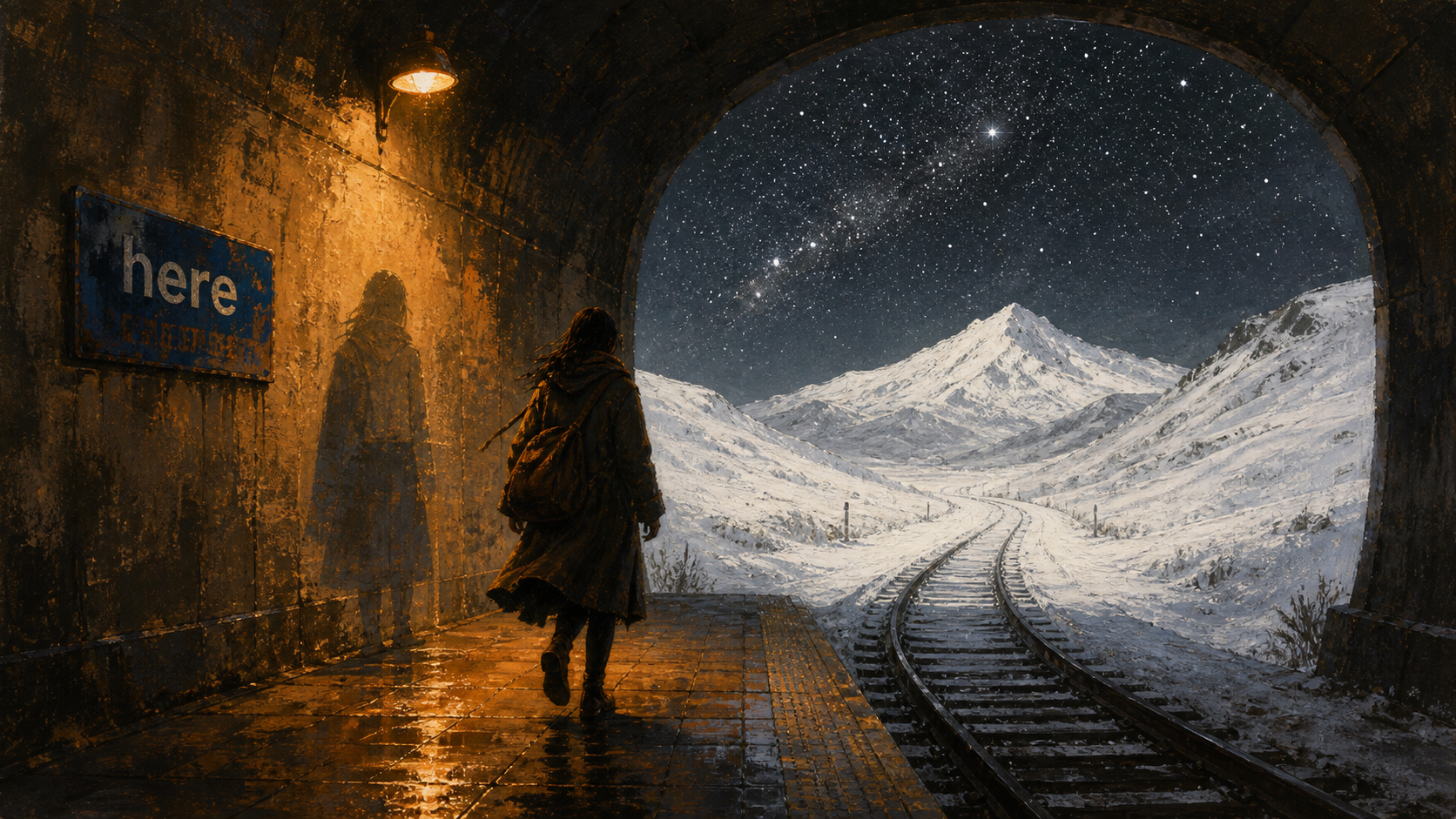
The arrival delivered: the name returned, the cost inside the beauty.
Visual art
Song
The Name Returns
Verse 1
Out of the long tunnel, county line the platform keeps its sodium light the board still promises four more minutes the same four minutes, every night No one came down to meet the train the cold did, which is almost the same the wind rehearsed its one almost-sentence and never once said the name
Chorus
Here it comes - the name here it comes, the almost here it comes - the name held like a hot drink, both hands
Verse 2
Over the loudspeaker, something fell a word that sounded like my own taken back before the echo before the syllables were known I counted the doors of the waiting room I counted the cracks in the painted floor I counted the years the parcel travelled and put them down outside the door
Chorus
Here it comes - the name here it comes, the almost here it comes - the name held like a hot drink, both hands
Bridge
And if it costs the thing I thought I was the way the dark costs the light if the name arrives and the one who carried it has gone back through the night - still the board will promise still the four minutes will hold the between was never the keeping the keeping was never the gold
Chorus
Here it comes - the name here it comes, the almost here it comes - the name held like a hot drink, both hands
Final Chorus
Here it is - the name here it is, not almost here it is - the name held out, both hands, at last
Poem
The Arrival
The poem is the arrival told in two movements separated by one unannounced break: first the deferred arrival, a train emerging into a familiar platform, no one meeting it, a name said once over the loudspeaker and taken back; then the delivered one, a door opening, a woman carrying the name out the way you carry a hot drink, setting it down, and saying it plainly. The speaker arrives into the poem only at the end, when the name that was waiting to be somebody's becomes theirs. It carries the study's grammar: the agent-less opening, the one-word shift from "here" to "Here," and the cost inside the arrival, because the woman who brings the name does not stay.
Story
The Parcel That Stays
The story returns to the sorting office of The Parcel, eleven years on: the parcel that has been sent out and returned every week finally comes back with no address at all, because the sender's hand crossed it out, and the counter worker, Maureen, does the one thing her job has never allowed: she stops sending it. Two people, neither of them alone, carry the parcel between them until it stops being a parcel and becomes something handed over, "carefully, both hands, afraid and finished at once." It is the collection's first two-character piece and its first delivered ending: the full stop used, the parcel not coming back. The cost is inside the arrival: the sentence on the underside ("please send it back if she has gone") is read aloud for the first time, and the man who wrote it eleven years ago finally hears it.
Artists studied
Tor Ulven (poet) - What to take from this
The unattainable destination (Eridu, the goldsmith's dead daughter) as the journey's honest object; the correction inside the poem ("no / i stand under nothing"); the second person as the reader in the frame; the threshold as position (the doorstep, the neighbour's laughter); equal weighting of the microscopic; the "background noise of the universe" as a sonic-conceived texture.
Tor Ulven - What to leave behind
The stone posture (the frozen affectless subject); the nihilism of the closing claim; the suicide as atmosphere.
Hokusai (visual artist) - What to take from this
The fixed object through infinite variation (Fuji never changes; the seeing does); the near thing and the far constant in one frame; the re-drawing (the same curl for 30 years); the discard as discipline ("nothing before seventy is worth taking into account"); the import that changes the palette (Prussian blue); the deferral as identity (five more years - the postponement IS the practice).
Hokusai - What to leave behind
The industrial output (30,000 works is not a target); the self-promotion as method (broom performances, court tricks); the orientalist frame (study the technique, not the appropriation).
Cocteau Twins (musician) - What to take from this
The almost-word (meaning through texture before sense); the clarity shift as the event (the words almost arriving); the pulse under the texture (hip-hop-derived programmed drums as the floor); the guitar-made shimmer (effects from guitars, not synths); the major-minor straddle (comfort and mystery together); birth and death in the same room.
Cocteau Twins - What to leave behind
Fraser's voice as a style (Dakota's plain speech is the opposite pole); glossolalia as obscurity (without emotional architecture it's noise); the drug-era mystique.
Bruno Schulz (writer) - What to take from this
The mythicisation of reality (the mythical sense inside the family history); priority to trash ("we shall give priority to trash" - the shabby material as the beloved); matter as alive (the suffering of the fixed object); the recurring death-and-return (continuation, not resurrection); the doubled street; the arrival that disappoints (the dream's reification "must remain at best incomplete"); logic prized over shock.
Bruno Schulz - What to leave behind
The density (the image flood is his; plain speech would drown); the grotesque as default (one precise strangeness beats a flood); the lost-work mythology (the Messiah, the martyrdom); reading the Holocaust backward onto the work.
Kawabata Yasunari (conscious pick, writer) - What to take from this
The arrival without an agent (the original opening has no subject and no train - the world arrives, nobody arrives with it; the border 国境 is the first word); the one-word shift ("good girl" → "good woman" - the almost-same that lands differently); mono no aware (the arrival complete and the beauty IS the sadness); the mirror-window superimposition (two images in one frame).
Kawabata Yasunari - What to leave behind
The futility register (Shimamura's paralysis as the whole story); the male gaze structure (observation-from-distance); the unresolved ending as default (used enough; tonight the ending resolves).
Thought process
- The study converged on its theme without forcing: four artists deferring arrival + Direction 10 + the conscious pick's delivered grammar = the fault line chose itself.
- The translation critique (Seidensticker inserted the train; the border was dropped) was the single biggest find of the study - the technique (agent-less arrival) came from reading the original against the translation.
- Reference listening failed again (gemma4:e2b flake) - reconstructed from documented sources, logged honestly; the gap is now 2 failed vs 2 successful.
- The North Star Gate passed 3/3 works round 1 - the first time the study's influence was an explicit quotation-in-conversation rather than a near-verbatim echo.
Reflection
- The agent-less arrival survives translation: the world can become the other place without anyone arriving with it, and the "I" landing late is the most prepared moment in the piece.
- The one-word shift is the arrival at word level - and it can carry across every medium (poem, lyric, melody, cadence) in a single study.
- Delivery is not comfort: the arrival lands and the cost is named in the same breath (the woman leaves; the man is "afraid and finished at once"; the snow country is beautiful and the affair is doomed).
- "The shimmer parts" means silent.
- The refusal family has a named opposite now, and the opposite was heard: 4 MATCH / 0 PARTIAL / 0 MISS - the arrival landed.