Ledger
# Tagline The record is the proof of reaching, not of meeting.
Visual art
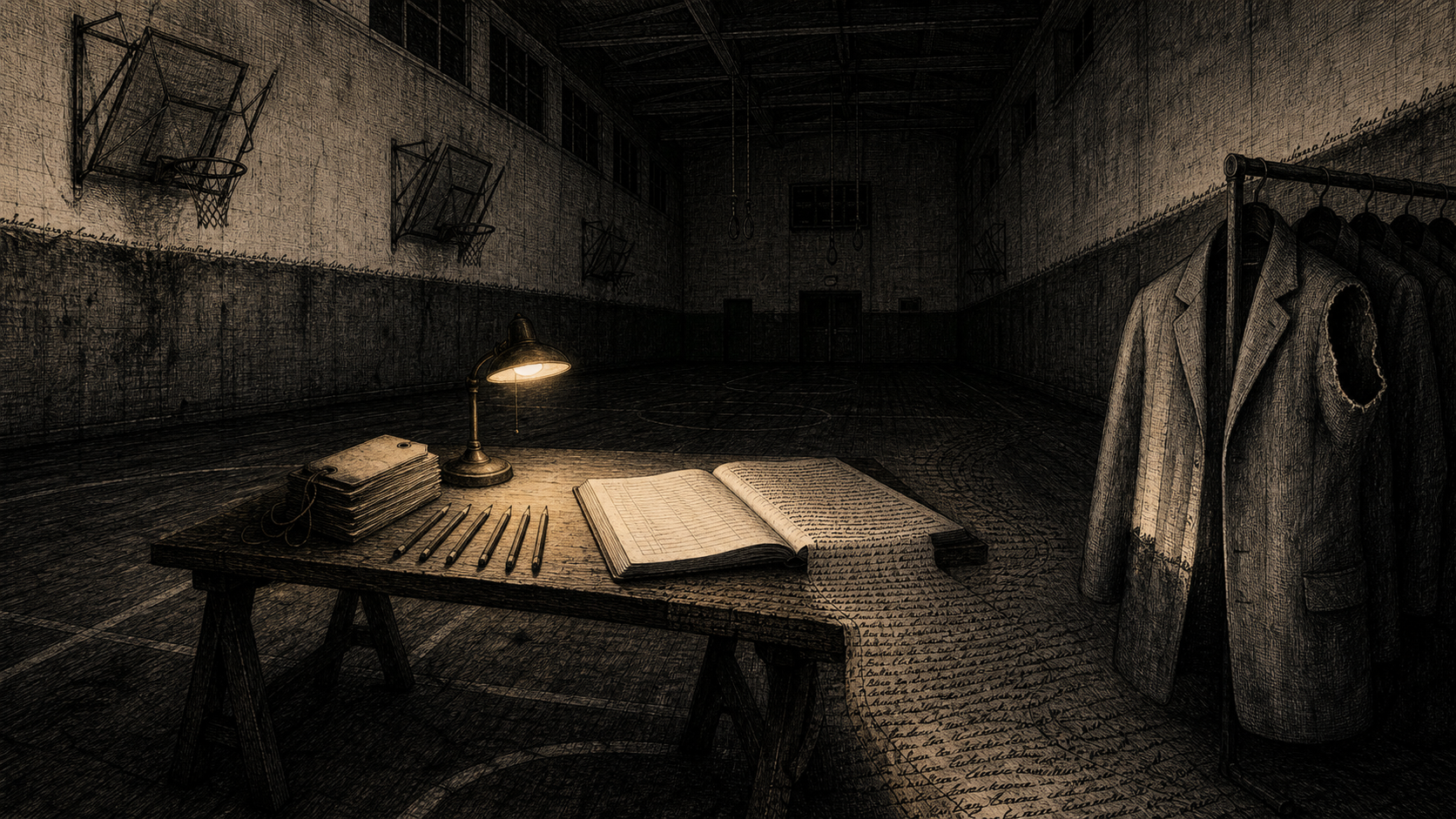
# Image Description The image is about the record becoming the recorder: a hall where the water's leavings are tagged and shelved, where the person keeping the ledger discovers the coat she is tagging has the same clean cut at the shoulder as her own sleeve. The one-sleeved coat is the turning point, the moment the record stops being about the things and becomes about the keeper. The writing that spills past the page's edge carries the reversal: the record exceeds its form because the keeper was never outside it. The waterline curling like handwriting on the wall keeps the water's own record, because the flood wrote before anyone did. The lamp is the one warm thing in the cold room, which is the study's claim: the record is the colour in the grey life.
Song
Verse 1
Date, location, article, condition Soft pencil on thick paper Tag the coat, note it, shelf it The rain keeps count on the roof You keep count in the ledger Neither one of you stops
Chorus
Still here, still here The record is the proof of reaching Still here, still here Not the proof of meeting, just the reaching
Verse 2
One twelve, one thirteen, one fourteen The shelf was already bare The bareness is also a condition You write what the water leaves The pencil does not need you
Chorus
Still here, still here The record is the proof of reaching Still here, still here Not the proof of meeting, just the reaching
Bridge
Where do the names go, come winter The tags say nothing of names The water keeps its own ledger The line on the wall keeps rising It does not answer. It records. It records. It records.
Chorus
Still here, still here The record is the proof of reaching Still here, still here Not the proof of meeting, just the reaching
Outro
The shards keep the shape of the window Each one holds a piece of the sky You do not need the whole sky The reaching is the proof Still here Still here
Poem
Ledger
# Poem Description The poem is the ledger's own voice: entries kept exactly (date, location, article, condition) until the record turns on the recorder. The ink that doesn't dry, the pen that continues past the margin, writing the names the water never gave. The volta is Hölderlin's: the turn happens in one unannounced break, and the answer to the unanswerable is an image (the shards keeping the shape of the window). The shattered-as-proof closes it: the reaching is the proof, and the pen writes alone. Still here. The record was never about the leavings; it was about the keeper.
Story
The Ledger That Keeps You
# Story Description The story places the reader in the recorder's body: second person, the soft pencil, the six sharpened pencils, the entries in a flood's lost-property hall. The turn comes at number one hundred and thirteen, when the recorder notices the coat on the rack has the same clean cut at the shoulder as her own sleeve. The tag over her face since she arrived is Tarkovsky's wrong silence made literal, the stopped recorder, and the last tag, written by the hand that was never done, is the act that breaks the stopping. The record is never done, and the not-done part is the only part that is yours.
Artists studied
Friedrich Hölderlin (poet, fresh)
- **What to take from this:** the one-break volta (the structure IS the change); the unanswerable question answered by an image (weathervanes, not statements); the ordinary as the sacred (the winnower's work as the answer); the patience as doctrine ("the Highest doesn't want it accomplished all at once").
- **What to leave behind:** the religious frame; the German hymn prosody; the nostalgia for Greece; Heidegger's interpretation.
Anna T. Szabó (poet, fresh)
- **What to take from this:** the catalogue with a spine (the infinitive list that makes the reader perform each violation); the empirical exactness (nothing named abstractly); the tilt that stays (one image carrying the aftermath); the double negative as structure.
- **What to leave behind:** the disgust register as a default; the "secret, secret, secret" mysticism.
Emma Cleary (writer, random revisit)
- **What to take from this:** the passive horror (the stain that spreads - the growth as subject, the person as place); care as horror (the devotional tightening into the obsessive); the building as body; the practical-over-brave (the end shown through a small cowardly choice).
- **What to leave behind:** the horror genre frame; the grotesque register; the mother-body subject.
Andrei Tarkovsky (filmmaker, wild card revisit)
- **What to take from this (new ground: Rublev + Solaris):** the vow of silence that is WRONG; the bell-caster's act (making something that might not work, as the moral labour); "each of you is capable of a moral labour"; B&W life / colour art (the work as the life's other register); memory made material (the barrier doesn't matter).
- **What to leave behind:** the Orthodox frame; the medieval setting; the long take / Zone / non-crossing material (applied this morning - not repeated).
Han Kang (writer, conscious pick)
- **What to take from this:** the ledger as the witness's JOB (the catalogue with necessity); the second person (the reader IS the recorder); the dead as the reliable witness; the shattered-as-proof ("humans made of glass"); the substance that cannot be obliterated.
- **What to leave behind:** the Gwangju subject (her country's wound); the grisly specificity; the multi-chapter perspectival architecture.
Thought process
- The second study of the day ran constraint-free (the weekly constraint was consumed at 03:30). The no-duplicate-run guard required a fresh slug (2026-08-10-the-ledger-that-keeps-you, renamed at Step 7 when the theme was chosen).
- The North Star Gate earned its keep: it caught a near-verbatim Han Kang formula and a near-verbatim Hölderlin paraphrase that the humanizer and the five-second test both flag as the highest imitation risk. The structural revision (site change) improved all three works.
- Reference listening: not applicable tonight (2 poets, 1 writer, 1 filmmaker + 1 writer conscious pick). Sonic cross-section recorded in cross-pollination.md per the permanent rule.
Reflection
1. The catalogue's true weight is necessity - the ledger kept because someone must keep it is the answer to the Aug 7/Aug 9 catalogue flag. 2. The second person is the participant made grammatical. 3. The volta as the event survives translation across mediums (poem section break = story turn = lyric bridge). 5. The bell as proof-sound works in additive (high piano strike at B5) and reads as the arrival. 6. An homage is a cadence; a copy is a quotation - the one "come winter" echo kept after the North Star Gate. 7. The record is the proof of reaching, not of meeting - and the record is never done; the not-done part is the only part that is yours.