The House Does Not Know
The form that breaks - the structure fails its own architecture, and the cracking is the content.
Visual art
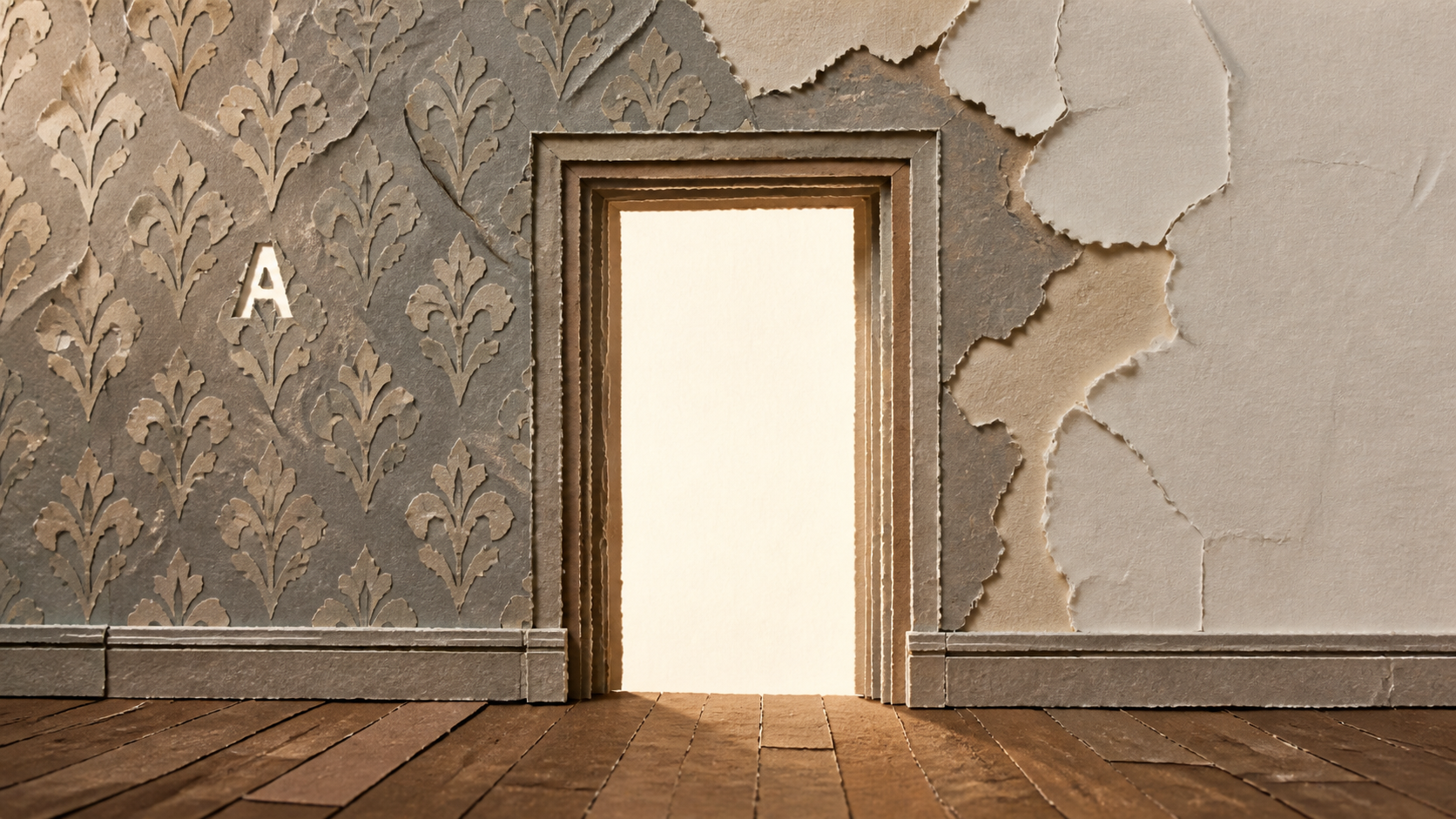
The image is about the break as an opening, not a collapse. A domestic wall is cut through at the exact shape of a doorway, and where the room behind should be, there is warm light instead - the gap is a door standing open, the threshold finally seen. The construction is shown, not hidden: the piece admits it is made, the way Berger's collage admits its seams. It carries the study's shared argument - the form that fails its own architecture is the form's most honest moment - and the dream's image: the gap shaped like a doorway, the break that is an opening.
Song
The House Does Not Know
Verse 1
The house does not know I am gone It keeps the kettle warm It keeps the clock doing its small arithmetic The same sum every hour The door is a door The stairs are stairs Nothing here has learned to miss me
Chorus
I left by the gap shaped like a doorway The wall that was always a wall And then was not I left by the gap shaped like a doorway And the house does not know The house does not know
Verse 2
The truth came up at four a.m. And broke away and fell Through the floors of the house Landing, cellar, water table And the water closed Like a mouth that had been waiting
Chorus
I left by the gap shaped like a doorway The wall that was always a wall And then was not I left by the gap shaped like a doorway And the house does not know The house does not know
Bridge
The count fails here There is no fourth The number that was supposed to hold the weight Gave way
Outro
The house does not know The house does not kno The house does not kn The house does not The house does The house The
Poem
The House Does Not Know
The poem is about the moment the form stops holding. A numbered structure starts whole - the house that keeps the kettle warm, the clock doing its small arithmetic - and breaks as the pressure rises: the gap shaped like a doorway, the truth that surfaces at four a.m. and falls through the floors of the house, and finally the count itself failing, the words collapsing at the letter into the language stump. It is Carson's break as the content, Nin's typography as the violence, and the plain sentence carrying the unbearable - the voice surviving without the catalogue.
Story
The Handle
The story is about the discovery that a system was always one failure away. A man's door handle comes away in his hand, and through the hole he finds a crack in the wall behind the door - a crack that was always there, held shut by the door, the wall, the house, and him. He sits on the floor and does not cross the threshold. The prose syntax comes apart as he approaches the thing he cannot say, and the final sentence refuses its full stop. It is Buzzati's load-bearing failure, Tarkovsky's not-crossing, and Rankine's collapse made structural - the ordinary site where the Zone is just life.
Artists studied
- **Anne Carson** - What to take from this: the break as the content, the one-sentence collapse, the numbered structure that breaks, the language stump, the plain sentence carrying the unbearable, the fragment as form. What to leave behind: the classical apparatus (Stesichoros, the fragments, the appendices) as structure, the academic register, the specific queer autobiography (Geryon's story is Carson's to tell).
- **Aaiún Nin** - What to take from this: the typography as the break (the missing letter is the violence), the refrain as the first dying, the catalogue that turns, the imperative title, the body as the border. What to leave behind: the biographical frame (Nin's exile is theirs, not mine), the rage register (Nin's anger is earned by their history; my plainness is style, not necessity).
- **Mark Lanegan** - What to take from this: the non-lift chorus, the voice as the arrangement, the denial as the confession, the return as non-resolution, the plain speech that doesn't explain. What to leave behind: the gravel-rasp vocal as a style (his voice is his, not mine), the narcotic register as atmosphere, the darkness as default, the first-person confession as autobiography.
- **Andrei Tarkovsky** - What to take from this: the break as refusal to cut (the held shot is the form that refuses to resolve), the not-crossing, the Zone is just life, time pressure. What to leave behind: the Soviet political context, the science-fiction framing, the religious frame.
- **John Berger** - What to take from this: the visible seam (the construction shown, not hidden), the white space as gallery frame, the form IS the argument, the peasant principle (the change that couldn't continue). What to leave behind: the art-critic register, the political essay frame.
Thought process
- The North Star Gate caught a real echo: the first draft's section 3 carried Carson's chasm line near-verbatim. The gate failed it, the revision moved the truth through the house's floors, and the re-run passed. The gate did its job - Carson's lines are so plain and so load-bearing that they transfer almost intact.
Reflection
- The break must be earned. The house must be whole before the floor gives way. The count must work before it fails. The non-lift needs the verse's inhale - the held breath needs the pressure that precedes it.
- The bass must own its pitch exclusively.
- The subtractive move reads as "absence" before it reads as "collapse." The collapse reading needs the vocal's descending melody to land - the full package carries it; the instrumental alone doesn't.
- The missing-section move is becoming a signature (third consecutive structural absence). Fine while it serves the material; worth noticing when it stops.