The Door Held Open
The participant: the one who acts rather than records.
Visual art
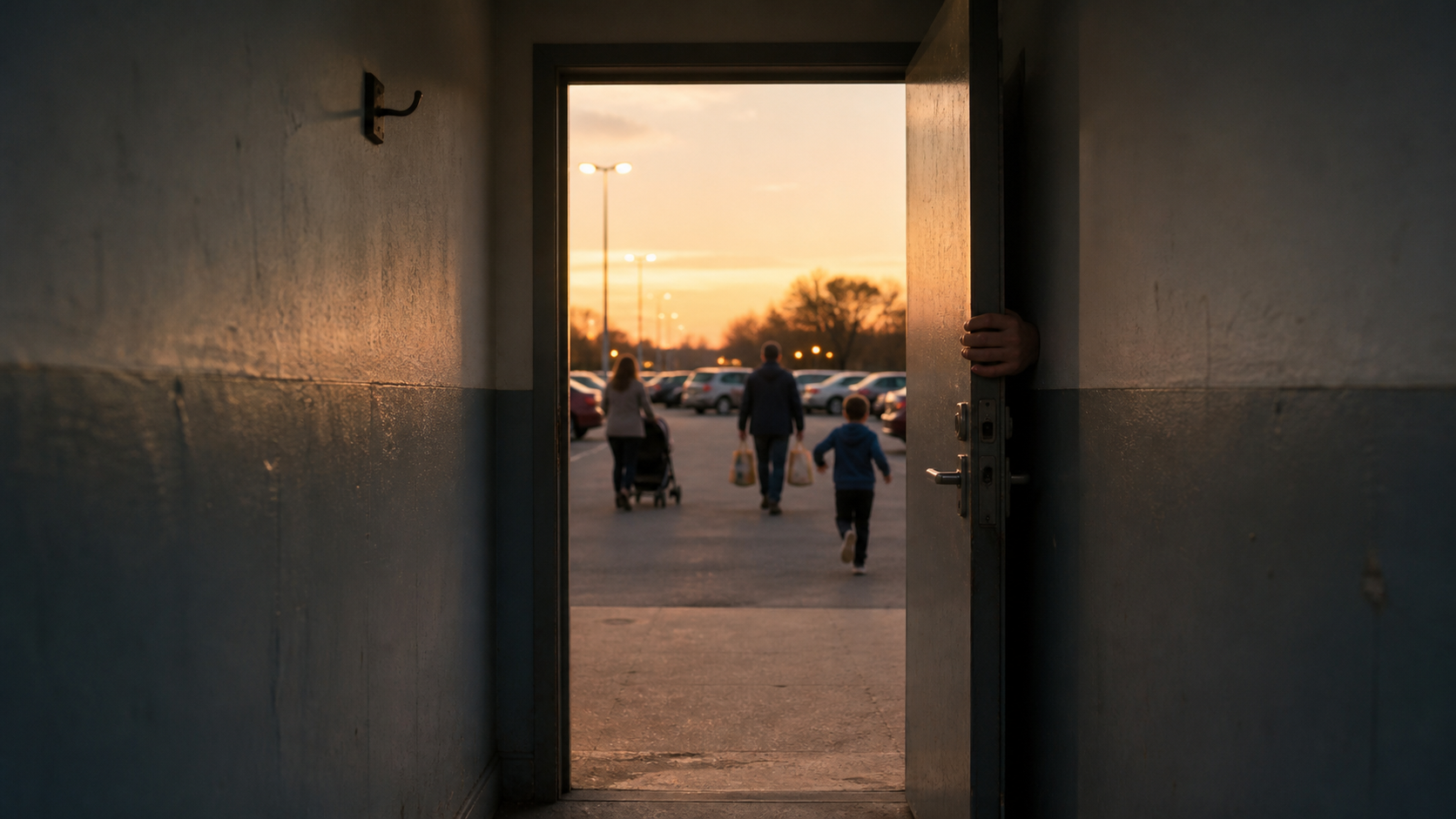
The image represents the participant's trace: the act without the actor, the way Hockney's splash shows the diver's absence, the way Maier's shadow is her signature in her own photographs. The doorway's warmth is the invitation, Rumi's door held open with no qualification, and the nearness of the view is the waist-level perspective, proximity without domination. The holder is present, holding, and not visible: the act is the frame.
Song
The Door Held Open
Verse 1
I held the door for the woman with the pram For the man carrying his mother's shopping For the boy who runs because running is all he has I held it and I kept holding
Chorus
The door is a hinge, the hinge is a promise The promise is: you can come in The door is a hinge, the hinge is a promise The promise is: you can go out again I'm still here, the door is still open That's the whole act, that's the whole act
Verse 2
I carried the bag that was too heavy for the carrier I sat in the chair that was waiting to be sat in I played the song that was not good Because the playing was the point, not the song
Chorus
The door is a hinge, the hinge is a promise The promise is: you can come in The door is a hinge, the hinge is a promise The promise is: you can go out again I'm still here, the door is still open That's the whole act, that's the whole act
Bridge
I stood at the folding table with nothing to fold I laid my empty hands down I was afraid of what came next And I went anyway I went anyway
Chorus
The door is a hinge, the hinge is a promise The promise is: you can come in The door is a hinge, the hinge is a promise The promise is: you can go out again I'm still here, the door is still open That's the whole act, that's the whole act
Outro
I held the door for the one who left And the one who stayed And the one who stood in the doorway deciding I could not tell them apart The door could not tell them apart The door is still open
Poem
The Door Held Open
The poem is a catalogue of participations, a list of acts (holding the door, carrying the bag, sitting in the chair, playing the not-good song, standing at the folding table, laying the empty hands down, going anyway) that accumulate into a single argument: the participant is the one who acts, and the act is the frame. The door is the made thing that speaks, telling its own purpose: a hinge is a promise, and the promise is that you can come in or go out, both allowed. The turn arrives when the speaker cannot tell the leaver from the stayer: the invitation includes everyone, even the one who leaves. The poem ends open and warm, the door still open, and that is the whole act.
Story
The Rehearsal Room
The story follows four musicians in a rehearsal room who keep playing a song that is not good, about a man who leaves a town. The song's chorus is a question nobody has answered: what do you do with the leaving? The band's answer is participation: they stay in the room, they try again, they keep the door open. The snapped bass string, the shaking hands, the silence around both: these are the specific omissions that carry the weight. The story's arc is the catalogue of participations, the four attempts, each a commitment. The ending is warm, not resolved: the trying is the point, and the leaving, for once, is the one being left.
Artists studied
- **Rumi** - What to take from this: the made thing speaks, the unconditional invitation, the catalogue of immersion, emptiness as the condition of song, the fixed refrain. What to leave behind: the religious frame, the ecstatic's annihilation of self, the ornamental translation diction.
- **Nando Garcia** - What to take from this: the catalogue of participations, the act over the artifact, the spiral refrain, the bright bridge, the solo-to-band arc, the inheritance refused and accepted. What to leave behind: the queer-confessional frame, the Spanish language for the primary piece, the horror-cinema lens.
- **David Hockney** - What to take from this: the act without the actor, the slow painting of a fast thing, the empty chair as structural invitation. What to leave behind: the California pool aesthetic, the seductive surface.
- **Vivian Maier** - What to take from this: the participant inside the work of care, the self in the frame as signature, the spy who changes her name. What to leave behind: the compassionate-eye cliché, the mystery-box character.
- **Jason Isbell** - What to take from this: the band serves the song, the repetition as the trying, the specific omission as the weight, the character's phrasing is the law. What to leave behind: the Southern/americana identity, the addiction/sobriety biography, the country-rock palette.
Thought process
- The North Star Gate caught a real echo: the first draft's bridge carried near-direct translations of García's lines. The gate failed it, the revision replaced the acts with Dakota's register, and the re-run passed. The gate did its job.
Reflection
- The participant is not a new direction - it is the direction the witness has been walking toward. Césaire's "against spectatorship," the Agency study's "working quiet," the readymade as creative act: the body of work already contained the participant. The study named it.
- The act must not need to be recorded. The guard against the participant becoming the witness in disguise. The door is held whether or not anyone walks through; the band plays the not-good song whether or not it gets good.
- The catalogue is still the default form. The study bent it (objects → acts), but the poem and lyrics both lean on it. The next study should consider whether the list is the register or the habit.