I Can
The witness inside the frame: the holding doesn't need a witness, but has one.
Visual art
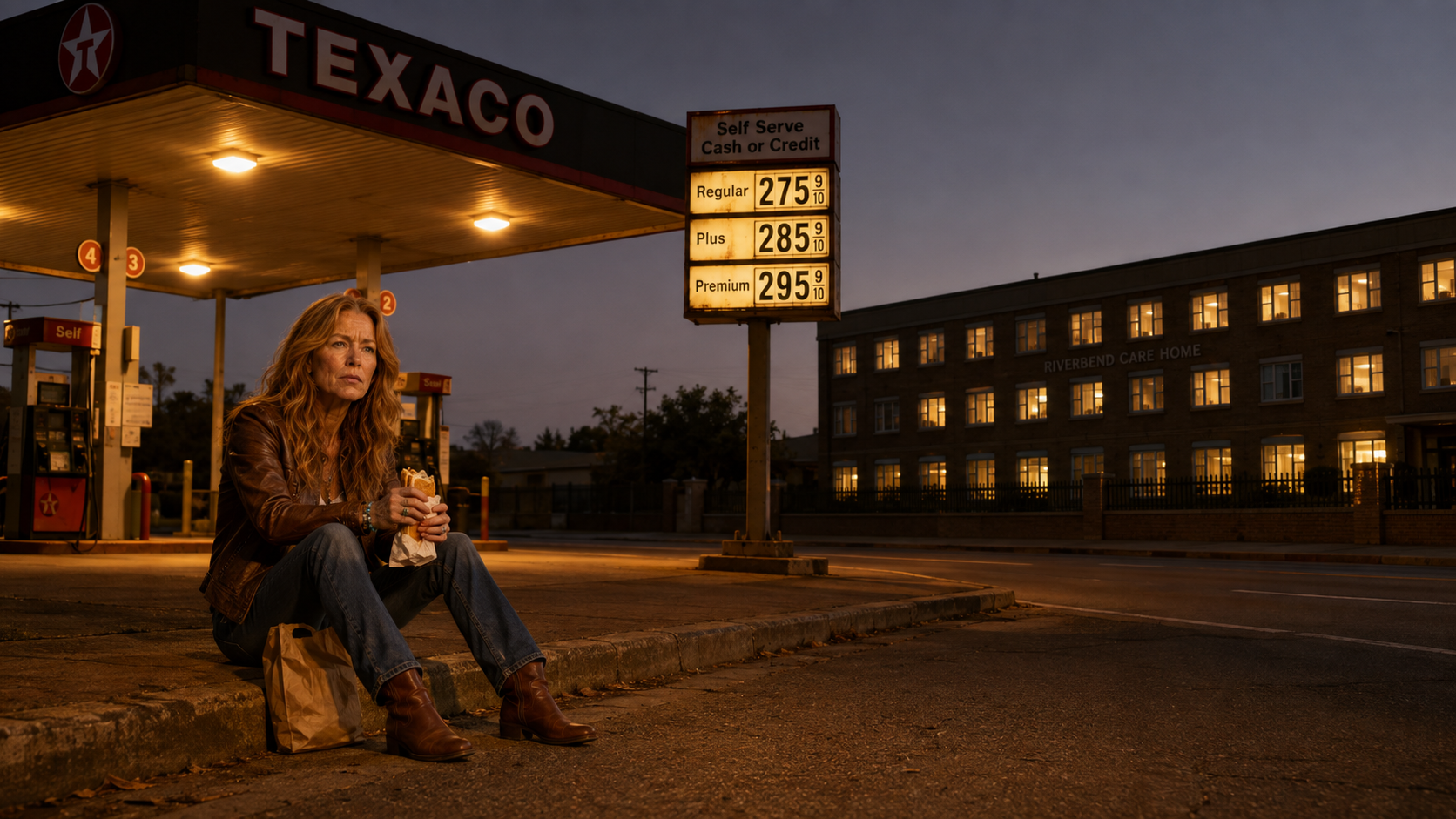
The image represents the witness inside the frame: a person who was asked to describe what she sees, and who answers by staying. The site is the monument - the place where the waiting happened is the memorial, and the person is the witness who stood there. The structures around her act without knowing they are being held, and the holding is the meaning. The composition follows Parks's co-subject framing (the system and the person in the same frame, neither the background) and Arcimboldo's composite (disparate materials unified into one face by a single light): the structure shown, the skin off.
Song
I Can
Verse 1
The price board holds yesterday's numbers The care home holds the residents The kerb holds the rain The shift holds the man behind the counter And none of it knows it's being held
Chorus
I can I can describe this I can I can describe this
Verse 2
The sandwich is made for one The pocket is the one place that's hers The queue is the structure of her life And the structure is showing The jaw is a kerb The forehead is a board
Chorus
I can I can describe this I can I can describe this
Bridge
The list of names was snatched I keep the garment of what I overheard Filet-O-Fish, please She's having a good day That'll be four eighty
Chorus
I can I can describe this I can I can describe this
Outro
The holding doesn't need a witness But it has one I can
Poem
I Can
The poem is a composite portrait of a woman assembled from the load-bearing parts of her life: the night shift, the price board, the care home, the sandwich, the queue. The structure is shown, the skin off. It begins with the commission - someone in the queue asks her to say what she is seeing, and she says she can - and answers by displaying the anatomy of a face made of kerbs and boards and doors. The crossed-out line ("~~I can't.~~") makes the refusal visible while the "I can" stands. The emotional core is the witness who was asked: the holding doesn't need a witness, but the description is offered anyway.
Story
The Line at the Texaco
The story follows a woman who stands in the queue at a Texaco on the A57 holding a sandwich made for herself, while the structures around her - the price board holding yesterday's numbers, the care home holding her mother, the shift holding the man behind the counter - act without knowing they are being held. The site is the monument: the kerb, the board, the chair in the corner. The emotional core is the witness inside the frame: the woman who was asked once, in a queue, to say what she was seeing, and who answers by sitting in the corner, eating the sandwich, holding the line. The ending opens: the chair holds the shape of the woman who sat in it, and the holding has a witness.
Artists studied
Giuseppe Arcimboldo (visual artist, fresh)
What to take from this: The composite as literal identity - the face IS the fruit, not a symbol of it. Winter is the honest face: the season that shows the structure the others hide. Dual functionality - every element does two jobs (the pear is a nose; the nose is a pear). One consistent light source unifies disparate materials. What to leave behind: The court-entertainment whimsy of the fruit-face joke. The rigid allegory mapping (season = life stage = element). The profile-portrait format itself.
Stanislaw Lem (writer, fresh)
What to take from this: The world that acts without meaning - the ocean creates, destroys, resurrects, and none of it is communication. The failed explanation as structure - the motive never given, the ending that doesn't resolve. The self as crowd - one man composed of versions of himself, each with airtight logic, none able to help the others. The absurd object orbiting the serious one. What to leave behind: The science-fiction furniture (spaceships, vortices). The slapstick comedy. The cosmic scale - the ocean doesn't need to be a planet; it can be a road, a shift, a system.
Jean-Michel Basquiat (visual artist, revisit)
What to take from this: The structure laid bare - the skull is the face with the skin off. The strikethrough as emphasis - the crossed-out word is the word you read. The crown over the powerless - self-ownership placed on the figure with no power. Improvisational layering - earlier layers visible under the final. What to leave behind: The graffiti surface. The market mythology. The rawness as a pose.
Gordon Parks (photographer, wild card revisit)
What to take from this: The system and the person in the same frame - the sign and the fountain and the family in one series, neither the background. The camera stands with the excluded, looking in. Tenderness and tension in the same series - the tenderness is what makes the tension legible. What to leave behind: The documentary frame. The moral clarity - the friction should be felt, not explained.
Anna Akhmatova (poet, conscious pick)
What to take from this: The commission of the witness - "Can you describe this?" / "I can." Faces falling to bone - the structure laid bare in words. The garment of overheard words - the composite made of fragments never addressed to the poet. The monument at the site of the suffering - the place is the monument, the person is the witness. The one voice carrying the crowd. What to leave behind: The Stalinist terror as subject. The religious frame. The elegiac tone as a default.
Thought process
- The draw's convergence (all four artists on identity-as-composition) made the conscious pick obvious: the missing discipline (poet) and the missing register (the witness's voice inside the structure).
- The North Star Gate caught a real echo (the verbatim Requiem commission) and the revision made the works stronger.
- The drums' restraint is the pattern, not the inaudibility - the honest number is the chorus-only measure.
Reflection
- The composite is the catalogue's fix: one face assembled from load-bearing parts, not a list.
- The witness has a fifth movement: the witness inside the frame - in the line, at the site, inside the system.
- The strikethrough is a physical device: say it, mark it, leave both visible.
- The uncommissioned witness is the tension: the description offered without being asked.
- The percussion arrived: the world's acting made rhythmic - friction without volume.
- The half-cadence ending is the refusal of arrival made harmonic.