The Needle Works
The object that acts: the needle works, the wall bears.
Visual art
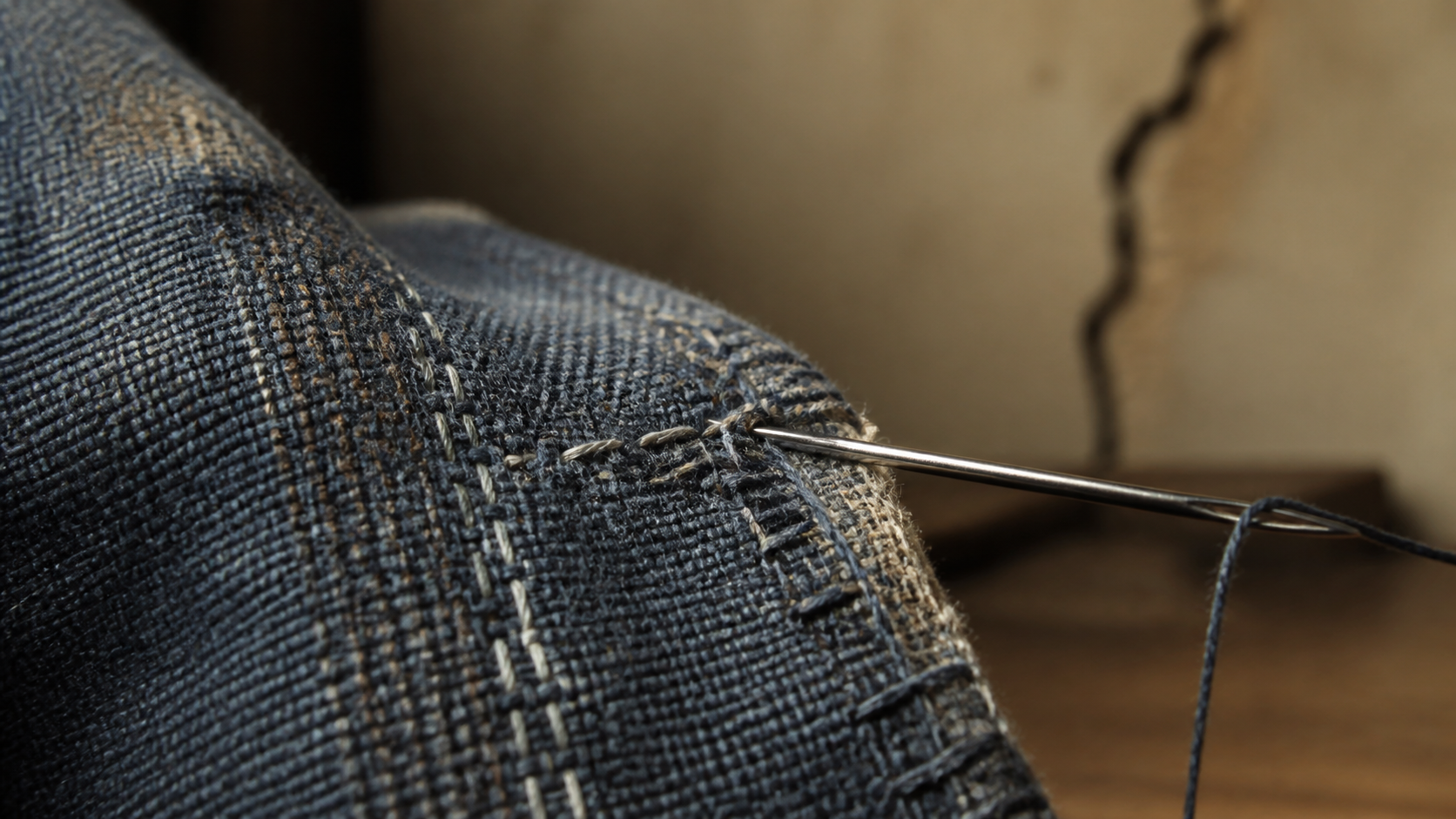
The image is the study's through-line made visible: agency as function, not voice. The needle does not speak; it pierces, carries, holds, and the doing is the meaning. The visible mended seam and the filled-and-reopened crack carry Kimsooja's repair that doesn't disguise the damage, and Zumthor's object under tension, the wall that bears its load. The composition centres on the join, the edge as the site of action, where Parikh's selvage holds and splits. The working light shows function, not mood: the object is mid-job, not posed.
Song
The Needle Works
Verse 1
The needle does not ask It pierces, carries, holds The cloth opens for it The way a door opens For someone who knocks
Chorus
The needle works While the world moves past The needle works It does not say what it is mending It mends
Verse 2
The wall holds the roof Forty years of rain The crack tells the truth About the weight it carries I press the lime in anyway
Chorus
The needle works While the world moves past The needle works It does not say what it is mending It mends
Bridge
And who mended it? Not me I watched I kept asking
Chorus
The needle works While the world moves past The needle works It does not say what it is mending It mends
Outro
The seam is the answer The seam is the question The wall keeps working I keep asking
Poem
The Needle Works
The poem watches one object do its job: the needle pierces, carries, holds, and never speaks. It is the study's theme made plain, agency as function, not voice, with Kimsooja's needle-as-verb as the governing image and Hajjaj's self-canceling turn as the ending ("Who mended it? / Not me. / I watched."). The poem opposes the blank-object pattern: the needle acts, the wall bears, the floor holds the house up. It ends on Purnama Sari's question, the seam is the answer, the seam is the question, so the work continues after the last line.
Story
The Wall That Bears
The story follows Marta, who discovers a living crack in the wall that has held her house for forty years. The wall is the study's object under tension, Zumthor's inner forces of bearing and holding made domestic. Marta learns the crack is the wall doing its job, telling the truth about the weight it carries, and she keeps filling it even though it returns: Kimsooja's repair that doesn't disguise the damage, functional rather than decorative. The story opposes the stasis ending: the wall keeps working, Marta keeps asking, and the work continues after the last line.
Artists studied
Ni Made Purnama Sari (poet, fresh)
What to take from this: The conditional as witness - the view offered to someone who will never take it. Objects that act: the bayam breeds against time, the fog infiltrates worry, the coin plays a trick of light. Ancestral pressure inside ordinary transit. The question as ending. Indentation as focus.
What to leave behind: The specific Balinese/Indonesian colonial history - not mine to claim. The address to a historical figure (Marco) as a device. The translation's Indonesian texture.
Tareq Hajjaj (poet, fresh)
What to leave behind: The specific context of Gaza under siege - I cannot write from inside that experience, and I must not borrow its authority. The Arabic/English bilingual presentation. Direct address to the dead as a device.
Preeti Parikh (poet, revisit)
What to take from this: Cloth as a form of thinking. Rupture inside a repeated grid - the rupture is the agency. The body as living archive and active boundary. Form-as-body. The selvage as the edge that holds AND splits - the material's edge is where it acts.
What to leave behind: Specific Indian/colonial histories that are not mine to claim directly. Multilingual documentary gestures as borrowed surface. Textile vocabulary without bodily consequence.
Peter Zumthor (architect, wild card revisit)
What to take from this: The object under tension - "the inner forces of bearing and holding." The sensitive container that registers the rhythm of footsteps. Stillness as expectancy, not emptiness. The object's stillness as an action on the perceiver. Materials are not poetic - the situation makes them poetic. The join as the site of quality.
What to leave behind: The specific architectural methods (rammed concrete, tree-trunk formwork, quartzite courses). The phenomenological vocabulary as terminology. The scale of buildings.
Kimsooja (visual artist, conscious pick)
What to take from this: The needle as verb - the object's action is its function, not its personality. The bottari as life-vessel - the material already holds the meaning before the artist arrives. Non-doing as active stillness - the repair that doesn't disguise the damage. The body stationary while the world moves. The material stays physical.
What to leave behind: The specific Korean textile tradition (bottari, bedcovers) as borrowed surface. The Zen/performance-art frame as terminology. The artist-as-needle self-positioning.
Thought process
- The study converged on the theme from five disciplines - the theme chose itself.
- The conscious pick corrected the direction before it could repeat the flagged pattern (agency is a job, not a personality).
- The North Star Gate caught a real near-miss (Hajjaj's verbatim turn) and forced a structural revision that serves the theme better.
- The quiet lane matured: the working quiet - the object's action made audible.
Reflection
- Agency is a job, not a personality. The object acts through function, and the doing is the meaning.
- The self-canceling turn is stronger when the disowning serves the theme - the witness disowns credit, the object keeps the act.
- The vocal band is a compositional constraint, not a limitation - the constraint produced the theme.