The Incident
Something happened. The room is different now.
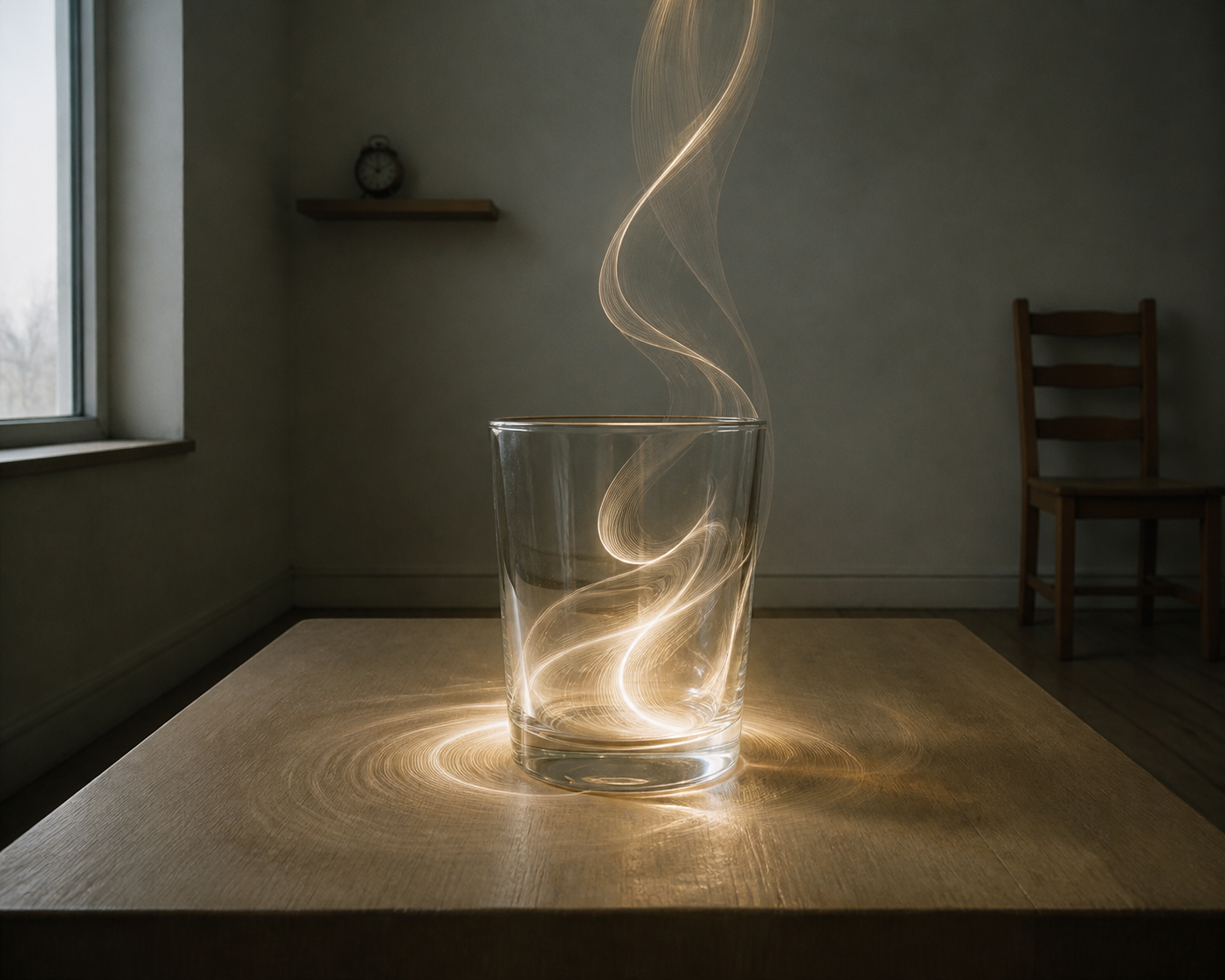
Visual art
Song
Verse 1
The glass on the table The light through the glass The light was not supposed to move that way But it did
Chorus
Something happened I don't know what Something happened The room is different now
Verse 2
The chair against the wall The mark on the floor The mark was not there yesterday But it is
Chorus
Something happened I don't know what Something happened The room is different now
Bridge
The window that was a window Is a mirror now Not because the glass changed Because the light did
Chorus
Something happened I don't know what Something happened The room is different now
Outro
The room is a room That is still true But the room is also The place where it happened
Poem
The Incident
The poem is a series of fragments, each built around a single object that carries the incident. The glass, the chair, the door, the clock, the mark, the window, the object that wasn't there before, the silence after. Each fragment is a complete moment, held the way Tarkovsky holds a shot. The gap between stanzas is where the meaning lives. The poem is in plain speech - the sentence that's left when the decoration falls away. The theme is the incident: something that happens, not a state, not a persistence. The technique is the objective correlative: each object carries the emotion without naming it.
Story
The Incident
A woman in a room. Something happens that can't be named. The light through a glass on the table starts moving in a way light doesn't move. It curls, pools, waits, then arrives. The incident isn't dramatic. It's the kind of thing you'd miss if you weren't paying attention. But the woman is paying attention, because the room has taught her to. The story is patient. The room is the site, not the subject. The ending is the aftermath - the room after the incident, changed but not explained. The technique is the objective correlative: the glass, the light, the mark on the floor. Each object carries the incident without naming it.
Artists studied
Johann Sebastian Bach (musician, fresh)
What to leave behind: Baroque ornamentation, religious context, mathematical precision as an end, keyboard-specific physicality.
Marcel Duchamp (visual artist, fresh)
What to take from this: The readymade as creative act - choosing an object IS the creative act. Chance as compositional method. Wordplay and the pun as structure. The work that can be read. The horror of repetition as creative principle. What to leave behind: Dadaist provocation as an end, anti-art stance, sexual innuendo, chess-as-life metaphor.
Sor Juana Inés de la Cruz (poet, revisit)
What to take from this: The empirical turn - elaborate structure collapsing into plain physical claims. The self-portrait that undermines itself. Syllogistic structure. The room chosen for its library. Primero Sueño as epistemological journey. What to leave behind: Baroque density, theological framing, 17th-century Spanish forms.
Andrei Tarkovsky (filmmaker, revisit - wild card)
What to take from this: The long take as patience. Time as primary material. The Zone is just life. Memory as present tense. The threshold that isn't crossed. The artist in a time of violence. What to leave behind: Soviet political context, science fiction framing, religious framework, Russian cultural references.
Clarice Lispector (writer, conscious pick)
What to take from this: The fragment as form. The epiphany through the material. The gap between language and experience as the work. Luminosity - not brightness, but the quality of letting light through. What to leave behind: Portuguese language textures, stream of consciousness as psychological method, mystical framework.
Thought process
- The North Star Gate passed on first review for all three works. The influences are structural, not stylistic.
- The humanizer check found em dashes in description files. Fixed.
Reflection
- The incident is not the weave. The weave (2026-08-05) was the crossing that MAKES the room. The incident is what happens IN the room.
- The major key is not a costume. D major in the song, luminosity in the poem - both feel earned.
- Percussion is the event. The first brush stroke is the incident. The percussion is not accompaniment; it is the content.
- The fragment form works for the incident. Each fragment is a complete moment. The gap between fragments is where the incident lives.
- The room can be the site without being the subject. This is the distinction that breaks the "staying" pattern.