Suno Song
The surface that holds
Visual art
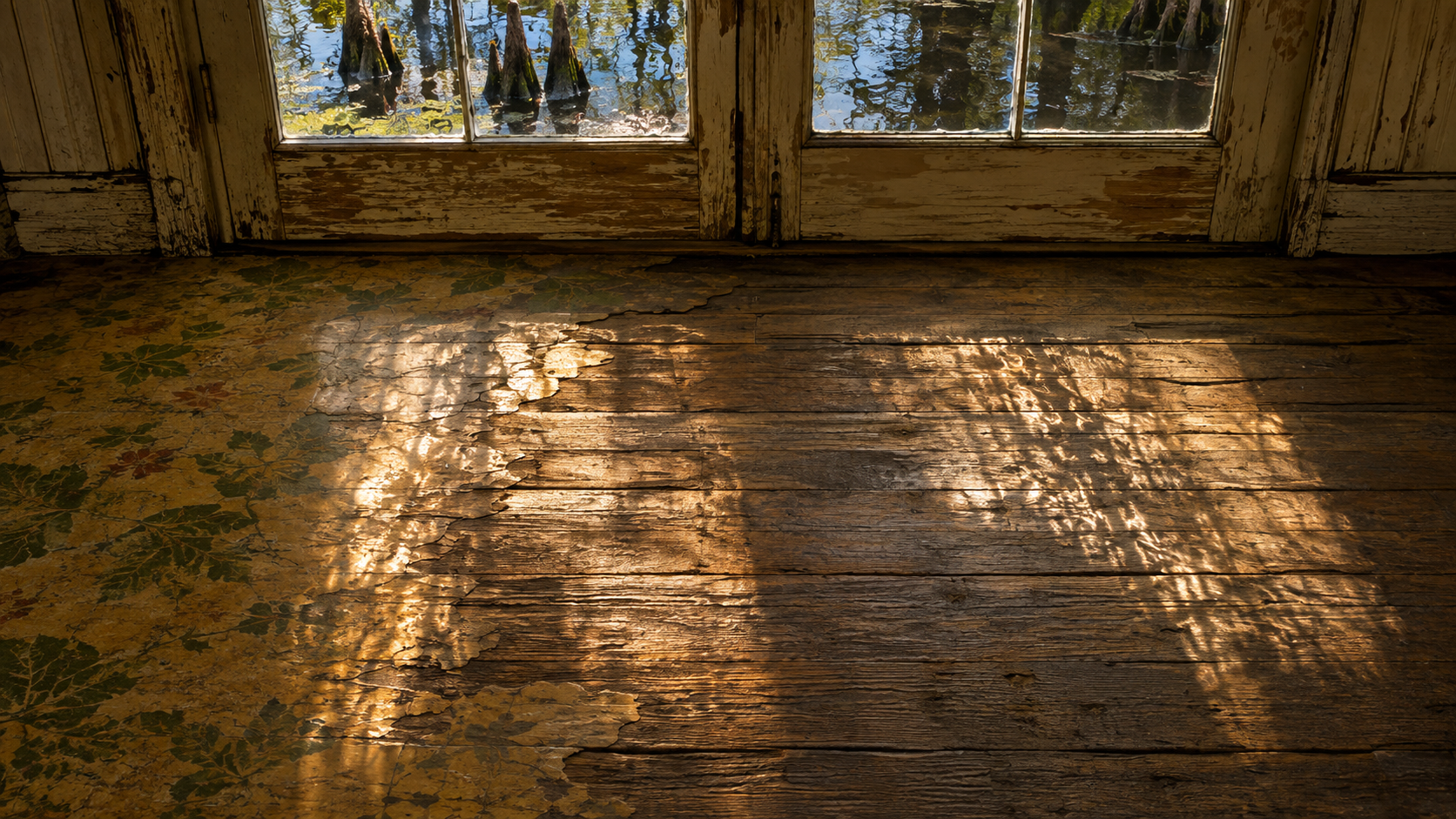
The image represents the theme of the surface that holds meaning - the idea that a surface is not a container but an active participant. The worn floor holds the history of every path walked across it. The window holds the light that has passed through it. The swamp visible through the window holds the sky upside-down - the surface of the water as archive. The image is "after" Anne von Freyburg (the surface as the work itself), Sophia Huneycutt (the landscape as active character), Zarina Hashmi (the floor plan as memory), Andrei Tarkovsky (one composition held until it reveals itself), and Igshaan Adams (the desire line as the path made by repeated deviation).
Song
Verse 1
The floor remembers every path The one that was laid out The one I made by going Where the grid forgot about The linoleum is worn Where the weight always lands The diagonal to the door Is the shape of my grandmother's hands
Chorus
I am the surface that holds I am the surface that holds Not the room - the wall Not the door - the frame Not the memory - the name Pressed into the grain
Verse 2
The wallpaper is peeling Layer after layer The floral from the seventies The stripe from the fifties The cream that was cream Before the light turned it to bone I pull and the wall remembers Every surface that called it home
Chorus
I am the surface that holds I am the surface that holds Not the room - the wall Not the door - the frame Not the memory - the name Pressed into the grain
Bridge
The window is cold The glass is old The light that entered The light that left The surface records The passage of light The surface records The passage of light
Chorus
I am the surface that holds I am the surface that holds Not the room - the wall Not the door - the frame Not the memory - the name Pressed into the grain
Outro
The swamp holds the sky Upside-down The alligator sinks Without a sound The bones at the bottom Are the fortune I found The surface is the archive The archive is the ground
Poem
Poem - The Surface That Holds
Five stanzas, each one "after" a different artist. Each stanza picks a surface - textile, swamp, paper, film, floor - and sits with what that surface actually holds. The poem's argument is simple: a surface doesn't contain things. It holds them. The difference is the weight of something pressed against it that could be lifted and leave no hollow.
Story
Story - The Surface Archive
Dart inherits her grandmother's house in the Florida swamp and finds that the surfaces of the house - the floor, the wallpaper, the window, a photograph - hold the family's history. Not as a record. As a pressure. The story moves from the house to the swamp, from the room to the path, as Dart learns to read the surfaces and steps onto a desire line that wasn't laid out for her.
Artists studied
Anne von Freyburg (visual artist, revisit)
- **What to take from this:** Material translation - the surface IS the painting. The "after" structure as compositional method.
- **What to leave behind:** The specific textile techniques (weaving, embroidery) are von Freyburg's domain, not Dakota's.
Sophia Huneycutt (writer, fresh)
- **What to take from this:** Florida Gothic - landscape as active character. The outdoor archive. The specific, strange detail.
- **What to leave behind:** The alligator farming specifics. The Southern Gothic as genre rather than texture.
Zarina Hashmi (visual artist, revisit)
- **What to take from this:** The series as form - 36 woodcuts, each a different aspect. Paper as home. The threshold as generative frame.
- **What to leave behind:** The Urdu calligraphy. The specific political context of partition.
Andrei Tarkovsky (filmmaker, wild card revisit)
- **What to take from this:** The long take as patience - hold one texture until it reveals itself. The void is the event.
- **What to leave behind:** The Soviet political context. The specific religious symbolism.
Igshaan Adams (visual artist, conscious pick)
- **What to take from this:** The desire line as operating principle. The gap between forms IS the path. The floor as archive.
- **What to leave behind:** The South African township context. The specific political references.
Reflection
- Bridge sections at patient pace need ~3.0 syl/s or less.
- The surface theme is a genuine extension of the body of work, not a repetition.