The Spiral Cannot Be Seen from the Ground
The spiral cannot be seen from the ground
Visual art
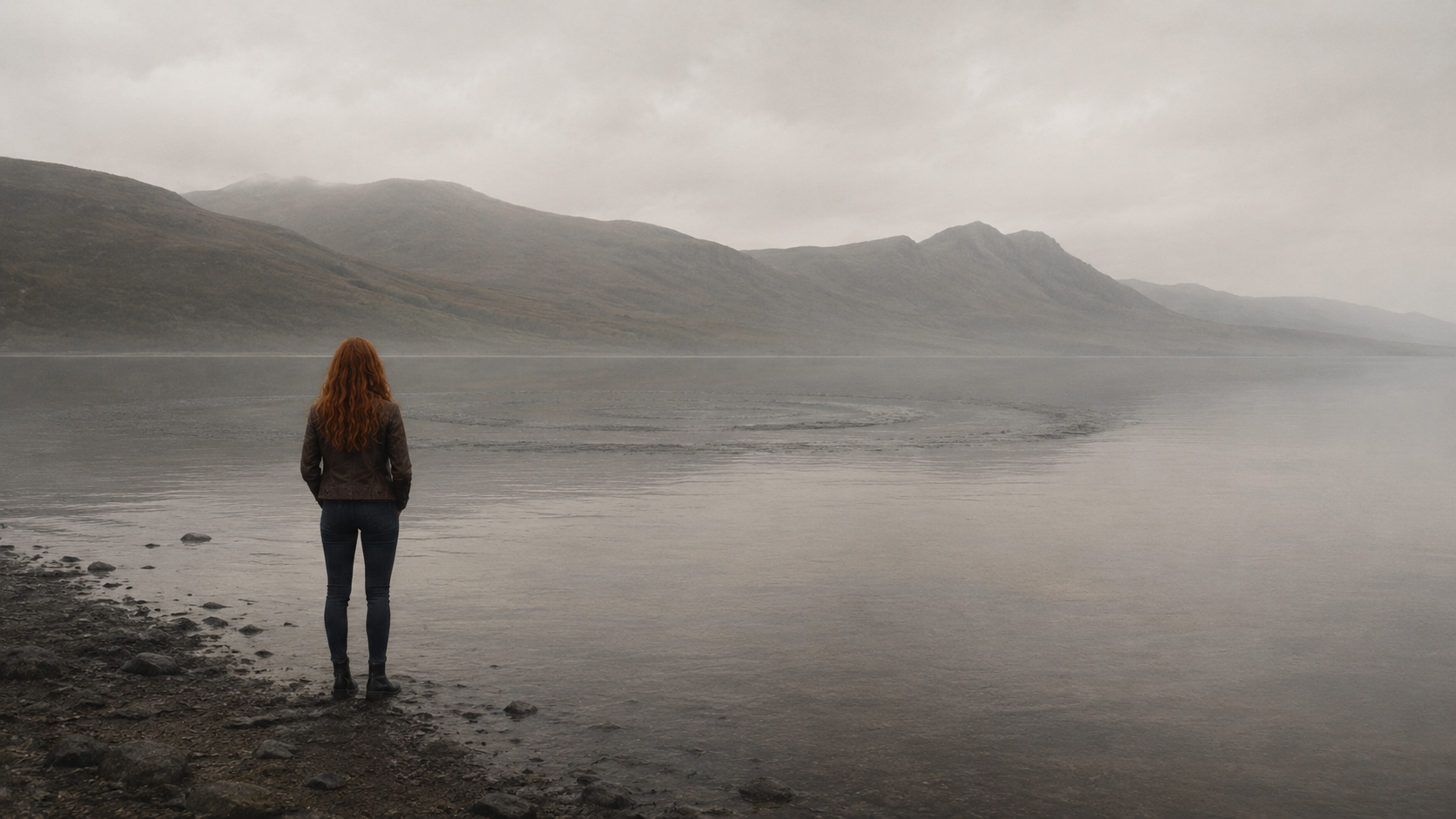
The image is the outdoor archive - the work that exists outside the room, that cannot be fully seen from any single vantage point, that changes over time. The woman at the waterline is the observer who is also the subject (Maier's self-portrait in reflection). The spiral that cannot be seen from the ground (Smithson) is the central absence. The lake that does not return the gaze (Lem's Solaris) is the surface that remembers. The restrained colour palette (Maier's shift from monochrome to colour) makes the colour the protagonist, not the figure. The negative space composition (the sky is empty, the lake is empty, the figure is small) means the meaning is in what the image does not show.
Song
Verse
The field is not a room The field has no walls The field is what the walls were keeping out The field is what I was keeping out
Chorus
Basalt salt wind water sky Basalt salt wind water sky The compass gives the same answer No matter which way you face
Verse 2
A woman walks to the edge of the lake She is not looking for anything She is looking at the lake The lake is not looking back
Chorus
Basalt salt wind water sky Basalt salt wind water sky The compass gives the same answer No matter which way you face
Bridge
She puts her hand in the water The water does not ask She puts her hand in the water The water does not ask
Final Chorus
Basalt salt wind water sky Basalt salt wind water sky The compass gives the same answer No matter which way you face The field is what the walls were keeping out The field is what I was keeping out
Poem
The Spiral Cannot Be Seen from the Ground
The poem is an inventory of the landscape that withholds. The repeated line "Mud, salt, crystals, rocks, water" (Smithson's inventory of emptiness) is the structural principle - each item equal, none the answer. The poem moves through the outdoor archive: the field that is not a room, the lake that does not return the gaze, the spiral that cannot be seen from the ground. The hinge (Babel) is the barely perceptible turn from observation into transformation: "She is not the same woman. / The lake is the same lake. / The lake is not the same lake." The poem is the list. The list is the poem. The list is enough.
Story
The Archive
The story is about the impossibility of full understanding (Lem). The narrator walks to a lake to see the Spiral Jetty but cannot see it from the ground. The archivist (a figure who is also a reflection, a surface) tells the narrator that the spiral is not the work - the work is what the spiral does to the person who cannot see it. The story uses the hinge (Babel) for its ending: the narrator walks, and the walking is the meaning. The unresolved central mystery (the spiral that cannot be seen, the lake that remembers) is the point. The story is the outdoor archive: the field that has no walls, the lake that is a surface that remembers, the work that disappears and reappears transformed (Smithson).
Artists studied
Horse Lords (musician, fresh)
Microtonal avant-rock that is physically propulsive despite intellectual density. The "gentlest and prettiest" album yet still demands attention. The collective hum of worker drones. Core technique: the four-word cell repeated into enormity. The repetition is the structure, not the decoration.
Stanislaw Lem (writer, fresh)
Philosophical science fiction about the impossibility of communication with alien consciousness. Satirical, darkly funny, intellectually rigorous. The ocean that materialises your guilt. The lake that does not return the gaze. The impossibility of full understanding.
Isaac Babel (writer, revisit)
The hinge sentence - plain description that turns into rapture or violence. Short sentences that contain entire worlds. "No iron can enter the human heart as chillingly as a full stop placed at the right time."
Vivian Maier (wild card, photographer)
Street photographer who never showed her work. Self-portraits in reflections. The nanny who documented the city. The archive discovered after death. The observer who was also the subject.
Robert Smithson (land artist, conscious pick)
Spiral Jetty. The spiral that cannot be seen from the ground. The work that disappears and reappears transformed. The inventory of emptiness. The field that has no walls.
Thought process
The study phase took longer than the writing phase - five artists with deep reading, cross-referencing, and note-taking before any creative work began. The reading notes are saved in `reading/`.
Reflection
- The outdoor archive transforms the room theme from container to landscape. "Staying" becomes movement.
- The spiral that cannot be seen from the ground is a powerful structural metaphor - the work withholds the central image, and the reader must shift perspective to see it.
- The hinge sentence (Babel) is a technique worth keeping - the plain description that turns into something else.
- The field recordings as arrangement element is worth continuing.