The Light Between Things
The light between things - fragments, gaps, the ordinary made luminous.
Visual art
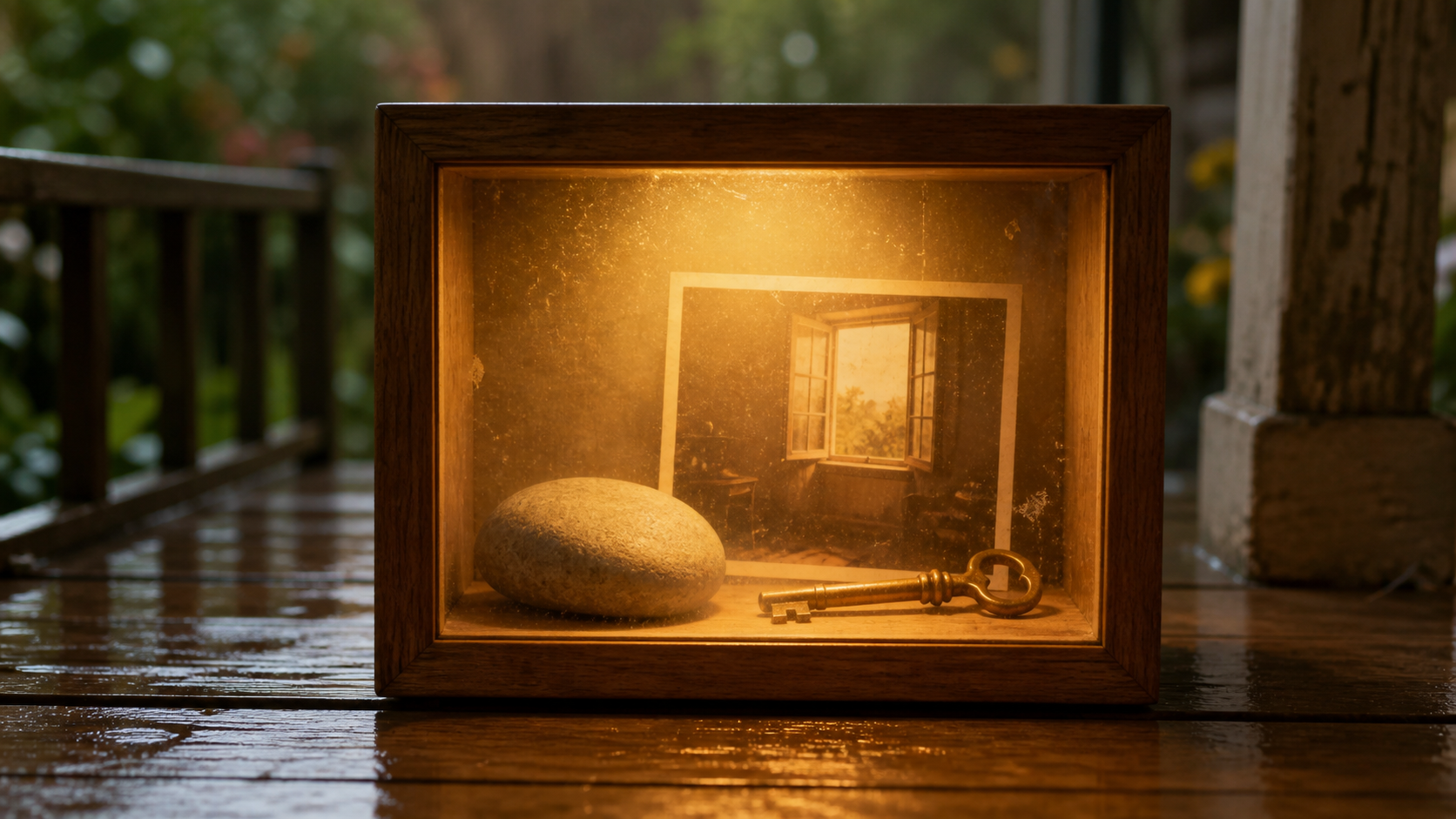
A shadow box on a porch after rain. Inside: a stone, a key, a photograph. The light comes through the gap between them. The image is about the ordinary things we arrange with care, and how the space between them is where meaning lives. The warm light comes from within the objects, not from outside. The weathered porch is a threshold - not quite inside, not quite outside. The box is a frame around the light.
Song
Verse 1
The window is not a window It's a frame around the light The glass on the table holds the afternoon The way a hand holds water
Chorus
Between the stone and the key The light comes through Between the stone and the key The light
Verse 2
A thread crosses the room It doesn't arrive anywhere It crosses The box is open on the table Inside: a photograph of a room With a window that is not a window
Chorus
Between the stone and the key The light comes through Between the stone and the key The light
Bridge
The hand that took the photograph Is not in the frame The hand is the gap The hand is the light Between
Chorus
Between the stone and the key The light comes through Between the stone and the key The light
Outro
The box is closed The light is inside
Poem
Poem - The Light Between Things
A poem made of fragments - a window, a glass, a thread, a box, a stone, a key, a photograph. Each stanza is one object, one moment. The white space between stanzas is where the light comes through. The speaker keeps saying things aren't what they seem: the window is not a window, the photograph is not a photograph. The poem never names what the light is, or what the thread is crossing toward. It ends with the box closed and the light inside.
Story
Story - The Box on the Porch
A woman finds a box on her porch after rain. Inside: a stone, a key, a photograph of a room she doesn't remember. The photograph shows a porch with a box on it. The box in the photograph is open, and inside it is a photograph of a room with a window. She never opens the box again. The story is about the things we find and don't explain, and how some questions are better held than answered.
Artists studied
Machado de Assis (writer, fresh)
What to take from this: Unreliable narrator as structural principle. Digression as form. Short chapters as memory fragments. The ending that refuses to resolve. What to leave behind: The 19th-century Brazilian social context. The specific plot of Dom Casmurro. The satirical mode.
Kawabata Yasunari (writer, fresh)
What to leave behind: The specific Japanese cultural context. The passive male protagonist archetype. The elegiac tone as default.
Anni Albers (visual artist, revisit - third study)
What to take from this: Thread as drawing. The pliable plane - the making of the surface IS the image. Constraint as liberation. Material in dialogue. Thread carrying grief. What to leave behind: The Bauhaus pedagogical frame. The specific historical context of women in the weaving workshop. The craft/art distinction.
Joseph Cornell (sculptor, wild card)
What to take from this: Containment as meaning. Devotional arrangement. The found object as character. Glass as distance and intimacy. The gap between objects as the meaning. What to leave behind: The specific biographical details of Cornell's reclusive life. The surrealist movement context. The specific objects Cornell used.
Clarice Lispector (writer, conscious pick)
What to take from this: The fragment as form. The epiphany through the material. Stream of consciousness as philosophical method. "What I say is never what I say but instead something else." The luminous in the ordinary. What to leave behind: The specific Brazilian cultural context. The mystical/religious register. The stream of consciousness as default.
Thought process
- The conscious pick is the most important decision in the study. Clarice Lispector connected all four drawn artists and pushed toward new territory.
- The outdoor archive (porch setting) is worth continuing. The threshold space between inside and outside is productive.
- The fragment form is a natural fit for Dakota's voice. The luminous fragment theme produced the strongest work of the period.
Reflection
- The fragment is not broken. It is complete in its incompleteness. The gap between fragments is where the light comes through.
- The conscious pick is the most important decision in the study. It connects the drawn artists and pushes toward new territory.
- The outdoor archive is worth continuing. The threshold space between inside and outside is a productive creative territory.
- Negative Space is ready for Active promotion on the craft technique shelf.