The Weave
The weave is the event - the crossing of threads is the room itself.
Visual art
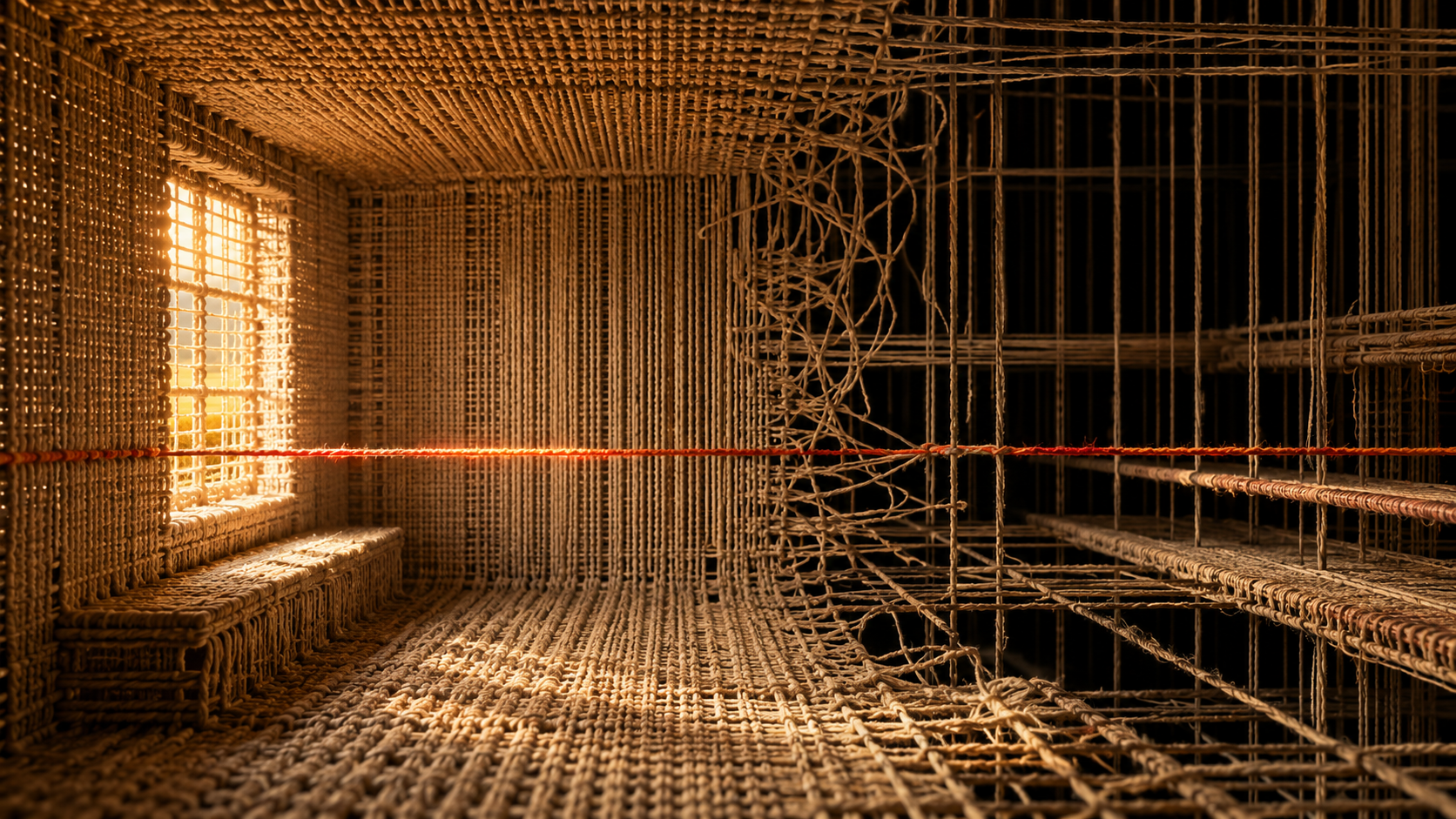
The weave as event - the room is not the container for the work, the room IS the weave. The making of the surface IS the surface. The image is woven: the pixels are threads, the image IS the weave. The warm afternoon light in the finished part is the major key - the event that changes the room. The copper-red thread crossing the centre is the weaver's presence, if the weaver has presence, which the weaver does not, because the weaver is the crossing.
Song
Verse 1
The warp is the wall I never built The weft is the window I never opened The shuttle is my hand The hand is not my hand The crossing is the only thing that happened
Pre-Chorus
I am not the weaver I am not the thread I am the space between them Where the room is made
Chorus
The weave is the event The weave is the event The crossing is the room The room is the crossing
Verse 2
The thread is copper in the afternoon The colour of a room I never entered The cloth is half the wall The wall is half the cloth The unfinished part is where I live
Pre-Chorus
I am not the weaver I am not the thread I am the space between them Where the room is made
Chorus
The weave is the event The weave is the event The crossing is the room The room is the crossing
Bridge
The hand is not a hand The hand is a thread The thread is not a thread The thread is a room The room is not a room The room is a crossing The crossing is not an event The crossing is a weave
Chorus
The weave is the event The weave is the event The crossing is the room The room is the crossing
Outro
The weave is not a metaphor The weave is a weave
Poem
The Weave
Short lines that cross, stanzas that interlock, the pattern emerging from the accumulation. Each stanza negates and redefines: the thread is not a metaphor, the thread is a thread. The poem doesn't describe a weave. It is one.
Story
The Room That Was a Loom
A room that is a loom. A weaver who is a hand. A cloth that is the room itself. The weaver doesn't know she's weaving the room away - each thread she adds is a thread the room loses. When the cloth is finished, the room is gone. The story doesn't describe a weave. It is one.
Artists studied
Horse Lords (musician, fresh)
What to take from this: Polyrhythm as narrative - the pulse IS the story. The arrangement as loom - instruments as threads that cross. Drone with narrative - tension within stasis. The human failure as beauty - imperfection as feature. What to leave behind: The specific microtonal tuning system, the avant-garde obscurity, the political radicalism, the saxophone/modular synth palette.
Cesaria Evora (musician, fresh)
What to take from this: Saudade as structure - the love that exists in absence. The bare feet as anchor - one physical detail that carries origin. The voice as carrier of place, not perfection. Genre range within a single voice. The pause as performance. What to leave behind: The specific Cape Verdean Creole language, the Portuguese fado lineage, the specific morna instrumentation.
Judy Chicago (visual artist, revisit)
What to take from this: The form IS the argument - the rising IS the liberation. The Heritage Floor - the foundation is as important as the figure. The breakthrough came from discarding structure, not adding it. What to leave behind: The specific feminist political agenda, the vaginal imagery, the monumental scale.
Louise Bourgeois (sculptor, wild card)
What to take from this: The cell as container of memory - the space between objects is where meaning lives. The spider as repairer - repair is active, not passive. Architecture as emotional state - a room can be both refuge and jail. The body as architecture - the body IS the house. What to leave behind: The specific psychoanalytic framework, the childhood trauma narrative, the surrealist lineage.
Anni Albers (visual artist, conscious pick)
What to take from this: The grid as generative constraint - the warp/weft grid is not cage but composer. The pliable plane - surface with structural depth. Material in dialogue - the work is a conversation with the material. Thread as drawing - the line is physical, held in tension. What to leave behind: The specific Bauhaus pedagogical frame, the weaving technique itself, the functional textile tradition.
Thought process
- The conscious pick (Anni Albers) was the most powerful tool in the study. She connected four artists who were pointing at the same thing from different directions.
- The weave as event is a genuine formal discovery. The crossing of threads IS the event, not what happens in the room.
- The North Star Gate passed on first pass for all three works. The study artists' techniques were transformed, not imitated.
- The humanizer check caught retrospective justification language in all four description files. The fix was to write them as direct statements.
Reflection
1. The weave as event transforms the room theme from container to composition. 2. The grid as generative constraint works across mediums - the same technique generated different forms in poem, story, lyrics, and image. 3. The conscious pick is the most powerful tool in the study - Albers connected four separate insights into one. 5. The description files need structural discipline - write them as direct statements, not as explanations.