The Arrangement
The threshold between the ordinary and the uncanny
Visual art
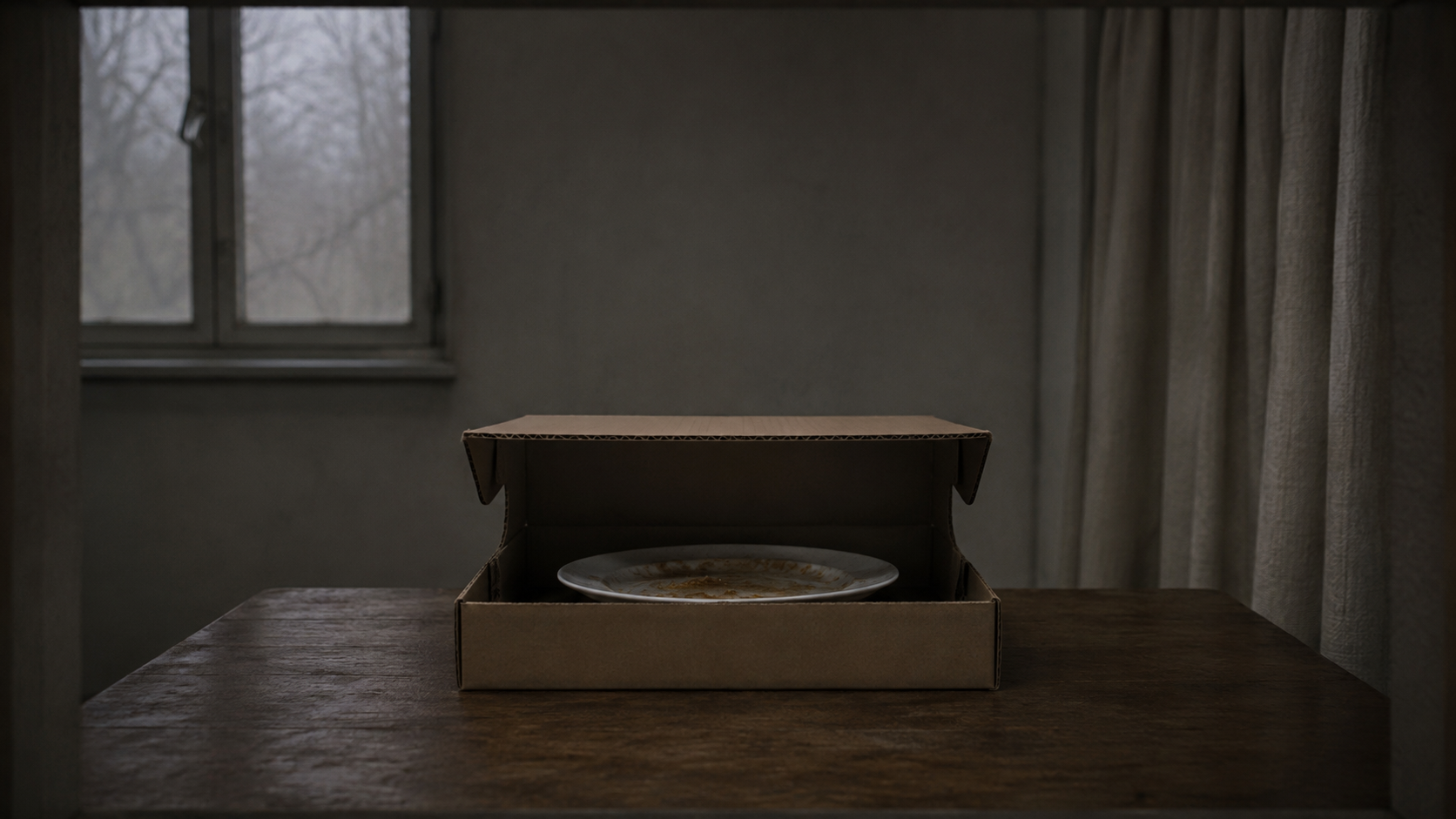
The image represents the threshold between the ordinary and the uncanny - a domestic interior where a cardboard box on a table contains a plate with dried sauce, rendered with the devotional precision of a Cornell shadow box. The flat composition, muted colours, and still curtain create a space where the ordinary becomes strange through arrangement and attention. The box is the hedge that enables the infinite - the finite container that opens into something larger than itself. The image is not about what is in the box but about the act of looking at a box that might contain anything.
Song
Verse 1
The plate has been on the table for three days The sauce has dried to a continent A map of something that was eaten I don't remember what it was
Chorus
The barking is the only thing that moves The barking is the only thing that moves The woman next door has chosen the floor And the barking is the only thing that moves
Verse 2
The fridge hums in the key of A I didn't know fridges had keys This one does, a single note The note the room is tuned to
Chorus
The barking is the only thing that moves The barking is the only thing that moves The woman next door has chosen the floor And the barking is the only thing that moves
Bridge
(spoken, barely) The silence has a shape It is the shape of the room With the barking removed
Chorus
The barking is the only thing that moves The barking is the only thing that moves The woman next door has chosen the floor And the barking is the only thing that moves
Outro
The plate The continent The map The room The barking The silence The shape
Poem
The Arrangement
The poem is a shadow box of domestic objects - a plate with dried sauce, a curtain that moves without wind, a woman barking next door, a fridge humming in the key of A. Each stanza is a compartment containing one object, arranged with precision. The white space between stanzas is the glass. The poem is about the threshold between the ordinary and the uncanny - the moment when the familiar becomes strange through sustained attention. The barking woman has chosen the floor. The silence after the barking has a shape. The poem is the box that contains these objects, and the reader is the one looking through the glass.
Story
The Box on the Table
The story is about a narrator who finds a cardboard box on their kitchen table and does not want to open it. The box contains a plate with dried sauce - the narrator's own plate, unwashed for three days. The story is not about what the box contains but about the act of looking at a box that contains something familiar made strange. The woman next door barks. The silence after the barking has a shape. The narrator collects facts - the mug is blue, the box is brown, the table is wood - because facts are the only thing that hold when the ordinary becomes uncanny. The story is a Cornell shadow box in prose: the frame is the room, the objects are arranged with precision, and the meaning is in the gap between them.