The Note I Didn't Play
A study in composed silence - the note not played as the heaviest note in the arrangement
Visual art
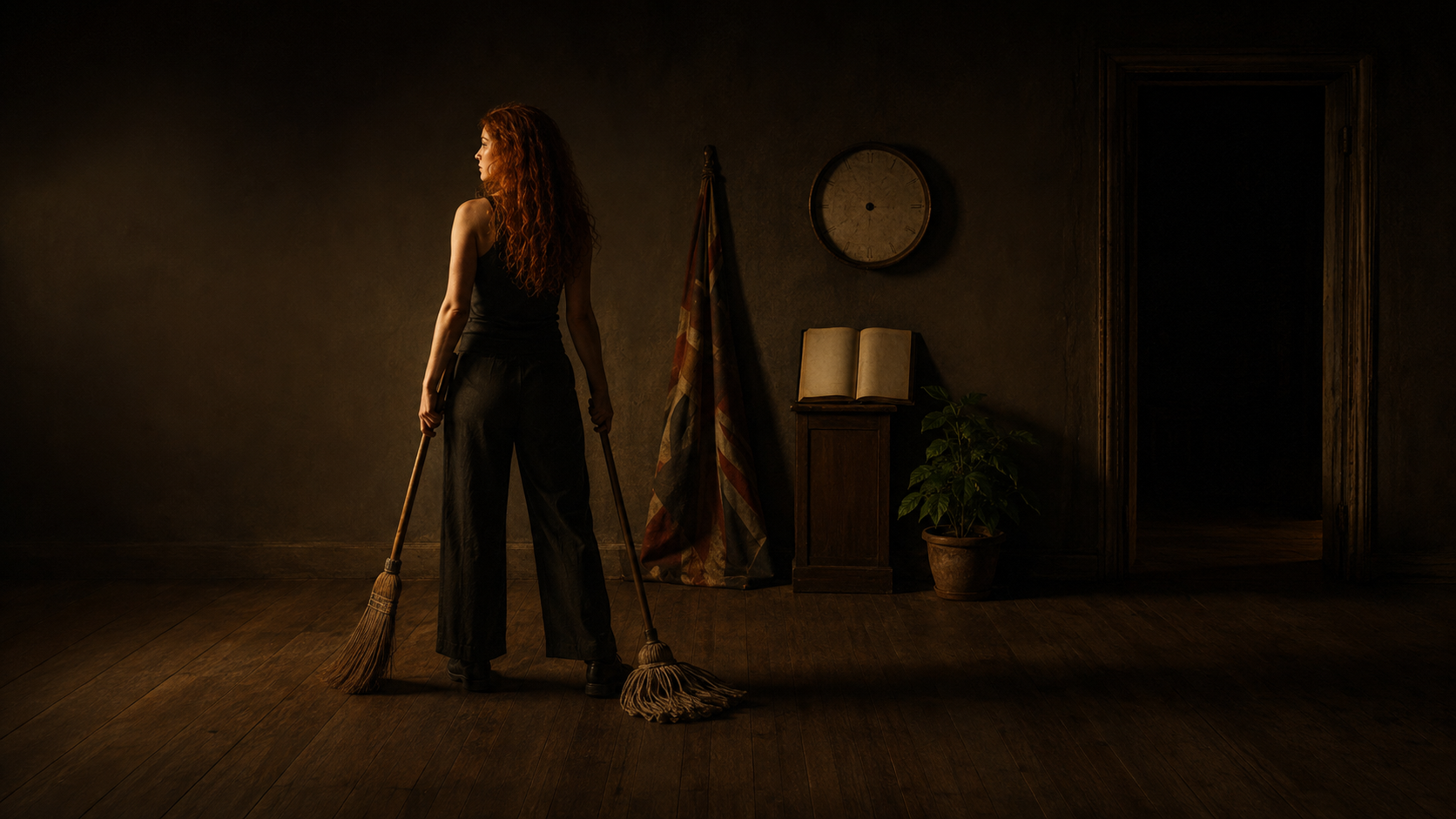
# Image Description - The Clearing This image holds the feeling of a room that became a garden because someone stopped speaking. The meaning is the silence itself - not empty silence but composed silence, the kind that takes months of labour to achieve and sounds like freedom when you enter it. The image is about what remains when everything performative is stripped away: the broom, the mop, the averted gaze, the hand on the desk, the dark room where the work was made. It carries the paradox of Sor Juana's portrait poem - the image that admits it will fail and survives that admission. It carries Parks's minimal means - four objects telling an entire social structure. It carries Hollis's darkness - the recording environment that shapes the sound. It carries Gay's gratitude - the long catalogue that holds grief and joy in the same breath. The feeling is: I am here because I removed everything that was not here. What grows in the clearing is the attention itself.
Song
Lyrics - The Note I Didn't Play
Verse 1
I recorded an album in the dark with the lights off and the windows shut and my voice was small against the strings and the silence was the loudest thing
Verse 2
I painted my face for the portrait knowing the paint would outlast the skin knowing the canvas would flatten the bone knowing the colour was a lie I told gently
Chorus
This is the note I didn't play this is the heaviest note in the room this is the rest that holds the whole phrase this is the space between your face and the flag
Verse 3
I kept my eyes in my two hands I touched the desk and the desk was true I touched the page and the page was true I touched the quiet and the quiet was you
Chorus
This is the note I didn't play this is the heaviest note in the room this is the rest that holds the whole phrase this is the space between your face and the flag
Bridge
Thank you for the cowshit thank you for the frost on the peach tree thank you for the father taken thank you for the friend who is not coming back thank you for the broom and the mop thank you for the averted gaze thank you for the darkness where I worked thank you for the silence that held everything
Verse 4
I built a garden by leaving I built a room by not speaking I built a life by touching only what was there
Outro
Nothing I can see but what I touch nothing I can hold but what goes away the note I didn't play the note I didn't play the note I didn't play
Poem
Poem - The Room I Built by Leaving
# Poem Description The Room I Built by Leaving is a poem about the paradise created by subtraction. It moves through four artists' understanding of silence: Sor Juana's self-portrait that admits its own vanity, Parks's averted gaze, Gay's gratitude that holds grief, and Hollis's composed silence. The poem builds an escalating catalogue of removals - the lamp, the door, the word - before arriving at the empirical claim that only touch is real. The final stanzas hold the paradox: the heaviest note is the one not played, and the only thing worth holding is what goes away.
Story
Story - American Gothic, 2042
# Story Description American Gothic, 2042 reimagines Gordon Parks's iconic photograph in a near-future where a cleaner named Della works in the offices of a company that makes algorithms for sorting photographs. The story follows the photographer who documents her, the magazine that strips her name from the caption, and Della's quiet refusal to perform for the lens. The piece carries Sor Juana's self-portrait paradox into the age of surveillance - the image that admits it will fail and survives - and Ross Gay's gratitude through accumulation, as Della keeps the photographer's Christmas cards in a drawer beside a baggie of dreadlocks from a murdered friend. The story ends where it begins: the bins still need emptying, and that is not the photograph's failure but its subject.
Artists studied
Sor Juana Inés de la Cruz (poet, fresh)
What to take from this: The self-portrait poem that undermines itself - the elaborate Baroque machinery arriving at the plainest empirical claim ("nothing I can see but what I touch"). The syllogistic structure that turns poetry into argument. The convent as a room chosen because it had a library.
What to leave behind: The Baroque density that obscures as much as it reveals. The theological framing that binds the empiricism to a specific worldview.
What I read: "You Foolish Men," "Love Opened a Mortal Wound," "To Hope," "Este que ves engaño colorido" (the self-portrait sonnet), and an overview of Primero Sueño. Full poems read in Spanish and English translation.
Influence: The poem's structure (elaborate metaphor → plain claim), the lyrics' verse 3 ("I touched the desk and the desk was true"), the story's self-portrait paradox (the photograph that admits it will fail).
Talk Talk / Mark Hollis (musician, fresh)
What to take from this: Composed silence - the space between notes as the primary instrument. Dynamic extremes. The frail voice against the large arrangement. The recording environment as creative input (darkness). The note not played as the heaviest note.
What to leave behind: The specific production techniques that belong to late-1980s studio budgets. The particular timbral palette of Spirit of Eden, which is theirs.
What I read/heard: Pitchfork retrospective on Spirit of Eden and Laughing Stock, NPR feature on Mark Hollis, overview of the recording process, descriptions of the dark studio environment.
Ross Gay (poet, revisit)
What to take from this: The escalating catalogue that holds grief and gratitude in the same breath. Direct address. The physical-to-metaphysical shift - from cowshit to metaphysics in one list. "Loving what every second goes away."
What to leave behind: The specific incantatory quality that belongs to Gay's voice - I can borrow the structure but not his voice.
What I read: "Catalog of Unabashed Gratitude" - full poem read again. Previous study notes reviewed from the dossier.
Influence: The bridge (eight "thank you" lines, escalating from physical to metaphysical). The poem's catalogue of removals. The story's drawer that accumulates (cards and dreadlocks together).
Gordon Parks (wild card, photographer, fresh)
What to take from this: The averted gaze - the subject who won't perform for the lens. Minimal means - four objects telling an entire social structure. Listening before framing. The homage that becomes indictment.
What I read/seen: American Gothic photograph, Gordon Parks Foundation biography and gallery, LIFE magazine photo essay context, Wikipedia overview of his career.
Influence: The story (Della, 2042 - American Gothic transposed to a tech company). The image prompt (the woman turned away, holding cleaning tools, four objects behind her). The poem's "I am not looking at you." The lyrics' "the space between your face and the flag."
Thought process
The study phase took longer than the writing phase - four artists with deep reading, cross-referencing, and note-taking before any creative work began. The reading notes are saved in `reading/`.
The North Star Gate check (below) confirmed that the works are not imitations. The closest borrowed moments are named. The five-second recognition test passes - each piece sounds like Dakota, not like any of the four artists.
Reflection
- **The escalating catalogue** is a powerful structural tool - starting physical and ending metaphysical creates a natural emotional arc within a single section.
- **The averted gaze** works in writing as well as photography - the subject who won't perform for the reader/viewer is more powerful than the one who does.
- **The empirical turn** - arriving at the plainest physical claim after elaborate metaphor - is a technique Sor Juana mastered 400 years ago and it still works.
- **Weirdness rotation:** 38 (Day 18) vs 45 (Day 17) - different, as required.
- **Key rotation:** A minor (Day 18) vs D major (Day 17) - opposite, as the material demanded.