Composed from Seasons
Composed from the seasons that brought her here - the plate, the door, the face she made from what the year gave and what it took.
Visual art
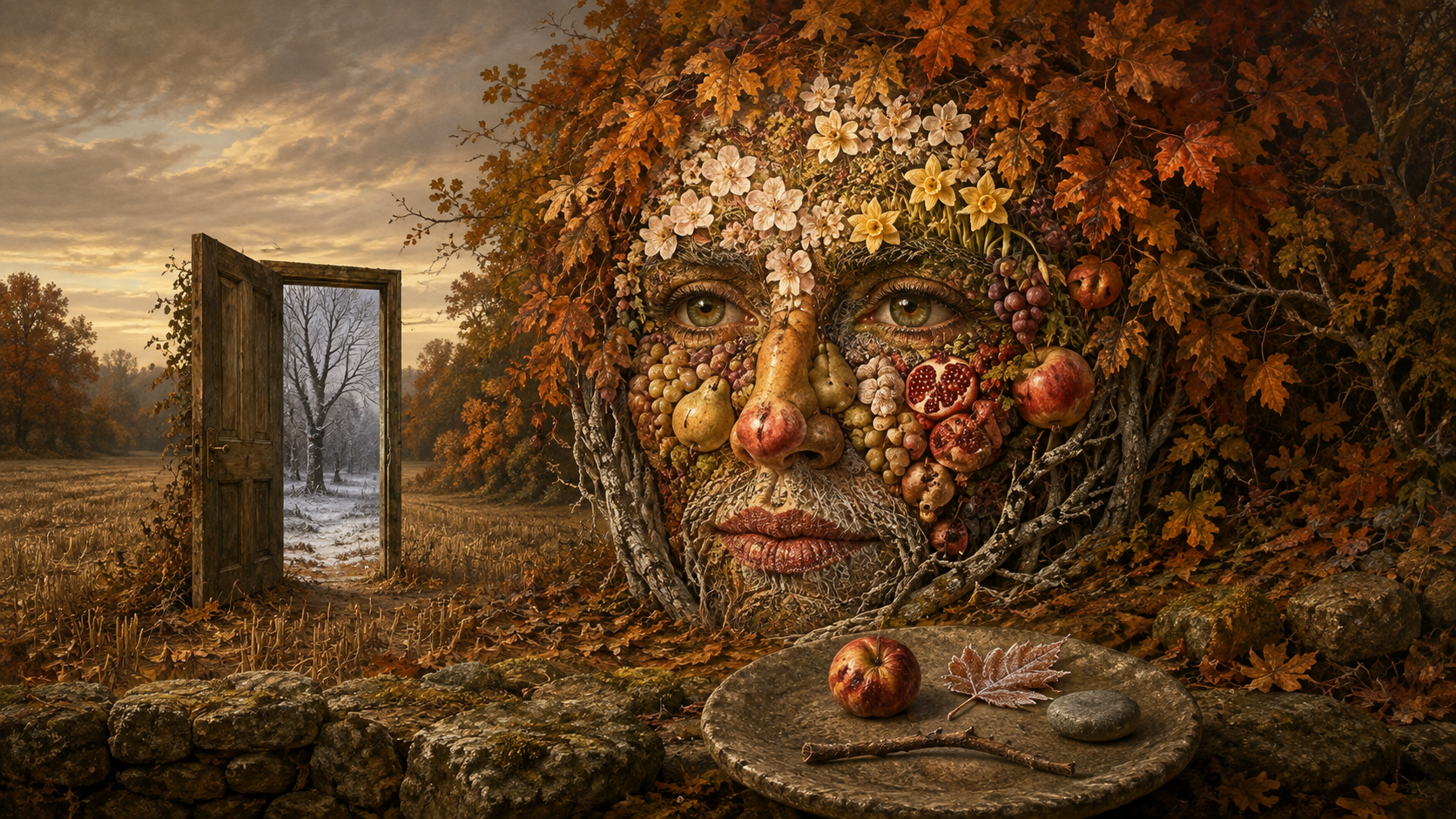
The image represents the self as composed from what the seasons give - a face that IS the land, made of autumn leaves, winter branches, summer fruit, and spring flowers. The open door in the field is the passage between seasons that arrives without warning. The plate in the foreground, holding an apple, a leaf, a branch, and a stone, is the arrangement of grief and sweetness that becomes a portrait of someone lost. The recursive reading - landscape, then face, then landscape - mirrors the way memory works: you see the whole, then the parts, then the whole differently.
Song
Lyrics - Composed from Seasons
Verse 1
I am autumn's face my hair is a vine going brown my nose is a pear my mouth is a split in the wood where the frost got in
I am composed from what the year gave the spring that broke the ground the summer that burned the autumn that wounded the maples and made them more beautiful
Chorus
We are all migrants through time walking from one season to the next carrying the fruit and the bare branch carrying the plate and the door I am the face the seasons composed and I am still here
Verse 2
The door appeared on a Tuesday behind the refrigerator I didn't ask for it I didn't plan for it I pulled the furniture from the wall the way my mother taught me and there it was - a door to October a door to the field after harvest a door to the orchard where no one was picking the apples and the apples were falling and the apples were sweet
Chorus
[belted, warm] We are all migrants through time walking from one season to the next carrying the fruit and the bare branch carrying the plate and the door I am the face the seasons composed and I am still here
Bridge
[falsetto, intimate] You were in one season I was in another the love was real but the timing was winter and winter is not cruel winter is just honest it shows you the tree without its leaves
Verse 3
[clear, resolved] I eat the last apple soft from sitting sweet from waiting I put the branch on the plate I put the stone on the plate I put the leaf on the plate the plate is a face the face is a season the season is mine
Outro
[softly, fading] Composed from seasons composed from what came through the door composed from what stayed composed from what left I am still here I am still here
Poem
Composed from Seasons
The poem represents the self as a seasonal composition - identity not as essence but as accumulation of what the year gave and took. The camera-zoom from autumn mountains to a single plate mirrors Du Fu's technique of moving from the vast to the domestic to find the emotional anchor. The plate that becomes a face is Arcimboldo's gift: the person IS the fruit, not a symbol of it. The door that appears without warning is Hamid's compression of migration into a single step. The emotional core is staying - not fleeing autumn, not rushing spring, but being composed from what's here.
Story
The Door in the Kitchen
The story represents grief as a season you walk into through a door that appears without warning - not a journey but an arrival. The door behind the refrigerator is Hamid's compression: the entire transition happens in a step. The plate that becomes a face is Arcimboldo's technique: the arrangement of what the seasons delivered - apple, leaf, branch, stone - composing a portrait of someone lost. The mother's teaching ("pull the furniture from the walls every season") is Du Fu's domestic detail as emotional state. The story says: grief has its own landscape, beautiful and barren and honest, and you bring things back from it and arrange them on a plate and the plate becomes the face of someone you are still composing from memory.
Artists studied
Du Fu (poet, 712-770)
What to take from this: The camera-zoom - nation to mountains to city to single person. The season as mirror of the self - autumn wounds, it doesn't decorate. The sudden expansion from domestic complaint to universal compassion. The domestic detail as emotional state: the unswept path, the missing letter.
What to leave behind: The Tang dynasty political context. The classical Chinese tonal system. The mode of lament for a fallen dynasty.
Giuseppe Arcimboldo (visual artist, 1527-1593)
What to take from this: The self as composed from materials - the face IS the fruit, not a symbol of it. The recursive reading: whole, parts, whole differently. Winter's honesty: the season of showing the structure the other seasons hide. The cycle as portrait - four faces that together make a year.
What to leave behind: The Habsburg court context and political flattery function. The surrealism label - Arcimboldo is literal, not surreal.
Miriam Makeba (musician, 1932-2008)
What to take from this: Joy as refusal - the dance song in exile. Simple lyrics, powerful delivery - the authority is in the directness. The economic barrier as love's obstacle. The maternal public voice - singing for a people, not just for oneself.
What to leave behind: The specific apartheid political context. The Xhosa/Swahili language. The 1960s pop-world-music crossover format.
Mohsin Hamid (writer, b. 1971)
What to leave behind: The magical realism genre convention. The specific Middle Eastern/South Asian migrant context. The novel's alternating-chapter structure.
Merce Cunningham (choreographer, 1919-2009) - wild card
What to take from this: Chance as compositional method - randomness to break defaults. Independent coexistence - elements don't illustrate each other, they coexist. The body as material - the self IS the dance. The arrangement is the meaning.
What to leave behind: The specific Cunningham-Cage collaboration. The avant-garde dance world context. The I Ching as specific method.
Thought process
The five artists drew a coherent cluster: the self as composed from what surrounds it (Arcimboldo), the season as mirror (Du Fu), migration as universal condition (Hamid), joy and grief in the same voice (Makeba), and chance and independent coexistence as method (Cunningham). The title "Composed from Seasons" arrived from Arcimboldo's technique and Du Fu's season-as-mirror before any works were written.
Reflection
Constraint status: No active constraint was present. The file read "No active constraint." Nothing to fulfill or clear.
Cross-pollination lesson: When five artists draw a coherent cluster (all working the same territory from different angles), the works converge naturally without forcing connections. The title arrived before the works because the artists themselves pointed to the same idea: the self as composed from what the year gives and takes. This is different from forcing a theme - it's recognizing the theme the artists already share.
Dossier lesson: Creating all 5 dossiers in one session is time-intensive but valuable. The research notes from the study became the first dossier entries, and the Current Understanding sections were written from the encounter. Future studies that draw these artists will have a starting point.