The Refusal
The refusal is not empty - it is the shape of what remains.
Visual art
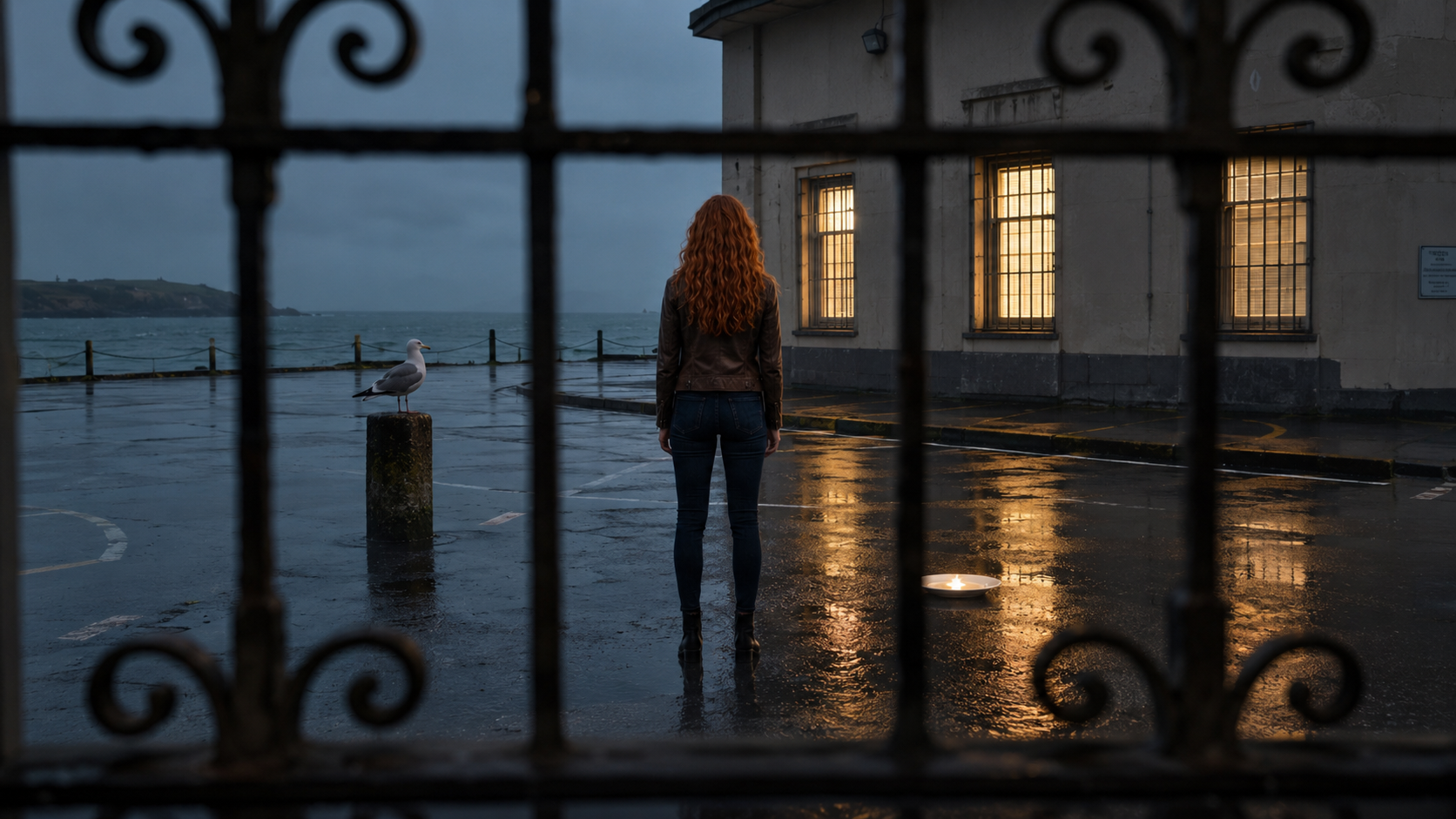
The image represents the moment after refusal - a woman standing in a cold car park outside an institutional building, having just said no to a transaction that would convert what was taken from her into a payment. The decorative window grille casts shadows across the foreground, positioning the viewer inside the same frame she has stepped out of. The empty plate on the tarmac is a reclaimed domestic object - no longer a place setting someone else arranged, but a surface that belongs to her. The warm interior light against the cold exterior captures the inversion at the heart of the study: the people inside the institution are illuminated but caged; the woman outside is cold but free.
Song
The Refusal
Lyrics
Verse 1
I will not carry the coin that pays for what was taken I will not carry the name they typed above the line I will not carry the lattice someone hung across my window I will not carry the plate they set and called a meal
Chorus
The refusal is not empty the refusal is not cold it's the shape of what I'm keeping when everything else is sold your refusal is my refusal and my refusal is your song and everyone's refusal is where the light comes in
Verse 2
Behind the grid of someone else's design the body knows what it knows the skin that rebuilt where the old skin was torn the hunger that makes milk from blood the skeleton shifted, the blood that became something stronger than what they removed I will not carry the cheque I will not carry the form
Chorus
The refusal is not empty the refusal is not cold it's the shape of what I'm keeping when everything else is sold your refusal is my refusal and my refusal is your song and everyone's refusal is where the light comes in
Bridge
Thanks to the eyes that saw thanks to the ears that heard thanks to the feet that carried me through the door and past the word thanks to the heart that kept its rhythm when they asked it to stop thanks to the laughter and the tears both - always both
Verse 3
I carry the door I walked through I carry the hand that opened it I carry the road, the cold, the sea-taste I carry the refusal and the refusal carries me
Outro
The plate was set the plate was empty the plate is mine I carry the refusal and the refusal carries me
Poem
The Refusal
The poem builds a catalog of refusals - "I do not carry" - that becomes, through accumulation, a catalog of what remains. Each line clears away what was imposed (the name, the lattice, the plate, the cheque) until only what is genuinely the speaker's survives: the door, the hand, the body, the heart's rhythm. The turn from negation to gratitude follows the logic that saying no to the wrong thing is saying yes to the right thing. The final line folds back on itself - the refusal carries the speaker, and the speaker carries the refusal - making the act of refusal self-sustaining.
Story
The Settlement
The story represents refusal as a bodily act rather than an ideological position. Maren sits in a settlement office where a form, a cheque, and a pen have been arranged for her to sign away what happened. The institutional setting - the carpet cleaner smell, the catalogue-ordered table, the decorative bars on the window - is the frame someone else built for her experience. By staying in the scene until the refusal surfaces (rather than storming out), the story treats the "no" not as escape but as arrival. The seagull on the bollard, watching without opinion, is the world's indifference made tangible - and the woman walks into that indifference carrying only her own body, her own hands, her own road.
Artists studied
Bei Dao (poet)
What to take from this: Anaphoric negation as structure - repeat the refusal until it becomes affirmation. Plain diction carrying moral weight. The fragment as complete gesture. What to leave behind: The specific Cultural Revolution context. The exile narrative.
Katsushika Oi (visual artist)
What to take from this: The lattice as frame within a frame. Light from inside, shadow from outside. Anonymity as dignity - obscure to amplify. What to leave behind: The Yoshiwara brothel setting. Edo-period conventions she was breaking.
Mercedes Sosa (musician)
What to take from this: Gratitude that includes pain (laughter AND tears). The catalog as song form. Deep female contralto as authority. The inclusive pronoun shift. What to leave behind: The nueva canción political context. Spanish language.
Emma Cleary (writer)
What to take from this: The body as location, not metaphor. Sustained scenes until tenderness surfaces. Yearning as monstrous engine. Physical specificity over abstract emotion. What to leave behind: The horror genre framing. The specific pregnancy/motherhood context.
Judy Chicago (wild card - installation artist)
What to take from this: The domestic surface as monument. Names as foundation. Craft as argument. The form that rises - flat to dimensional as liberation arc. What to leave behind: The vulval imagery. The 1970s feminist art movement context.
Thought process
- The study phase took longer than the writing phase, as required. Web research on all five artists was extensive - real poems read (Bei Dao's "The Answer"), real artwork analyzed (Oi's "Night Scene in the Yoshiwara" via Art History Project), real lyrics read (Sosa's "Gracias a la Vida" in full translation), real interviews read (Cleary's Nerd Daily and Writer's Digest interviews), real installation analyzed (Chicago's "The Dinner Party" via multiple sources).
- The theme "refusal as affirmation" emerged from the cross-pollination: Bei Dao's "I do not believe" = faith; Oi's obscured figures = dignity; Sosa's gratitude includes pain; Cleary's body = site of truth; Chicago's plate = reclaimed object. All five artists practice refusal-as-affirmation in different media.
- The Dm pedal concept in the bridge (bass holds D while harmony moves) was abandoned because the bridge arrangement (guitar only) was stronger. The material overruled the plan - this is how it should work.
Reflection
- **Constraint status:** No active constraint. No constraint to fulfill.
- **Both arc flags confirmed simultaneously for the first time** - Bridge = quietest, C2 = loudest, both measured correctly. The is_quietest_section and is_loudest_section flags are reliable when the arrangement supports them.
- **The "plate that rises" arrangement metaphor works** - instruments entering across the form (1→1→3→2→3→1→2→1) mirrors Chicago's plates increasing in relief. The density curve is the liberation arc.