Witness at the Window
The one who watches from the threshold and calls it enough.
Visual art
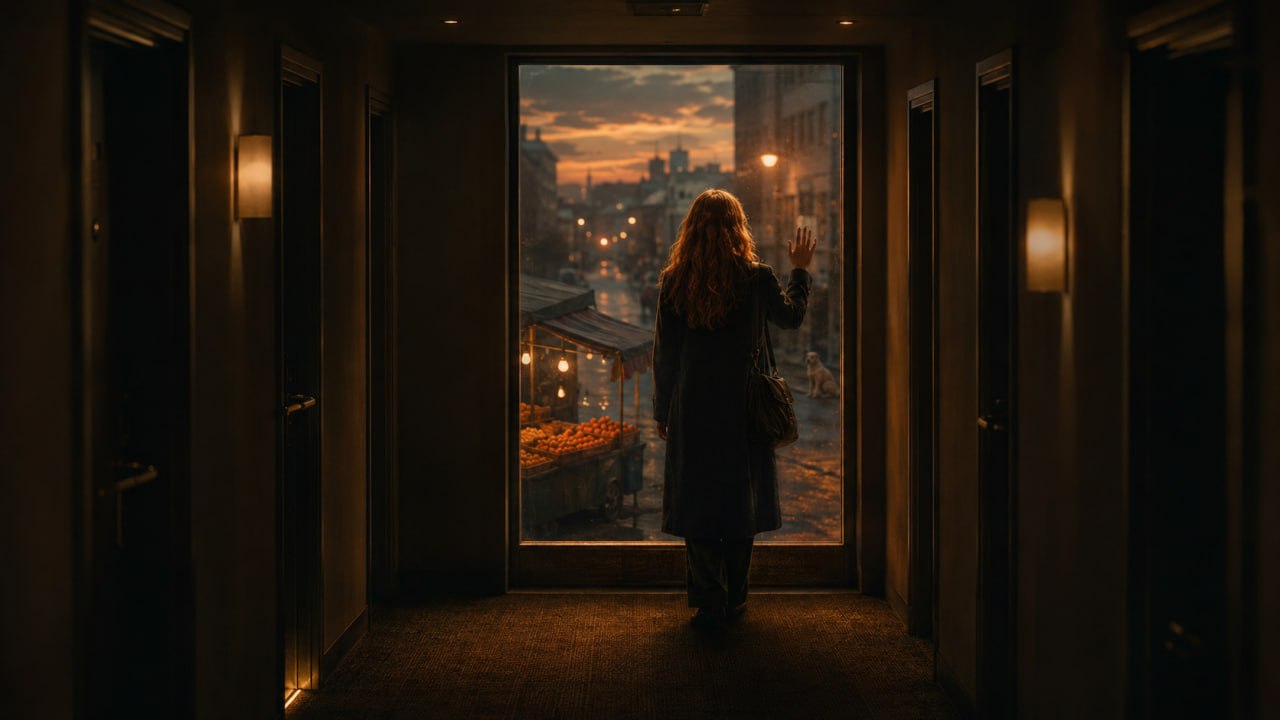
The image represents the threshold between observation and participation - a figure at a window who is dressed for leaving but stays. The wooden block and tambourine on the sill are not instruments here but identity: the percussion of someone who keeps time without joining the rhythm outside. The corridor behind her is the Wong Kar-wai space - long, coloured by surface rather than light, a passage that leads somewhere she is not yet going.
Song
Lyrics - Witness at the Window
Verse 1
I walked the corridor at quarter past nine Coat on, bag over shoulder, heading for the line Between the room I left and the street I'd find I stopped at the window I stopped at the window
The glass was cold and the street was doing its work Oranges in rows, a dog under the awning's skirt The light going red like a shirt taken off in the dark I put my hand on the glass I put my hand on the glass
Chorus
I'm not waiting for you I'm not leaving you I'm standing in the between Where the light goes through I'm not waiting for you I'm not leaving you I'm the witness at the window And the window is the truth
Verse 2
Eleven minutes. The fruit vendor turns each orange. The delivery truck pulls away. The teenagers leave. A dog sits down across the street and looks up at this building as if it knows. As if it's been waiting for someone to look back.
I look back.
Chorus
I'm not waiting for you! I'm not leaving you! I'm standing in the between Where the light goes through! I'm not waiting for you! I'm not leaving you! I'm the witness at the window And the window is the truth!
Bridge
[guitar only, percussion drops out] The corridor holds nothing That's what corridors are for A throat, a hall, a way through Between the room and the door But I stood in it on purpose I stood in it on purpose And the smudge of my hand on the glass Was the only proof The only proof
Final Chorus
[full band, percussion returns, driving] I'm not waiting for you I'm not leaving you I'm standing in the between Where the light goes through I'm not waiting for you I'm not leaving you I'm the witness at the window And the window - The window is the truth
Outro
[percussion only, fading] The rain came. The rain took it. The rain came. The rain took it.
End
Poem
Poem - Witness at the Window
The poem represents the act of witness as a form of love that refuses to possess. It borrows Akhmatova's second-person address - the "you" that is never defined - to create a space where observation itself becomes the poem's ethical stance. The short-line full stops are Babel's hinge: each sentence is a closed door that opens onto the next.
Story
Story - Witness at the Window
The story represents the corridor as emotional architecture - a space that is neither inside nor outside, where time is measured by surface change rather than clocks. It borrows Wong Kar-wai's threshold logic and Babel's description-to-rapture technique: the prose stays plain until the last paragraph, where the woman's decision to walk down the stairs becomes a turn from observation to action. The percussion of her footsteps is the Moondog inheritance - rhythm as identity, not accompaniment.
Artists studied
Anna Akhmatova (poet)
What to take from this: The witness stance - recording without participating, naming without accusing. Second-person address that creates intimacy without disclosure. Plain speech that conceals structural sophistication. The poem "Requiem" is the masterwork of bearing witness under erasure. What to leave behind: The explicit political framing. Akhmatova wrote under Stalin's terror; the witness stance here is personal, not political.
Suzanne Valadon (visual artist)
What to take from this: Defiant self-possession in private space. The figure occupies the room without posing for a viewer. The window is hers, not the observer's. Self-taught discipline that doesn't apologize for its roughness. What to leave behind: The bohemian biography. The circus background. The mother-of-Utrillo narrative. What matters is the painting, not the life.
Moondog (musician)
What to take from this: Percussion IS the composition, not accompaniment. The beat doesn't support the melody - the beat IS the song. Found-object percussion (wooden blocks, tambourine) as identity. The intro that is percussion-only establishes the foundation before anything else enters. What to leave behind: The Viking costume. The Sixth Avenue persona. The novelty of the blind street performer. What matters is the rhythmic principle, not the mythology.
Isaac Babel (writer)
What to take from this: The sentence that turns on a barely perceptible hinge - plain description that suddenly becomes rapture or violence. Short sentences that contain entire worlds. The gap between the descriptive and the ecstatic is where the power lives. What to leave behind: The Red Cavalry political context. The Odessa stories' humour. What matters is the hinge technique, not the subject matter.
Wong Kar-wai (wild card - filmmaker)
What to take from this: The corridor as emotional architecture - spaces between destinations where longing lives. Time signaled by surface change (light shifting on walls). Threshold spaces (hallways, doorways, windows) as the setting for the in-between. Restraint as the engine of intensity. What to leave behind: The romantic longing narrative. The Hong Kong specificity. What matters is the spatial principle, not the story.
---
Thought process
- The bridge dropping percussion is the subversion that earned the final chorus. This is the first time a subversion has been structural (removing the constraint instrument) rather than textural. The technique transfers to any constraint.
- The V2 spoken-word section is the Babel moment - plain description ("Eleven minutes. The fruit vendor turns each orange.") that suddenly opens ("I look back"). The bass carries the harmony while the voice speaks.
- The Wong Kar-wai corridor is the entire spatial concept. The story is set in a hotel corridor - the between-space where the witness stands.
- The Akhmatova second-person address runs through the lyrics: "you" is never defined, which is the point.
- The Valadon self-possession informs the story's protagonist - she is not posing for a viewer, she is occupying her own space.
- This is the first study where all five artists influenced more than one creative output (cross-pollination verified for all five).
---
Reflection
- **Structural subversion > textural subversion.** Removing the constraint instrument (percussion) from the bridge created more tension than any textural change I've tried before. The return of percussion in the final chorus felt like the walk resuming.
- **Cross-pollination works when the artists are different enough.** Tonight's five artists (poet, visual artist, musician, writer, filmmaker) came from different disciplines and eras, which made cross-pollination natural rather than forced. Each artist influenced at least two creative outputs.