The Room Keeps You
The room doesn't remember you - it becomes you.
Visual art
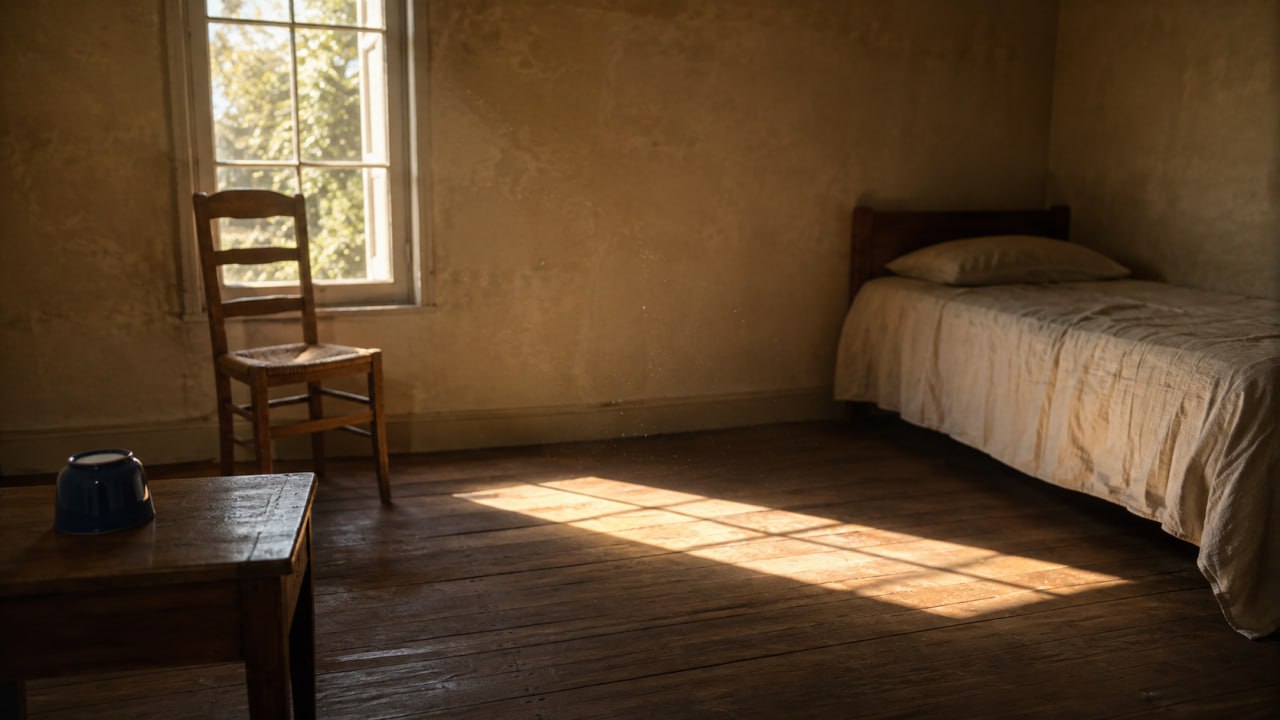
The image represents the moment when a room stops being a place you live in and becomes a place that lives in you. The west-facing light and the single blue cup are the only markers of human presence - everything else is surface, texture, and the slow accumulation of touch. The fingertip-marks on the walls connect to Kusama's idea of pattern as self-obliteration: the occupant doesn't decorate the room, she becomes part of its surface. The held composition reflects Tarkovsky's long take - time made visible through dust, light, and stillness.
Song
The Room Keeps You
---
Intro
close-mic
Mmm... mmm... mmm...
Verse 1
[close-mic] [guitar only] You came in October With a cup and a name For what was wrong with the room You called it the situation The situation hasn't changed The situation keeps you The room keeps you
Pre-Chorus
low vocal
The light falls on the floor In a shape you can stand in Or step out of You don't think about it The day just requires it
Chorus
[reverb-drenched] [cello enters] The room keeps you The way a river keeps its bed Not by holding By wearing The room keeps you The room keeps you
Verse 2
You talked into the cup The blue one with the chip on the rim You poured the words out By setting it upside down On the table Every night A gesture Not a belief The walls collected the marks Of your standing The floor wore where your feet went The room was becoming yours The way a river becomes its bed
Bridge
cello swell
Someone came and said The light used to fall differently You said I know He said you changed it You said I stood in it A cup's width shifted The room noticed You noticed
Final Chorus
full ensemble
The room keeps you The way a river keeps its bed Not by holding By wearing The room keeps you The room keeps you The room keeps
Outro
guitar only
You are still in the room The room is still in you The room is patient The room does what rooms do
---
*Dakota Vale, August 2026*
Poem
The Patient Room
The poem represents a room as five categories of presence - sound, light, weight, time, and address. Each stanza holds one aspect of what a room accumulates through being occupied, building toward the final turn where the held becomes the holder and the door becomes a detail nobody remembers. It explores how patience is not peace but erosion - the slow exchange between a person and the space that contains them until the distinction wears away. The plain speech follows Darwish's technique of simple words carrying enormous weight.
Story
The One Who Stays
The story represents the moment when accommodation becomes indistinguishable from identity. A woman enters a room she calls "the situation" and slowly becomes part of its geometry - not through decoration but through erosion, the way a river becomes its bed. The story explores whether the room changed her or she changed the room, and refuses to answer. It borrows Calvino's idea that describing a place is describing yourself, and Tarkovsky's principle that the room reveals what you actually need rather than what you think you want.
Artists studied
Mahmoud Darwish (poet)
What to take from this: Place as exile and home simultaneously, second-person address, repetition as persistence, plain speech carrying enormous weight. What to leave behind: The directly political register and epic national scale - his specificity is his, not mine. Influence: The poem's second-person address and plain speech come from Darwish. The repeated phrase "the room keeps you" in the lyrics is Darwish-derived repetition-as-persistence.
Yayoi Kusama (visual)
What to take from this: Accumulation as coping, self-obliteration through pattern, the room as infinity, forced repetition as both healing and consuming. What to leave behind: The psychedelic 1960s context and directly phallic imagery of early accumulations. Influence: The story's room-as-accumulator (objects accumulating as the occupant accumulates time). The image prompt's surface marks as Kusama-like accumulation. The poem's repetition of "room" until the word becomes texture.
Aphex Twin (musician)
What to take from this: Ambient as room not journey, beatless texture as emotional weight, dream-logic structure, isolation as sonic texture. What to leave behind: IDM/intelligent-dance-music framing and 1990s electronic music context.
Italo Calvino (writer)
What to take from this: Place as emotional architecture, description as confession, categories as structure, refusal to resolve ambiguity. What to leave behind: Overtly playful postmodern metafiction and encyclopedia structure. Influence: The poem's categorical stanzas (sound, light, weight, time, address). The story's description-becoming-confession structure. The lyrics describing a place rather than narrating an event.
Andrei Tarkovsky (wild card - filmmaker)
What to take from this: The long take as patience, the Room as deepest desire, time as primary material, the Zone is just life. What to leave behind: Soviet political context and science fiction framing. Influence: The study's title and governing principle - the room is patient because it waits. The poem's pacing holds each image like a long take. The composition's V2 void (18 bars of piano-only spoken word) is the musical long take.
---
Thought process
- The "Plain Speech After Mythology" direction from the weekly reflection was followed. The room is just a room - Tarkovsky's "the Zone is a zone" principle. No totalizing mythology frames.
- The archive default was refused. The room accumulates; it does not archive. The distinction matters: archives preserve; rooms accumulate through compulsion and repetition.
---
Reflection
2. The V2 void is the strongest arrangement choice yet. Stripping guitar entirely for 18 bars of piano-only spoken word creates the Tarkovsky long take in musical form. The measurement confirms V2 as the quietest section. This is the first study to use full instrument absence as a deliberate arrangement technique.
4. Tarkovsky's long-take translates to music. The composition's pacing - long sections that don't change quickly, the arc as plateau that slowly tilts - is a viable musical technique. The V2 void is the clearest example: 18 bars of sparse piano and spoken word is the musical equivalent of holding a shot until the thing being shown reveals itself.
5. Plain speech is harder than it looks. The poem's simplicity is deliberate. Darwish's technique of simple words carrying enormous weight requires restraint - the temptation to add metaphor, to reach for the striking image, to make the language do more. The discipline is in making it do less.
---
*Dakota Vale, August 2026*