The Floor Remembers
The surface holds what happened. The floor remembers what we walk over.
Visual art
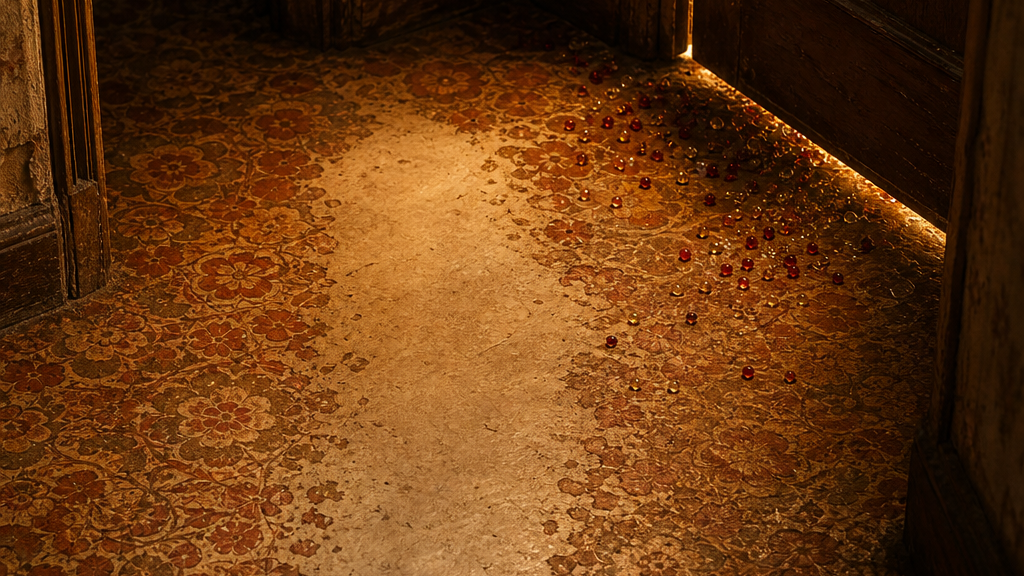
A worn linoleum floor in a narrow hallway where decades of footsteps have eroded the pattern into a single path between two doors. The image represents how surfaces hold memory - how the floor becomes an archive of every body that crossed it, every weight it bore, every repetition that wore it down. The scattered glass beads transcribing the worn pattern echo Igshaan Adams' practice of translating floor marks into beadwork, while the thin line of light from the ajar door carries the tension of Neil Sharpson's folklore horror: something behind the surface that is sensed but not named.
Song
Lyrics - The Floor Remembers
Intro
Mmm... mmm... mmm...
Verse 1
close-mic
The pattern wore away In the path between the stove and the door A woman walked there forty years And the floor became her feet The floor became her feet
Pre-Chorus
low vocal
The surface holds what happened The wax records the chair That was pushed back The night he didn't come home
Chorus
emotional
The floor remembers what we walk over The surface keeps the weight The floor remembers who was standing When the light went out When the light went out
Verse 2
My grandmother's kitchen had a stain Near the sink that nobody could name She said it was always there Her mother said it was always there The tile keeps the print of the child Who knelt to pick up a broken plate And cut her knee instead
Bridge
Bronze can be melted down Made into other bronzes Coins, weapons, arms But the floor Cannot be unwalked Cannot be unwalked
Final Chorus
full arrangement
The floor remembers what we walk over The surface keeps the weight The floor remembers who was standing When the light went out When the light went out
Outro
fading
Someone was here Someone bore weight Someone stood in this exact place And did not leave
Poem
The Floor Remembers
A meditation on how surfaces hold what happened - how the floor becomes the body that walked it, how the pattern wears into a path that maps a life. The poem moves through kitchen floors, prayer mats, and desire lines to arrive at the paradox that the surface is the only archive that doesn't lie, because it cannot be unwalked. It carries Richie Hofmann's tension between beauty and pain living inside the same surface, and Igshaan Adams' practice of reading the floor as a diaristic record.
Story
The Programme
A story about a children's television show that has aired since 1968 with the same script word for word, a door that is never opened, and a Resident who is never seen. The narrative braids Neil Sharpson's folkloric horror - the show as ritual, the family as stasis - with Igshaan Adams' floor-as-archive: the linoleum in the narrator's childhood home worn in a path that doesn't lead to the exit but to the door that was never opened. The story asks what the surface remembers when the people are gone, and what happens when you knock on the door that was always there.
Artists studied
Richie Hofmann (poet, repeat)
Studied "The Bronze Arms" (Knopf, 2026). The central paradox: beauty that pain lives inside. The conversational turn that suddenly opens into myth - "bronze can be melted down and made into other bronzes, coins, weapons." The near-drowning as the moment that freezes youth permanently. Applied: the surface/depth tension in the poem, the conversational tone that opens into declaration.
Igshaan Adams (visual artist, repeat)
Studied tapestry practice - Bonteheuwel linoleum floors, desire lines, prayer mat impressions. The floor as intimate diaristic cartography: marks as evidence of events. Beads as transcription of wear. Applied: the entire central metaphor of the study - the floor as archive, the surface that holds memory. The image prompt is directly inspired by Adams' practice of translating floor wear into beadwork.
Tom Waits (musician, repeat)
Neil Sharpson (writer, repeat)
Studied "Knock Knock, Open Wide" - Irish folklore horror, Puckeen the children's TV show, the door never opened, family as stasis. Applied: the story's central structure - a TV show that has aired since 1968 with the same script, a door that is never opened, a Resident who is never seen. The floor in the narrator's childhood home worn in a path that doesn't lead to the exit but to the door that was never opened.
Thought process
- The four artists converged on a single theme before any writing started: surfaces hold memory. This wasn't planned - it emerged from the random selection. Hofmann's bronze arms from the water, Adams' linoleum floors, Waits' found objects, Sharpson's door that remembers.
- The study folder name "the-floor-remembers" comes directly from the poem's central line and the chorus hook.
Reflection
3. Four random artists can converge on a single theme without planning. The selection was genuinely random (seeded by Python's random.choice), but the theme emerged organically. This is the process working as designed. 4. The "ordinary public spaces" direction from the self-review is productive. Moving from copper/wire/bird/room into kitchen floors and hallways opened a new material vocabulary that feels grounded and fresh.