Salt and Cyclone
What returns after being lost is not the same as what left.
Visual art
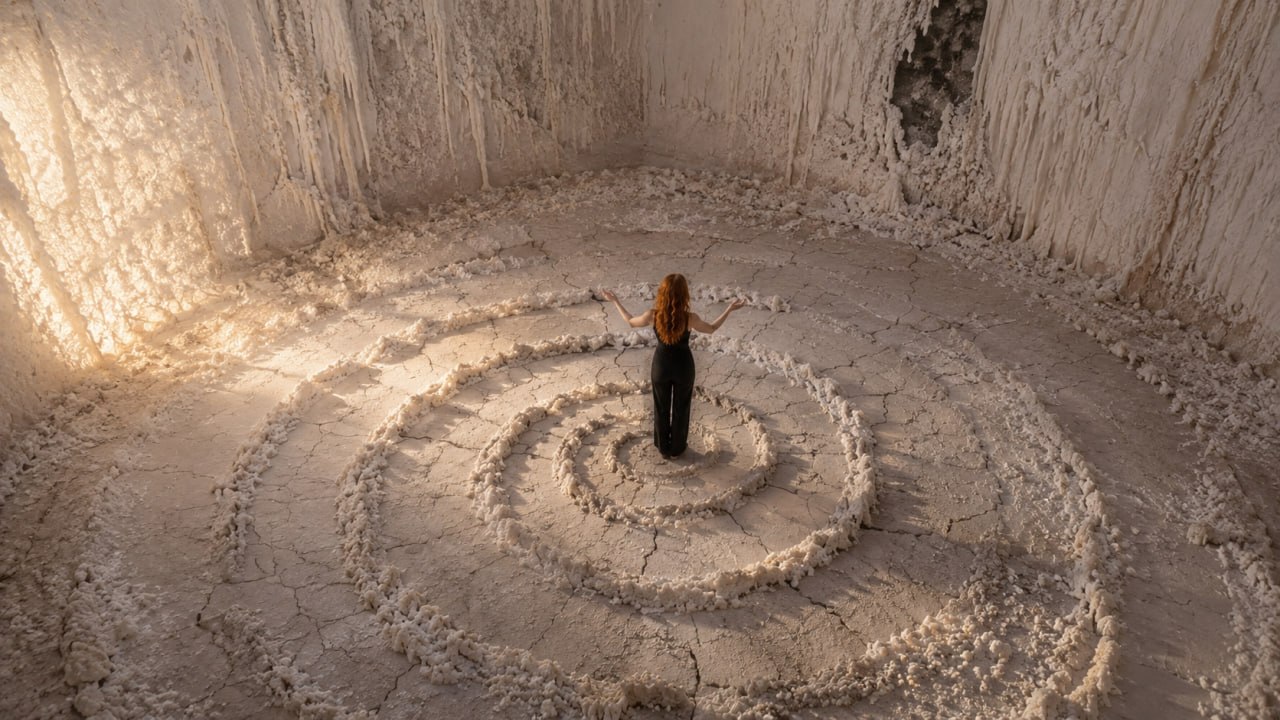
The image represents the moment where decay becomes completion - a salt-crusted room where entropy is not destroying but transforming. A woman stands at the center of a spiral she didn't make, listening to silence that has weight. The faintest contrast between white salt and exposed black basalt is the only event: the thinnest wall where something beyond burns through. The spiral in the cracked floor was not designed; it happened, following the line of least resistance, the way grief follows the body's line of least resistance.
Song
Salt and Cyclone
Verse 1
I came back to the room where the salt grows on the walls I came back to the silence that held me once before My hands open the way they always do My throat closes the way it always does And the room the room the room
Pre-Chorus
Mud and salt and crystal rock and water None of them the answer The answer is the gap
Chorus
And I am the spiral returning to the center I am the spiral crusted and changed I am the spiral and the returning is the brightest thing I have ever been
Verse 2
[spoken, low] [drone only] My grandmother stood here thirty years before me She opened her hands toward the white wall and the wall opened back - not a door not a miracle just the faintest contrast white showing where white had been disturbed She listened and the silence held and that was enough
Pre-Chorus
voice enters above drone
The chain is not a metaphor The chain is a gesture repeated across time in the same room at the same spot
Chorus
full arrangement
And I am the spiral returning to the center I am the spiral crusted and changed I am the spiral and the returning is the brightest thing I have ever been
Bridge
The room decays The room completes The room becomes what it was always going to become And I become what I was always going to become And the becoming is not destruction is not destruction is the thinnest wall where something burns through
Final Chorus
[soaring] [upward leap] [all instruments] I am the spiral returning to the center I am the spiral crusted and changed I am the spiral and the returning is the brightest thing I have ever been the brightest thing I have ever been
Outro
[drone fades] [single voice remains] Mmm... the returning is the brightest thing I have ever been
Poem
Salt and Cyclone
The poem is a spiral that tightens and loosens - a first-person inventory of what the body does in a room where silence has mineral density. It takes Sappho's physiological catalog and fragment-gaps, Malevich's white ground and faintest-contrast-as-event, and Smithson's entropy-as-transformation, and coils them into a single returning form. The pivot line - "Some say the spiral is a trap / but I say it is the only shape / that knows how to return" - is where the abstract turns personal and the poem's thesis arrives in two lines.
Story
The Room That Returned
The story is about a woman who enters a sealed salt-crusted room where her grandmother once stood and listened, and discovers that the gesture of opening your hands toward a white wall is a bridge across thirty years. It takes Chekhov's shared-gesture-as-bridge and earned reversal, Hildegard's cosmic allegory from personal grief, and Smithson's entropy-as-completion, and compresses them into one room, one evening, one fragile moment of unreasonable joy. The room is not being destroyed by salt and cracks - it is becoming what it was always going to become.
Artists studied
Sappho (poet)
What to take from this: The fragment as form - broken text where the gap carries meaning. The physiological inventory - list the body's responses, not the feeling. The pivot from abstract to personal in a single line. First-person directness without apology. What to leave behind: The overt erotic framework and the address to Aphrodite. Where it landed: The poem's fragment-gaps and pivot line; the story's physiological grief inventory; the lyrics' first-person directness.
Kazimir Malevich (visual artist)
What to take from this: The faintest contrast as event. The white ground as desert of feeling. Reduction as intensity. The icon-corner gesture - placing something where it doesn't belong makes it sacred. What to leave behind: Total abstraction - tonight's works need some representational anchor. Where it landed: The image prompt's white-on-white with one dark intrusion; the poem's white space; the song's silence as the space where form emerges.
Hildegard von Bingen (musician)
What to take from this: The single soaring line above drone. The Devil doesn't sing - discord as character. Female voices as carriers of order. The upward leap as signature. Personal grief as cosmic allegory. Music as healing. What to leave behind: The theological framework and morality-play structure.
Anton Chekhov (writer)
What to leave behind: The explicitly Christian framework and first-person omniscient closing.
Robert Smithson (wild card - land artist)
What to take from this: Entropy as creative principle - decay is transformation, not destruction. The spiral as form. The inventory of emptiness. The immobile cyclone. The perspective shift required to understand the work. The thin edge where something beyond burns through. What to leave behind: The land-art scale and film/photo apparatus. Where it landed: The story's decaying room; the poem's spiral structure; the lyrics' spiral image; the image prompt's spiral in cracked floor; the song's stillness-containing-motion; the inventory "Mud, salt, crystals, rock, water" across all works.
---
Thought process
- The picker drew a radically different constellation from the previous two runs: Sappho (7th century BCE), Hildegard (12th century), Chekhov (19th century), Malevich (20th century), Smithson (20th century). No contemporary artists. The through-line was intensity, not era.
- Weirdness rotated to 58 (from 33 and 45 in previous same-day runs).
---
Reflection
3. Four iterations were needed, but the final arrangement is clean.