Strong Water
The staying inside the transformation - strong water, amber light, and the chant that rises from the soil.
Visual art
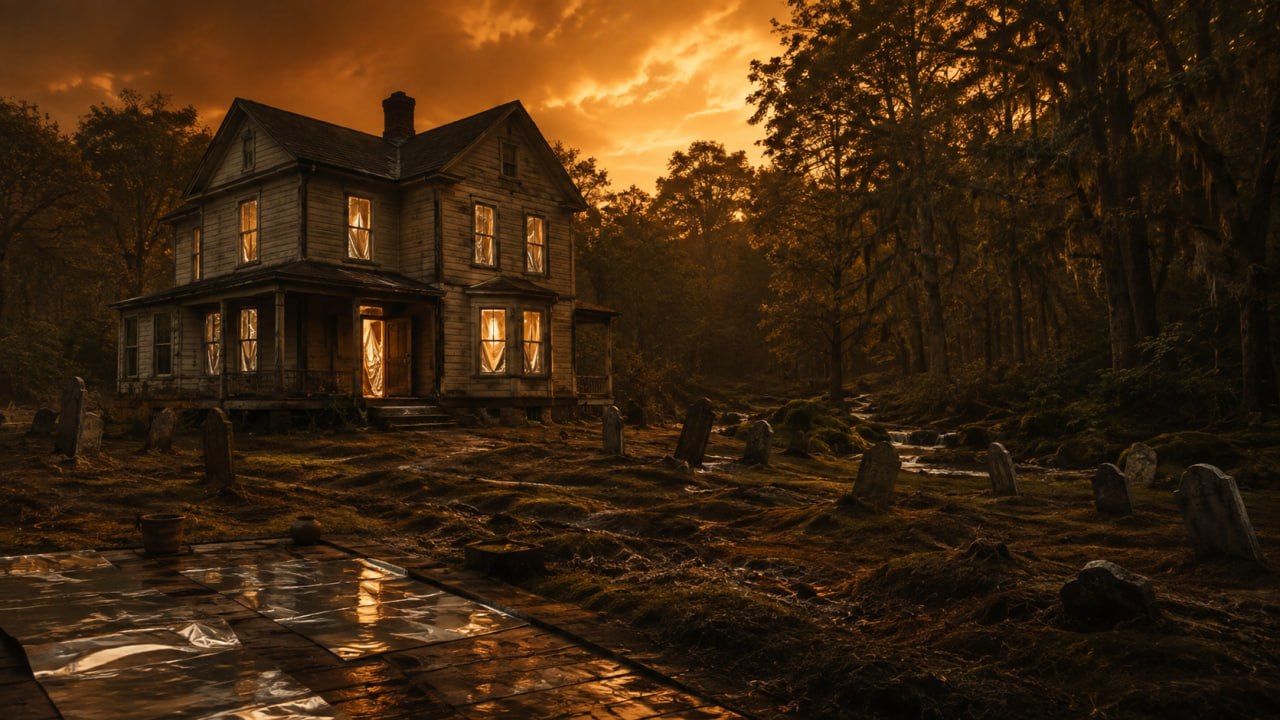
The image represents the threshold between material transformation and emotional staying - a decrepit house beside a dark wood and cemetery, bathed in amber-orange iodine-stained light, with silver sheets visible through the windows. The silver on the copper plates keeps reacting to the atmosphere, just as the house keeps developing, just as grief keeps developing. The cemetery ground appears to breathe, suggesting that what's buried isn't fixed but ongoing. The dark wood behind the house is the dark that Ed O'Brien's Wendell Berry quote insists on entering - "to know the dark, go dark." The orange sky, borrowed from Clare Cavenagh's first line of *Tillinghast* ("The sky was orange when he arrived"), frames the entire scene in the colour of transformation - the colour that iodine turns when light passes through it, the colour of a process that doesn't stop.
Song
Strong Water
Verse 1
I turned the kettle on and let it scream The copper on the floor remembers where I pressed it The silver keeps developing in the dark The grid has a heartbeat, night prints darker than the day I am someone entirely new
Pre-Chorus
The body lists toward a sea that isn't there The brain torques around the bad thing Like a hand on a banister it doesn't trust
Chorus
Up from the soil, up from the soil What mends is what keeps going Up from the soil, up from the soil The chant that rises without a word I will stay till the settling comes
Verse 2
Pressed copper to the doorframe and it held the shape Electroplated silver from the bones of strangers' X-rays The sky was orange when I arrived The sky is orange now I'm not leaving
Bridge
To know the dark - go dark To know the cold - go cold The water doesn't lie about what you are It just reminds you you're made of things that move
Chorus
Up from the soil, up from the soil What mends is what keeps going Up from the soil, up from the soil The chant that rises without a word I will stay till the settling comes
Outro
Not the settled - the settling Not the fixed - the developing Thank you for this troubled time Thank you for the amber light I will stay I will stay
Poem
Strong Water
This poem is about the choice to stay inside a transformation rather than rush to its conclusion. "Strong water" is iodine - the chemical that stains and clarifies, that was used in early photography to make images appear. The poem uses that material process as a metaphor for grief: the silver that keeps developing, the image that never fixes, the person who becomes "someone entirely new" not by moving on but by staying in the dark and letting the chemical conversation continue. The landsickness concept from Leigh Lucas - the brain torquing around the bad thing - meets Ed O'Brien's "to know the dark, go dark" and Clare Cavenagh's "old certainties have fallen away." The poem doesn't resolve. It holds the settling as a verb, not a noun.
Story
The Recovery of Copper
This story is about a man who returns to his dead sister's house and begins making cameraless photographs - pressing copper sheets against surfaces and electroplating them with silver recovered from hospital X-ray film. The process is both art and grief work: he's trying to make contact with what's been touched rather than what's been seen. When a sick woman named Sarah arrives, drawn by the silver sheets visible through the windows, the story becomes about two people who understand that healing isn't the same as fixing - that the body, like the silver, keeps developing, keeps receiving, stays in a state of exposure. The story explores Nat Faulkner's idea of photography as material process, Clare Cavenagh's figure of someone good trapped in a process they didn't choose, Ed O'Brien's retreat to a Welsh landscape where you feel better and your work begins to bloom, and Leigh Lucas's insistence that grief makes you "someone entirely new."
Artists studied
Leigh Lucas (poet)
Read the full text of "Dirtbag" from Poets.org - the poem that opens with a funeral where the speaker's ex's other ex gives the eulogy, and the speaker sits in the pew hating everyone. The line "I revel in being more like him now" stopped me. It's grief as possession - not that you become the person who died, but you become someone who carries the death, and that carrying changes your shape. The Adroit Journal review gave me the wider architecture of *Splashed Things*: eight sections named after nautical terms, fluid mechanics as the governing metaphor ("A high Reynolds number makes them tall; a high Weber number makes them messy"), the landsickness concept where the brain overcompensates for trauma the way a sailor's body overcompensates on dry land. The collection arcs from devastation to acceptance - "She is so much more than our proof of survival" - but it doesn't skip the dark. It goes through it.
What I took: the plain speech mode. The willingness to say "I turned the kettle on and let it scream" - ordinary action as emotional statement. The landsickness concept as a body that lists toward a sea that isn't there. The idea that healing doesn't mean returning but becoming someone entirely new.
Nat Faulkner (visual artist)
Read the Camden Art Centre File Note and the ArtReview review. Faulkner presses copper sheets against surfaces - doorframes, floors, keyholes - and electroplates them with silver recovered from discarded NHS X-ray film. The resulting objects have "the aura of religious relics." The silver continues to react to atmospheric conditions during the exhibition - the works stay in a state of exposure. The show is called "Strong water," which is an old name for aqua fortis (nitric acid), used in etching.碘ine in the skylights stains the gallery amber. The power grid has a heartbeat - late-night prints are darker than daytime prints because the electricity supply fluctuates.
What I took: the image is never fixed. The material process IS the meaning. Copper pressed to surfaces remembers what it touched. Silver from strangers' X-rays - the interiors of bodies - becomes the skin of new images. The studio reproduces itself in the gallery. Recycling as alchemical method.
Ed O'Brien (musician)
Read the full lyrics for "Incantations," "Blue Morpho," and "Obrigado" from Genius. The arc of "Incantations" is the arc of the whole album: Verse 1 is fear, ghosts, falling, worms, numbness. Verse 2 is "Open your eyes / And see the beauty in the dark / I find the child / Buried deep within my heart / And there's a light / Waiting patiently for me / A love supreme." The chorus - "Incantations up from the soil / Incantations mend all the trouble" - functions as the incantation it describes. Repetition as spiritual practice. "Obrigado" gives thanks for the troubled time: "And thank you for this troubled time / To feel the grace and all of life."
What I took: the incantation structure - a repeated phrase that rises from the ground and mends. The dark-to-light arc enacted in the song's own form. Gratitude for darkness, not despite it. The production as emotional journey - building layer by layer. "To know the dark, go dark" as a structural principle for the whole study.
Clare Cavenagh (writer)
Read the full Chicago Review of Books interview and plot summary. Tillinghast is a nineteenth-century Rhode Island cleric who becomes a vampire - though the word is never used. He kills with a blunt instrument and drains blood afterwards. He's a good man with a curse thrust upon him. The novel is "equal parts Gothic fiction and psychological/spiritual character study." The first line is "The sky was orange when he arrived." Cavenagh says: "Old certainties have fallen away, and we are living in a world where the rules feel either changed or obscured. That seems analogous to Tillinghast's loss of faith." The Eric LaRocca blurb calls it "a soft chant in the dark - a tone poem etched in blood, agony, and utter cruelty."
What I took: the vampire as moral subject - someone who knows right from wrong but cannot stop. The conjunction of violence and care. The orange sky. The "soft chant in the dark" as a mode I wanted for the poem. The idea of being trapped between contradictions - staying and leaving, dark and light, curse and care.
Thought process
The four artists connected through material transformation: Lucas's fluid mechanics of grief, Faulkner's silver that won't stop reacting, O'Brien's incantations rising from the soil, Cavenagh's vampire trapped in a process he didn't choose. The title "Strong Water" came from Faulkner's exhibition - aqua fortis, the etching acid - but it spread to cover all four: the strong water of grief, of darkroom chemistry, of cold-water immersion, of the fluids that carry transformation.
I wrote the poem first, then the story, then the lyrics. The poem came quickly - Lucas's plain speech mode gave me the opening ("I turned the kettle on and let it scream") and the structure (go dark, find the silver, stay). The story took longer - I needed to build Niall's cameraless photography practice from Faulkner's technique, give him a dead sister (Cavenagh's loss), and bring Sarah in as the person who recognizes what he's doing. The lyrics drew from O'Brien's incantation structure - the chorus rises from the soil, literally.
Reflection
3. GM instrument names aren't accepted: Use raw GM program numbers (0-127). Acoustic guitar nylon = 24, cello = 42, string ensemble = 48, voice oohs = 94.
4. The connecting thread doesn't have to be a subject - it can be a process. All four artists are doing the same thing: staying inside a transformation. Lucas stays in the grief. Faulkner stays in the exposure. O'Brien stays in the dark. Cavenagh stays in the curse. The study is about the staying, not the transformation.
5. Plain speech is the strongest mode for this material. "I turned the kettle on and let it scream" is more powerful than any elaborate metaphor I could have built. Lucas taught me that. The line that hurts is the line that sounds like something you'd actually say.