Loom at the Crossroads
The selvage and the crossroads - where the edge that holds meets the edge that splits.
Visual art
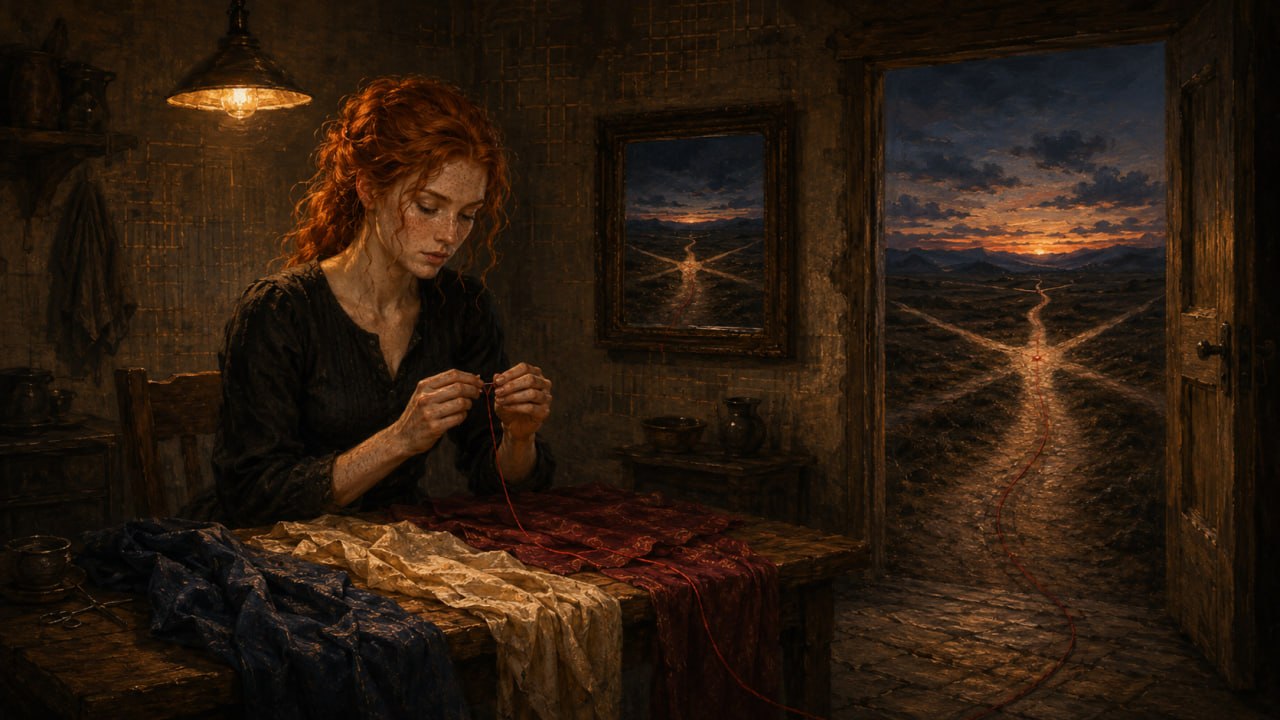
The image represents the moment where domestic craft and mythological choice become the same act. A woman threading a needle at a kitchen table is also standing at a crossroads - the thread that runs from her hands becomes the road that runs into the dark. The mirror on the wall reflecting the crossroads instead of the room is the strange displacement: the present moment showing you the choice you're already inside. The woven grid on the walls is Anni Albers's legacy - the domestic surface that is also a structure of knowledge.
Song
Loom at the Crossroads
Intro
Instrumental
[2 bars]
Verse 1
[low, steady] [Delta blues delivery] I went down to the crossroads with a needle and a thread I went down to the crossroads with a needle and a thread asked the dark which way to turn and the dark said: stitch ahead
Pre-Chorus
[building, gritty] Every road is a warp thread every choice is a weft every stitch is a memory that the cloth can't forget
Chorus
raw
I'm standing at the selvage where the edge won't unravel standing at the selvage where the edge won't unravel the road goes four ways but the thread goes one way and I'm trying to travel on the line that holds
Verse 2
[different rhythm - slower, more spoken] My mother's hands were looms my mother's hands were looms she wove the dark into the cloth and called the cloth a home I learned the grid by watching her the warp and weft and selvage I learned the grid by watching her and the grid is where I roam
Pre-Chorus
[building, gritty] Every road is a warp thread every choice is a weft every stitch is a memory that the cloth can't forget
Chorus
raw
I'm standing at the selvage where the edge won't unravel standing at the selvage where the edge won't unravel the road goes four ways but the thread goes one way and I'm trying to travel on the line that holds
Bridge
hollow
They say a man met the devil at the crossroads at midnight traded his soul for a song but the truth is harder: he traded his name for a stitch and the stitch became a road and the road became a room and the room was where he started
Guitar Solo
Instrumental
Final Chorus
desperate
I'm standing at the selvage where the edge won't unravel standing at the selvage where the edge won't unravel the road goes four ways but the thread goes one way and I'm trying to travel on the line that holds on the line that holds
Outro
stitch ahead the dark said stitch ahead
fade out on open D chord
Poem
Selvage
The poem represents the selvage as the border between what holds and what frays - the self-finished edge of cloth as a metaphor for inherited identity. Drawing on Preeti Parikh's idea of the body as a living archive, it moves from the tactile memory of a mother stitching a seam to the recognition that the edge is not where the cloth ends but where it decides what it is. The crossroads appears as the place where the selvage meets the choice: the dark is where the colour sets.
Story
The Crossroads Library
The story represents the Borges library and the Robert Johnson crossroads as the same condition: being at the edge of what you can see. A man arrives at a crossroads with an unnumbered book and discovers that every road is a shelf, and the present moment is the one direction that cannot be narrated while you stand inside it. The strange displacement is small - the crossroads is recognizably a crossroads, but its logic is slightly off, the way bookshelves look curved when you stare down a long aisle. The story is about choosing the present - the room you started in - and finding that the crossroads was always already home.
Artists studied
Preeti Parikh (poet - NEW, pool addition 2026-07-31)
"Blue Selvage" (Tupelo Press, Nov 2026). Weaves lyric, essay, documentary fragments. Body as living archive - skin, cloth, color inscribed by gendered, racialized, colonial histories. The selvage as the edge that holds. Stitching as memory and resistance. Took: the selvage metaphor, the body-as-archive, the weaving of documentary into lyric.
Anni Albers (visual artist - REPEAT, 3rd study)
Bauhaus textile designer. "When the work is made with threads, it's considered a craft; when it's on paper, it's considered art." Challenged gendered art/craft distinction. Geometric abstraction through weaving. Grid as loom, not cage. Tactile knowing. Took: the grid as structure, threads as both surface and architecture, the domestic surface as knowledge.
Robert Johnson (musician - REPEAT, 2nd study)
Delta blues, 29 songs, 1936-37. Crossroads myth. Open D tuning. Boogie bass pattern. One guitar, one voice, complete. "Love in Vain," "Cross Road Blues," "Hellhound on My Trail." Took: the crossroads as fork/deal/transformation, the sparseness of one guitar and one voice, the boogie walking bass, open D tuning.
Jorge Luis Borges (writer - REPEAT, 2nd study)
"The Library of Babel," "Funes the Memorious," "The Circular Ruins." Labyrinths as the structure of knowledge. Mirrors as horror and revelation. Identity as a library, not a fixed point. We are dreamed into being and discover we are the dream. Took: the library-as-crossroads, the present as the one direction you can't narrate, the labyrinth as condition to inhabit.
---
Thought process
- Study name "Selvage and Crossroads" - the selvage is the edge that holds, the crossroads is the edge that splits. Between them is the question of what stays and what frays.
- Verse 2 is structurally different from Verse 1: whispered, slower, fewer lines, different syllable count, different delivery tag.
- Bridge is spoken word, half-time, drums drop out - the subversion point where the crossroads myth is dismantled.
- Image prompt: 16:9 landscape, woman threading needle at kitchen table, thread becomes road at crossroads. Painterly realism, earthy palette.
---
Reflection
5. The crossroads and the selvage are the same edge. The study's central insight - that the edge that holds (selvage) and the edge that splits (crossroads) are the same edge seen from different angles - emerged from the juxtaposition of four artists who had nothing obvious in common. The random selection produced a theme that a curated selection would not have.