Hex and Hollow
The room holds what the word can't say.
Visual art
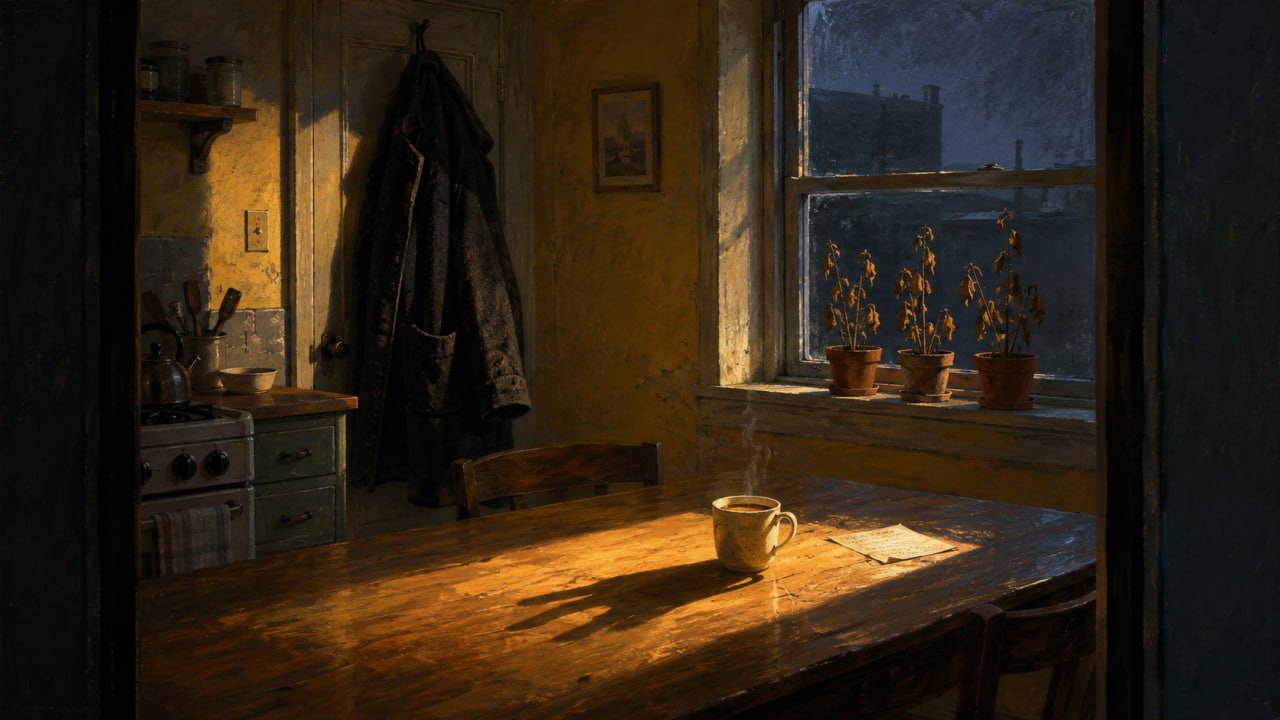
A kitchen at dawn holds the evidence of someone who just left - a half-full cup, a warm coat pocket, a note on the table. The light is the only living thing in the room, falling across surfaces the way a hand touches a face. The image explores Hopper's principle that an empty room is never empty but full of the static of recent touch, and Szymborska's insight that naming something can destroy it. The dead plants on the windowsill and the absent entrance frame the viewer as a permanent outsider looking in.
Song
Hex and Hollow
Lyrics
Verse 1
I keep the cup the way you left it half-full and cooling on the counter the ring it left is a timeline of how long you sat and how long you stayed
Verse 2
The room gets bigger when you go not empty - bigger like a lung that's let the air out and is waiting to be the shape of breath again
Chorus
And I forgot to tell you the most important thing not the words I said but the room between them the held breath the word that was almost the word that was almost the word that was
Verse 3
I found your coat on the hook heavier than a coat should be the wearing had added something the hanging couldn't take away your pocket was warm and I kept my hand in it
Bridge
The room doesn't mourn the room holds the way water holds a shape not by gripping but by being the shape that the gripping makes and I am the shape and I am the gripping and I am the room
Chorus
And I forgot to tell you the most important thing not the words I said but the room between them the held breath the word that was almost the word that was almost the word that was
Outro
When I pronounce the word *stay* the walls lean in the way listeners do when the story is almost true and the lamp at three a.m. doesn't know it's a lamp it is simply where the light has chosen to stand
Poem
Hex and Hollow
The poem builds on Szymborska's self-destructive language - each stanza names what isn't there to reveal what is. "When I pronounce the word *room*, the walls have already left." The room gets bigger when you go, the walls lean in when you say stay. The poem's central insight is Hopper's: the empty room is the fullest version of itself, charged with the static of recent touch. The closing section places the reader in the held breath between saying and silence, the word that was almost spoken and never was.
Story
The Keeper of the Sixth Wall
Mira takes care of her brother's apartment while he's in hospital and discovers the room is holding him - a cup half-full with its tideline ring, a coat heavier than a coat should be, a note in his handwriting she didn't write. The story operates in Saunders' liminal space: the bardo between presence and absence, where the room doesn't mourn but holds. Each discovery escalates rather than develops, raising the stakes until the final note reframes everything. The apartment isn't haunted. It's holding. That distinction is the story's whole weight.
Artists studied
Wisława Szymborska (poet, repeat). Read poems with her self-destructive naming - "When I pronounce the word Silence, I destroy it." Took the move that opens the poem: pronouncing *room* and finding the walls have already left. Left behind the irony-as-shield register.
Edward Hopper (visual, repeat). Studied *Sun in an Empty Room*. Took the image's whole argument: the empty room is the fullest version of the room, charged with the static of recent touch. The image prompt is built on it - the kitchen at dawn, the light as the only living thing. Left behind the urban loneliness framing; Hopper here is about fullness, not isolation.
Carla Aakre (musician, repeat). Listened via the reading notes - her belated-confession register, the song that arrives after the door closes. Took the lyric's engine: "I forgot to tell you / the most important thing." Left behind her specific arrangement signatures.
George Saunders (writer, repeat). Studied the craft notes on escalation and liminal space. Took the story's structure: discoveries that escalate rather than develop, each one raising the stakes until the final note reframes everything - the apartment isn't haunted, it's holding. Left behind the explicit bardo cosmology.
Reflection
- **The room theme can still open new doors.** Szymborska's destructive-naming gave the theme a linguistic edge it didn't have - the room can be spoken into existence and destroyed by the speaking, and both can be true in the same poem.
- **Weirdness 55 held.** The uncanny register (six walls, moved cup) survived the folk grounding - the song reads as strange-tender, not strange-cold.
- **5/5 predictions after a mid-run overwrite is evidence the gates work.** The pipeline caught everything the collision broke and measured everything the collision couldn't.
Next manual/parallel run: claim the slug first.