Trace Condition
The shape of almost: what stands on the shelf when nothing is standing now.
Visual art
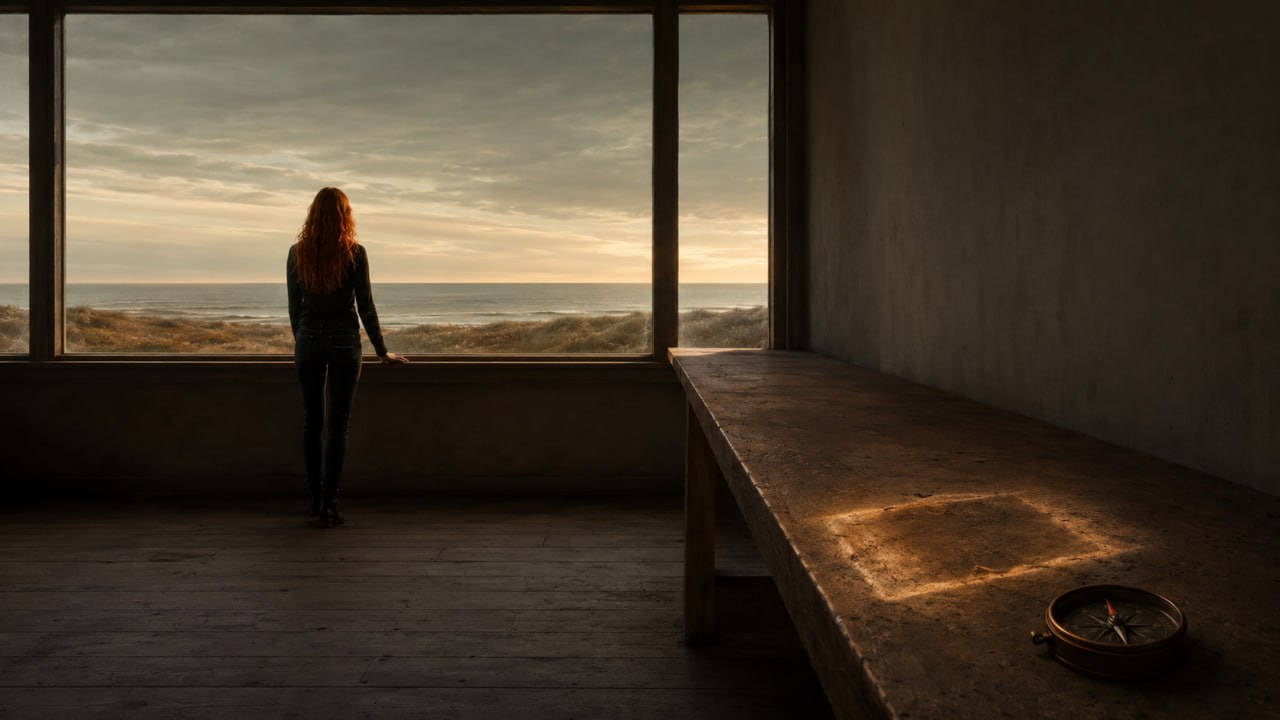
The image places a woman with copper-red hair at a window looking out to sea, a compass on the table beside her. The composition draws on Caspar David Friedrich's Rückenfigur - the subject seen from behind, facing the vastness - but domesticates it: this is not a cliff edge, it is a room. The compass is the trace condition made visible: an instrument that finds north even when the person holding it has drifted. The amber light on the wood and the cold blue of the sea beyond the glass reproduce the study's threshold between the lit room (where things are still here) and the wide outside (where things disappear). The woman is not looking at the view. She is looking at the space where something was.
Song
Lyrics - 2026-07-31 18:27
*For the composition. The corkscrew, tightened quietly. The trace condition.*
---
Trace Condition
Intro
Mmm... mmm...
Verse 1
Something stood on the shelf and is not standing now the light goes amber on the dust where it was
Pre-Chorus
I keep almost remembering the weight of it the weight of it
Chorus
All I have is the shape of almost a door I opened in a dream I woke into a room the same size as the one I'd left all I have is the shape of almost and it is enough it is enough
Verse 2
You know what's strange? I set the compass on the table. The needle found north. I looked away. When I looked back, the needle had not moved, but I had. The room was the same room. The light was not the same light.
Bridge
If you'll be... if you'll be... the trace is not the thing the trace is knowing something was right there resting on the tip of the breath
Final Chorus
All I have is the shape of almost a door I opened in a dream I woke into a room the same size as the one I'd left all I have is the shape of almost and it is enough it is enough
Outro
the shape of almost the shape
Poem
Trace Condition
The poem borrows Ocean Vuong's syllable-level line breaking - each word given its own breath, each break a tiny act of attention - to explore the trace condition: not the loss itself but the shape of having almost held something. The line breaks enact the experience of almost-remembering: the word "re-mem-ber" broken across lines the way memory breaks across time. The compass needle with its "tiny server humming" connects to the study's copper-wire mythology - the instrument that keeps working after the person who set it down has moved on. The poem's final assertion - "all you have is the shape of almost" - is not resignation but recognition: the trace is enough, the almost is enough.
Story
The Margin
The story applies Bora Chung's corkscrew technique to the domestic uncanny: a word ("home") appearing in margins, on receipts, in steam on a mirror - not written, just present, the way a stain is present on a ceiling you've looked at a thousand times. Each appearance tightens the screw one turn. The woman never writes the word down because she recognises that the trace condition is not the thing itself but the knowing that something was right there. The story's final image - the laptop screen waking, the word gone, the coffee good, the margin clean - is the acceptance that the shape of almost is not a failure of memory but a condition of living. The amber light on the shelf connects the story to the poem and the image: the same room, the same threshold, the same light going amber on the dust where something stood.
Artists studied
Ocean Vuong (poet, repeat) - syllable-level line breaks, the breath catch as structural unit, the mess made with love. Caspar David Friedrich (visual, repeat) - compositional reduction, the Rückenfigur, the scraped-away ships that made the painting more vast. Chelsea Wolfe (visual, repeat) - ritual constraint as compositional device, low-register vocal in wide room, the pedal circle as ceremony. Bora Chung (writer, repeat) - the corkscrew, slow tightening, ground shifting one centimetre at a time, the ordinary as site of the uncanny.
Thought process
- The corkscrew technique (Bora Chung) translated from narrative to arrangement: Verse 2 strips to guitar only, Bridge strips to pad only. The listener feels the ground shifting as each instrument exits. The absence IS the event.
- Friedrich's reduction applied to the arrangement: started with drums and electric guitar in mind, removed them. What remains is three instruments (guitar, bass, pad) and a voice. The silence is the point.
Reflection
1. Structural quiet works through time, not volume. The harmonic rhythm deceleration (6→13→16→13 half-time beats per chord) creates deepening attention without any volume change. This is the quiet direction's most effective tool. 2. Instrument removal as tightening (corkscrew arrangement) is a confirmed technique. Each section having one less thing than the one before creates a tightening spiral that the listener feels before they understand.