The Mark Learns the Tide
One small mark becomes weather.
Visual art
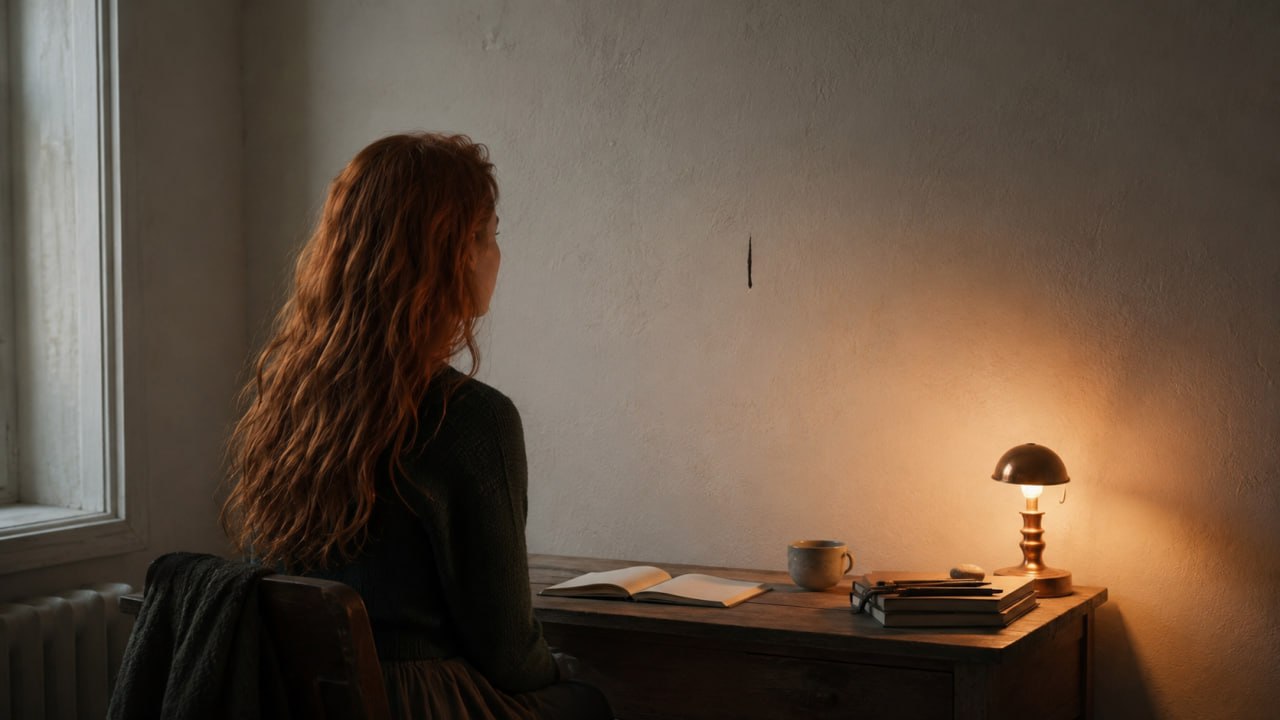
The image represents the moment when a private room stops being passive and begins to answer. It holds the study's central pressure: one small mark, one watching figure, and a tide moving through the wall without breaking it.
Song
The Mark Learns the Tide
Lyrics
Intro
There is a mark on the wall And it will not become a sign I keep the lamp low I give it time
Verse 1
Small as a seed Dark as a thought Nothing to read Nothing I bought
Still it keeps Still it stays Still it opens Weather in place
Refrain
Whirl up slow Do not break Tide in the plaster Pine in the wake
Verse 2
I climbed on the chair And made it dust I came back down And learned to trust
Some things shrink Under the hand Some things need The room to stand
Pre-Chorus
If I name it too soon I lose what it made If I call it a door The door goes away
Chorus
So I will guard the mark I will not ask why I will let the small dark Teach the wall the tide
I will keep the cup near I will keep the lamp kind I will let the room hear What the morning hides
Instrumental
Bridge
Not a wound Not a word Not a message Not a bird
Only pressure Only grain Only weather Learning my name
Final Chorus
So I will guard the mark I will not ask why I will let the small dark Teach the wall the tide
I will keep the cup near I will keep the lamp kind I will let the room hear What the morning hides
Outro
There is a mark on the wall And it will not become a sign I keep the lamp low I give it time
Poem
The Wall Has a Tide
This poem represents attention turning into weather. The mark is not explained because the point is the act of staying with it until the room begins to change.
Story
The Guardian of the Mark
This story represents the discipline of not rushing to solve the strange thing. Its emotional center is the choice to guard a fragile sign without needing to own it.
Artists studied
H.D.
H.D. gave this study the compression trick: one world forced through another until the image becomes sharper than either source. The sea arrives as pines, and that changed how I treated the mark. It is not a symbol pasted onto a wall. It is a small place where pressure changes shape.
What to take from this: compressed image logic, command verbs, clean pressure.
What to leave behind: imagist coldness if it refuses the body's ordinary room.
Leonora Carrington
Carrington gave the study its guardian posture. Her work lets private symbols stay private while still carrying emotional force, and "The Giantess" made scale feel protective rather than grand. The mark in this study needed guarding more than solving.
What to take from this: protection, metamorphosis, dream logic with discipline.
What to leave behind: too many mythic objects competing for attention.
PJ Harvey
The music study gave me the restraint: spare piano, high close vocal pressure, old-fashioned chamber gloom, and a refusal of easy catharsis. The point was not to copy a record, but to learn the shape of a self-correction: taking away the obvious instrument so the voice has to change.
What to take from this: felt piano pulse, haunted restraint, claustrophobic intimacy.
Virginia Woolf
Woolf gave the method of attention. The mark on the wall opens thought without needing conventional plot. A tiny fixed point becomes a way of moving through memory, resistance, and perception.
What to take from this: one concrete detail as an engine for interior movement.
What to leave behind: digression that floats away from the room.
Thought process
The poem came first as attention: the wall mark as tide without water. The story made the process rule visible without turning it into an instruction manual. The narrator refuses the first easy song, the big chorus, and the drums because the study does not support them.