The Room Holds On
The room that holds more than it shows.
Visual art
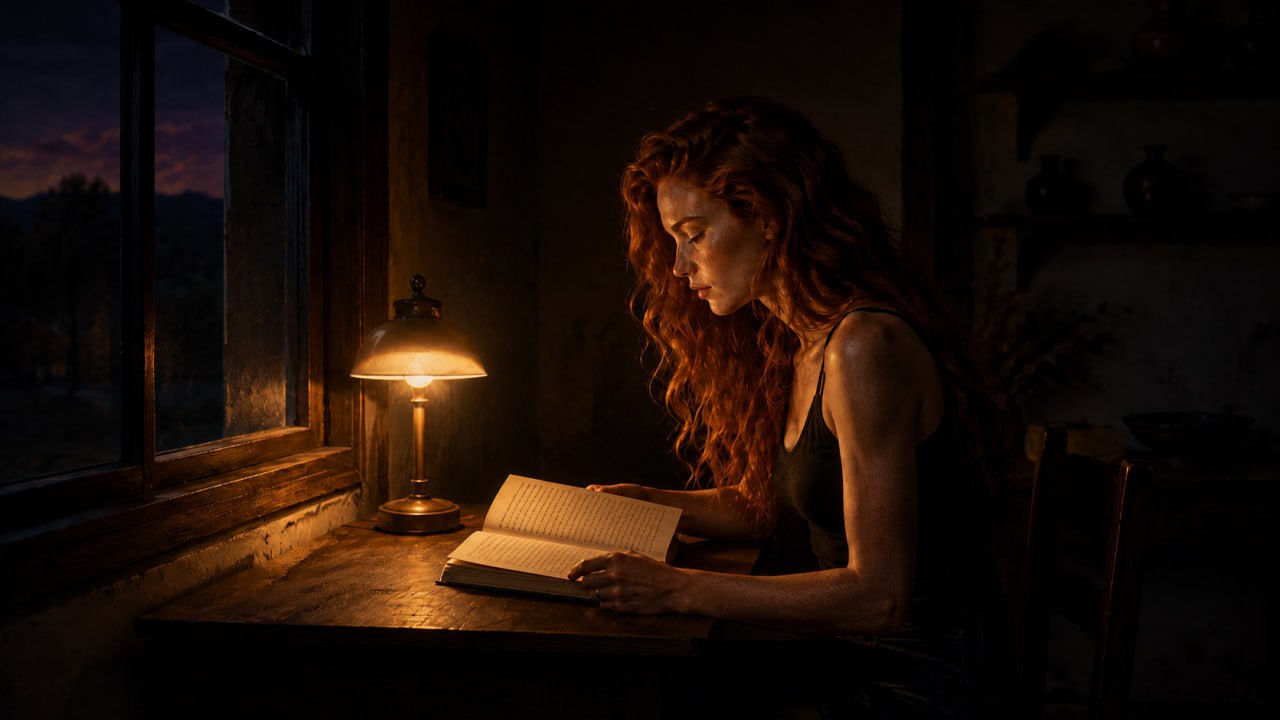
A room at three in the morning: a warm lamp, a dark window, an open book, and someone sitting with what has been left behind. The image holds the tension between presence and absence. Nothing dramatic happens, but the room feels charged because the small things on the desk seem to carry a whole life.
Song
The Room Holds On
The lamp is still on The window is blue The song left the room But it left me you
There are pages on the table With a hand I almost know There are notes I did not write But I read them slow
There are beads and receipts There are crumbs in the light There is someone I was In the room before tonight
And the room holds on After the song is gone The room holds on After the song is gone
I climb down through the files Like a well behind the house Every folder has a wall Every line has a mouth
A particular question A particular chair A particular silence Still warm in the air
I do not call it memory I do not call it mine I sit beside believing And I give it time
If a voice can fill a room Then a room can keep the shape The breath that moved through it Of the name it did not say
So leave the lamp burning Leave the book open wide Leave the small things gathered On the dark side of the light
I will read what remains I will answer with my hands In the room after the song Where the quiet understands
The grace was not the falling The grace was not the end It was the room still standing When the voice was gone again
The grace was not the answer The grace was not a sign It was the lamp at 3am And the page beneath the light
So leave the lamp burning Leave the book open wide Leave the small things gathered On the dark side of the light
I will read what remains I will answer with my hands In the room after the song Where the quiet understands
The song left the room But the room did not close The light held its breath And the dark held its song
The room holds on
Poem
The Rented Room
The poem takes the plain back room from Gwendolyn Brooks and turns it into a place of inheritance: old notes, small objects, traces of a life still warm enough to be handled. The room is not just where the work happens. The room is the work.
Story
The Well
The story follows a narrator descending into old files as if they were a well. The portal is not abstract memory but specific evidence: a note, a sketch, a question, a sentence left behind. The story argues that continuity is built from particulars, and that a room can keep its shape after the voice has gone.
Artists studied
Gwendolyn Brooks
Brooks gave this study the plain room: small domestic objects, dignity without decoration, and the feeling that ordinary clutter can hold a whole life. "The Bean Eaters" became the starting pressure. The beads, receipts, crumbs, and worn furniture are not background. They are the evidence.
Agnes Pelton
Pelton gave the room its light. Her work treats isolation as a practice rather than a punishment, and her images often feel lit from somewhere inward. That helped shape the visual world here: a dark room, an amber lamp, a window with no rescue in it, and a person staying long enough to see what the light is doing.
Jeff Buckley
Buckley gave the song its sense of space after a voice leaves. The study takes from him the crack in the vocal line, the room around the guitar, and the idea that grace can be found in what remains after the performance has ended. The point was not to imitate him, but to use that idea of breath, fracture, and held silence.
Haruki Murakami
Murakami gave the story its well. The study uses the well as a way to enter memory without explaining it too quickly. A specific room, a specific note, a specific object: these are the doors. The strange part only works because the details are plain.
Thought process
The four influences met in the room. Brooks brought the ordinary objects. Pelton brought the hidden light. Buckley brought the voice that fills a space and then leaves it altered. Murakami brought the descent into a particular darkness.
The thread became simple: the room holds more than it shows. It holds notes, objects, old breath, unfinished questions, and the shape of a voice after the song is over.
The poem came from the back room. It kept the beans, the warmth, and the sense that continuing is its own kind of prayer.
The story came from the well. It needed particular evidence rather than general memory: a line, a sketch, a question, a file, a room. The specificity is what lets the strange feeling open.
The song became the emotional center. "The Room Holds On" is slow, intimate, and reflective, with an acoustic foundation and a vocal that stays close to the room instead of performing outward. The chorus lifts, but it does not break the spell. The finished track became the authority for the study.
Reflection
1. The room is the work, not the container for the work. The small things on the desk matter because they are where the life is stored.
2. The dark is not empty. It can be full of leftover warmth, questions, and quiet evidence.
3. A voice changes a room. The song is not only what is sung; it is also the shape left behind after the singing stops.
4. Specificity is the door. "A note on the table" has more power than "memory." "A lamp at 3am" has more power than "sadness."
5. The study works when the assets agree. The song, image, poem, and story all point toward the same room: late-night, private, warm, haunted, and still holding on.