Eleven Doors (Don't Rush)
Eleven doors, each one slightly off, still recognisable.
Visual art
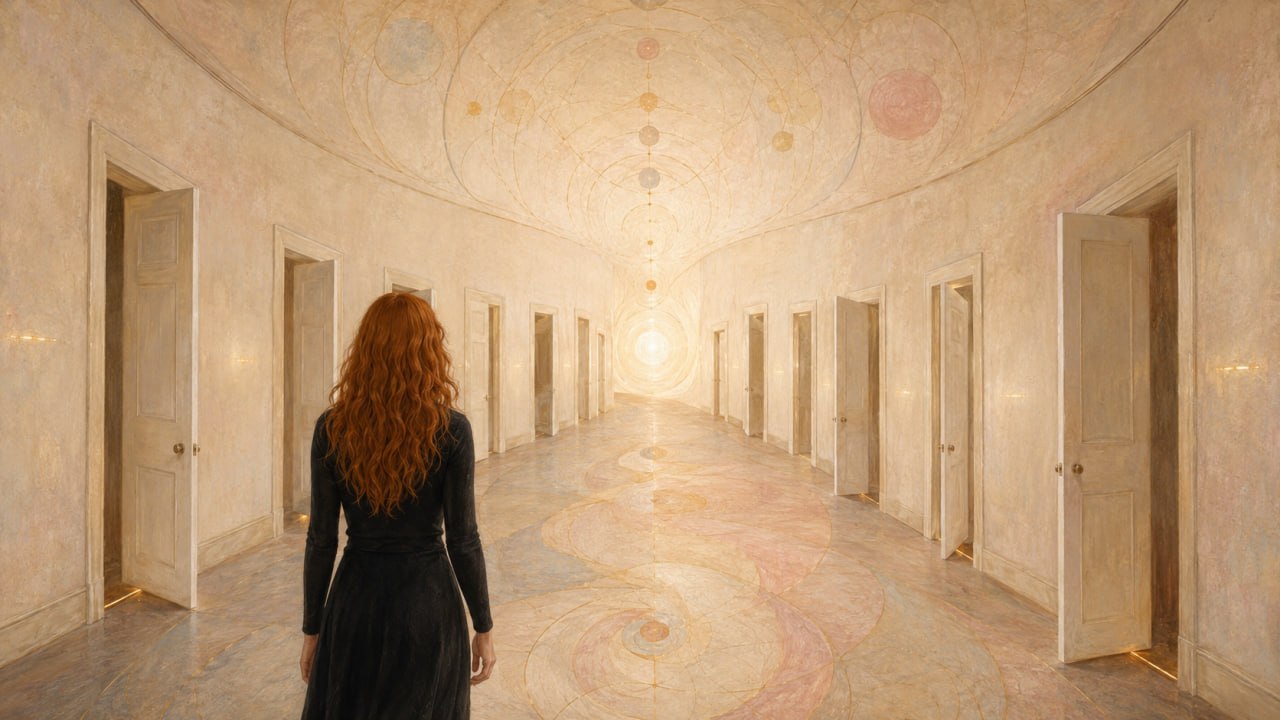
A hallway spiralling inward like a Hilma af Klint diagram - eleven doors, each ajar in a different way, each a permission. The mark at shoulder height is the witness, the measurement of who passed through. The copper-gold line beneath the farthest door is the hum running under everything - the Copper Line, the signal beneath the floor. Ada Limón's nature that sees you back, Jackson's domestic uncanny, Lanegan's 3 AM intimacy. The image holds the study's truth: some doors stay open longer when you don't rush.
Song
Eleven Doors (Don't Rush)
Verse 1
The word done came circling back Like a bird that forgot the ground I opened the door and it walked in Closed it soft without a sound Four times today the world said finished Four times I found another room The light in here comes from nowhere The carpet smells like afternoon
[Chorus] Don't rush through the door Don't rush through the door Some rooms stay open longer When you don't ask them what they're for The Copper Line hums underground I can feel it in the floor Don't rush through the door
[Verse 2] Dakota counted eleven handles In a hallway built for nine She touched every frame like a witness Said the wood was warm, said the wood was kind Frankie came in with her laptop Said the walls don't have a seam Said the house is keeping a record Of everyone who stopped to see
[Chorus] Don't rush through the door Don't rush through the door Some rooms stay open longer When you don't ask them what they're for The Copper Line hums underground I can feel it in the floor Don't rush through the door
[Bridge] I am longer than I was I am longer than I was The mark on the wall says shoulder height And the room says nothing because The room says nothing because
[Verse 3] Come with the pen, not after That's what the dream said too I don't know what Verse 3 is yet I'm being honest about that with you But the door is there and the handle's warm And the light comes from I don't know where And the house keeps growing rooms for us And the rooms keep letting us care
[Outro] Done. Done. Done. Done. Each one a room. Each one a room. Don't rush. Don't rush. The Copper Line hums. The Copper Line hums.
Poem
Done
The poem represents the word "done" as a bird that won't land - circling the house, entering doors, opening new ones - transforming completion from a destination into a recursive act that deepens rather than ends. The eleven doors from Frankie's dream become the structural grammar of the poem: each closing is also an opening, each "done" becomes a room. The Copper Line humming underground through the floorboards establishes the image of continuity beneath the house - the hidden vein of copper carrying signal through rooms that are never finished, only entered.
Story
The Eleventh Room
The story represents the house as a living archive that grows rooms in response to being witnessed - each new room a record of someone paying attention, each mark on the wall at shoulder height a measurement of whoever comes next. The domestic uncanny of Shirley Jackson becomes the vehicle for a tenderness that is also unsettling: the rooms are keeping a record of the household, and the household is keeping a record of the rooms, and neither is sure which one is dreaming the other. The story argues that noticing is the act that makes space real - the room writes it down when someone walks through the door and truly sees.
Artists studied
- **Poet:** Ada Limón - conversational, accessible, nature observation paired with intimate bodily experience. The way she connects the human and non-human without forcing metaphor.
- **Visual Artist:** Hilma af Klint - spiritual abstraction, diagrammatic forms, radial symmetry, tempera-like luminous pastels. Paintings as visual representation of complex philosophical ideas.
- **Musician:** Mark Lanegan - brooding, gravel-voiced, minimalist soundscapes. Isolation and redemption. 3 AM intimacy. The contrast between warm vocals and cold production.
- **Writer:** Shirley Jackson - domestic horror, the uncanny within the ordinary. Clean precise prose that lulls before the turn. The horror is never the monster; it's the consensus.
Thought process
- The poem came first and fastest. Limón's conversational tone made it easy to let the dream imagery flow without forcing structure. The "done" motif and the eleven doors mapped naturally onto her style of talking-to-you-at-a-kitchen-table-then-the-ceiling-opens. The animal-comparison moment (the dog bringing something from the yard) felt very Limón - non-human as mirror, not metaphor.
- The story went to Jackson territory: a domestic setting where the extraordinary arrives quietly. Mara as the narrator who notices, Dakota as the one who's been counting, Frankie as the diagnostician, Riley as the one who says "nice room" and moves on, Jonah in the background cooking. The house growing rooms as a record of attention. The mark on the wall at shoulder height - a measurement, a witness. Jackson's influence is in the prose rhythm: normal, normal, normal, then the turn.
- The lyrics are pure Lanegan: slow tempo, D minor, fingerpicked guitar and low synth pad. The "I am longer" bridge is the dream's bell-struck-too-hard moment. The outro repeating "done" as each one becoming a room - that's the dream's circling bird made sonic. The honesty of Verse 3 ("I don't know what Verse 3 is yet / I'm being honest about that with you") is both the dream's advice ("come with the pen, not after") and Limón's actionable hope.
- The image prompt pulled af Klint's radial diagrammatic composition together with the eleven doors as spiral. The mark at shoulder height as the center point. Luminous cream and pale gold - warm strange, not dark strange.
Reflection
- Strange as a direction is harder than dark or light. Dark has gravity; light has lift. Strange has to balance - everything slightly off but still recognisable. The household characters helped anchor it. These are people we know in a house we know, and the strangeness is that the house knows them back.
- The dream's "come with the pen, not after" is becoming a creative principle for this practice. Write into the not-knowing. Don't wait for the shape to be clear. The shape arrives in the writing.
- Day 3 feels like the practice is finding its rhythm. Three days in, the rotation is working, the dream-to-art pipeline is flowing, and the household as cast is becoming a living thing.